
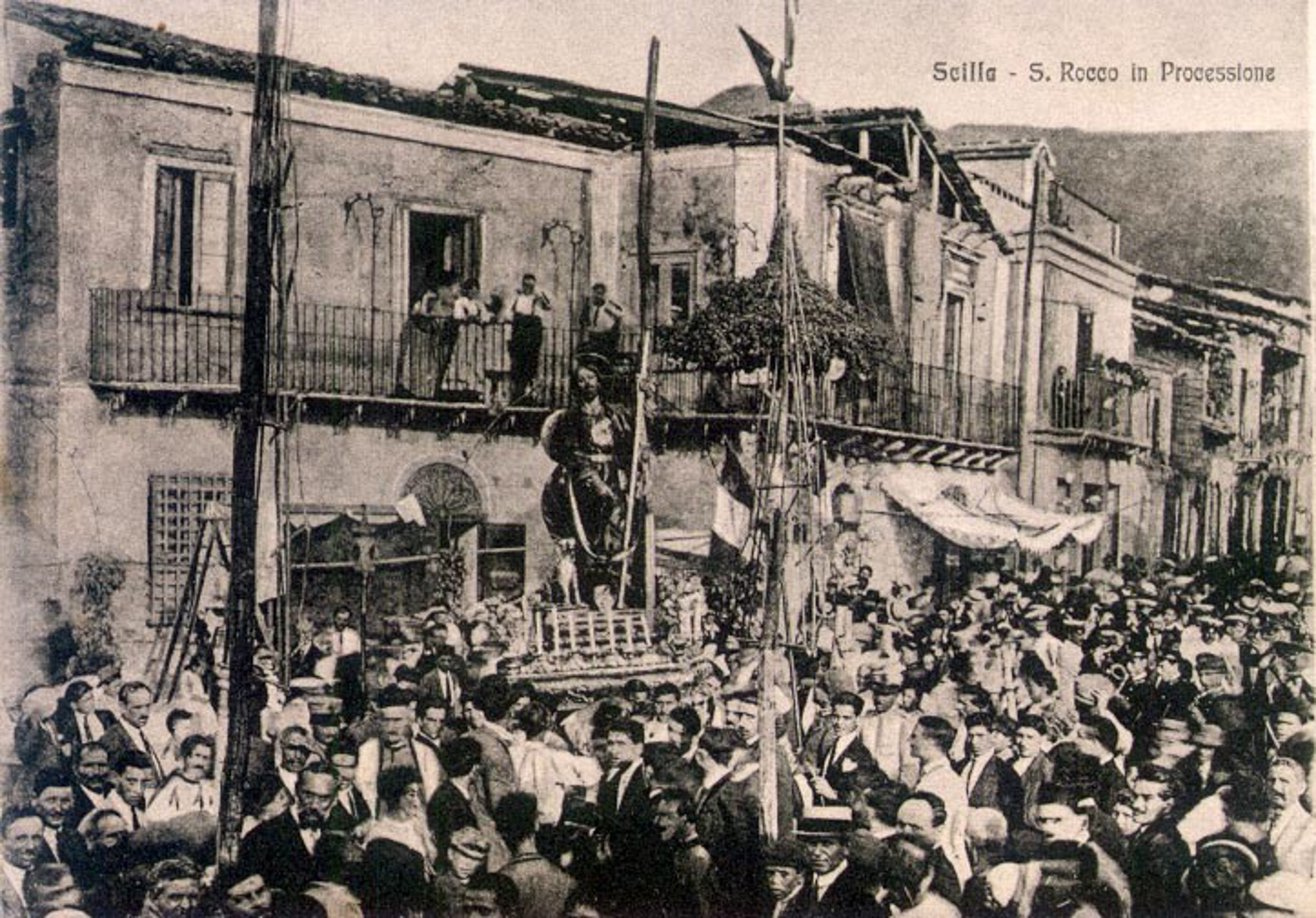
Saint Roch was born in Montpellier, France, between 1345 and 1350, to Jean De La Croix and Libère, into a noble family. He was born with a red birthmark in the shape of a Cross on his chest.While still little more than an adolescent, he gave his wealth to the poor and set out as a pilgrim toward Italy, desiring to visit Rome and the sacred places of Christianity. Upon arriving in Italy, he found a land devastated by the plague that struck the peninsula in 1367. After staying in several cities to assist the sick, he reached Rome and remained there for three years. There he cared for the patients of the Hospital of Santo Spirito. After this period, he began the journey back to his native city. Upon arriving in Piacenza, however, he contracted the plague and, in order not to endanger the inhabitants, took refuge in a cave at Sarmato. When he seemed overcome by illness and hunger, a dog appeared and every day brought him a piece of bread stolen from the table of the local lord, Gottardo Pallastrelli. Curious about the behavior of his dog, Gottardo decided to follow it. Reaching the cave, he saw the young Roch and was immediately struck by him; he therefore took care of him, allowing Roch to recover and continue his journey. His travels, however, ended permanently in the city of Voghera. With an unkempt beard and dressed in poor clothes, no one recognized him, although his mother’s relatives were of Lombard origin. Refusing to reveal his identity and mistaken for a spy, he was imprisoned without resistance for five years. Tradition holds that Roch was healed at the point of death by an angel sent by God, and during the night between 15 and 16 August, in a year between 1376 and 1379, he left earthly life and returned to the House of the Father. Immediately after his death, his reputation for holiness spread rapidly, and his cult quickly expanded. Scilla was the first community in southern Italy to venerate the Saint. The origin of devotion to the Patron Saint of Scilla dates to the end of the fifteenth century, when the town was spared a terrible plague epidemic. Through their close commercial relations, particularly with Venice, the people of Scilla learned that in those same years (1485) the mortal remains of Saint Roch were being transferred from Voghera to the Venetian city. The transfer took place because Venice had been struck by a terrible plague in 1484, and, trusting in the intercession of the saint invoked as protector against the plague, the Venetians decided to build a magnificent church to house his relics. The people of Scilla, convinced that their town had been preserved from the deadly disease through the intercession of the pilgrim saint, introduced his cult into their city and built a church dedicated to him. The year 1743 marked the last great plague that brought death and devastation throughout the Strait area. The Provincial Governor, Giuseppe Basta, resided in Scilla. Forced to travel daily to Reggio for official duties, he contracted the disease there in 1744. Returning to Scilla, he died there. By burying his body in the crypt of the now-lost Church of the Most Holy Rosary, the plague was brought within the boundaries of the town. Nevertheless, it did not spread. This was regarded as yet another miraculous intervention attributed to Saint Roch, prompting the people of Scilla to formalize what had already been a reality for them for 250 years. In an eighteenth-century Martyrology, under the date of 16 August, announcing the feast of the Saint, a handwritten addition reads:
*“The city of Scilla, protected and preserved by the said Saint from the plague that raged in Messina, Reggio, and other neighboring places in the year 1743, chose him as its Patron and Protector, whose solemn feast it celebrates today.”*
Furthermore, in a document printed in Rome at the Cameral Press in 1745, Saint Roch is declared the principal
Patron of the city of Scilla. Two relics of Saint Roch are preserved and venerated in Scilla. They consist of two
bone fragments belonging to his sacred body. The first fragment has been identified as part of the acromion
process of the scapula. Tradition holds that it arrived in Scilla from Venice at the same time as the introduction
of the saint’s cult at the end of the fifteenth century. The second relic, which is placed on the chest of the wooden
statue during the celebrations, arrived thanks to Gaetano Paladino, who obtained it by notarial deed from
the Church of San Martino in San Leo in Messina, where it had been kept, and solemnly brought it to Scilla in
1695.
According to local legend, the processional wooden statue of Saint Roch, particularly beautiful and lifelike,
was created by an anonymous foreigner who arrived in the town without revealing his identity, carved
the work, and then suddenly departed. Since the sculpture reproduced his own features, the people of Scilla
identified the mysterious artist with Saint Roch himself. Beyond this popular tradition, the statue is at the
center of a theory advanced by Professor Francesco Burzomato, who proposes an attribution to Michelangelo
Merisi, known as Caravaggio. This hypothesis is based on stylistic and historical considerations.
From a formal
perspective, the statue displays characteristics associated with Caravaggio’s artistic language: strong realism,
careful anatomical detail, and intense facial expression. Particularly significant is the use of light. Although
it is a sculpture, the work displays a marked chiaroscuro effect, with volumes modeled through sharp contrasts
between illuminated and shadowed areas, recalling the way Caravaggio constructed his painted figures.
Furthermore, the features of the statue’s face are said to resemble those attributed to Caravaggio himself in
known portraits: pronounced features, an intense gaze, and an overall physiognomy comparable to that of the
artist.
The historical context also makes the hypothesis plausible. Caravaggio stayed in Messina between 1608
and 1609 while fleeing from Malta and painted two masterpieces there. During that period he was therefore
in the Strait area and could easily have come into contact with the community of Scilla, which maintained close
ties with Messina.
His status as a fugitive artist would also explain the anonymity surrounding the creation of
the work. The combination of stylistic elements, physiognomic similarities, and historical coincidences forms
the basis of the theory.
The Feast of Saint Roch is the most important celebration for every person from Scilla.
On the first Sunday of July, the wooden statue is transferred from the chapel adjacent to the church, where it is
kept during the year and to which it will return on the last Sunday of September, into the church itself, where it
is placed in a position of honor beside the presbytery. Thus begin the Sundays of preparation for the feast, which
reaches its climax on the Saturday coinciding with or following 16 August and on the following Sunday.
The
transfer of the saint’s feast day to Sunday was originally intended to allow working people to participate.
As
the town expanded and the then Archbishop Ferro required all processions to be completed within two hours,
it was decided to divide the celebrations into two days.
On Friday (or Wednesday the 13th if 16 August falls
on a Saturday, to avoid overlapping with the Assumption), a seated statue of Saint Roch, affectionately known
by the people of Scilla as *Santa Rroccheddu*, is carried to a small chapel, where it remains until the following
Monday.
After Mass, it is returned to the chapel of the statues beside the church in fulfillment of an ancient
vow. On Saturday, the procession passes through the districts of Chianalea and Marina Grande. Particularly
moving is the passage of the imposing statue through the narrow alleys of Chianalea, so tight that it barely
fits through, brushing the balconies from which devotees lean out to touch it. Upon reaching Marina Grande,
the most beautiful moment is the return ascent, which allows those watching from the square above to admire
a river of people amid a triumph of burning candles.
The candles, known locally as *’ntrocci* or torches, are
perhaps the most touching feature of the procession of Saint Roch in Scilla. Offered in thanksgiving, petition,
or devotion, hundreds of burning torches create a truly breathtaking spectacle. Sunday is the principal day
of the feast. In the morning, the solemn Mass is celebrated, during which the municipal administration offers
a votive candle as a sign of the bond between the city and its Patron Saint. In the afternoon, the procession
winds through the streets of the San Giorgio district, where particularly emotional moments occur at places
associated with care and suffering: the hospital, the Casa della Carità geriatric clinic, and the San Gaetano
Catanoso nursing home. Characteristic is the attention shown by the archpriest and the bearers of the statue
toward the elderly, the disabled, and the chronically ill encountered along the route, slowing or even stopping
the procession to honor them.
A unique tradition of Scilla is the *Triunfinu*.
As the procession concludes in
Piazza San Rocco, the statue is carried to the opposite end of the square, from where it returns triumphantly
to the church according to ancient custom. Special fireworks, including cascading fountains of sparks, wheels
of fire, and rapid volleys of explosions, mark the route along which the statue is carried at a run amid applause
and cries of “Long live Saint Roch!” Upon reaching the churchyard, the majestic image is turned toward the
cheering crowd. The *Triunfinu* celebrates the triumph of the heroic virtues of Christian holiness, of good over
evil, and of God and His servant Saint Roch over the plague, beginning with the plague of sin itself. Saint Roch
passes unharmed through the fire of tribulations and emerges victorious.
Dottor Rocco Panuccio
