
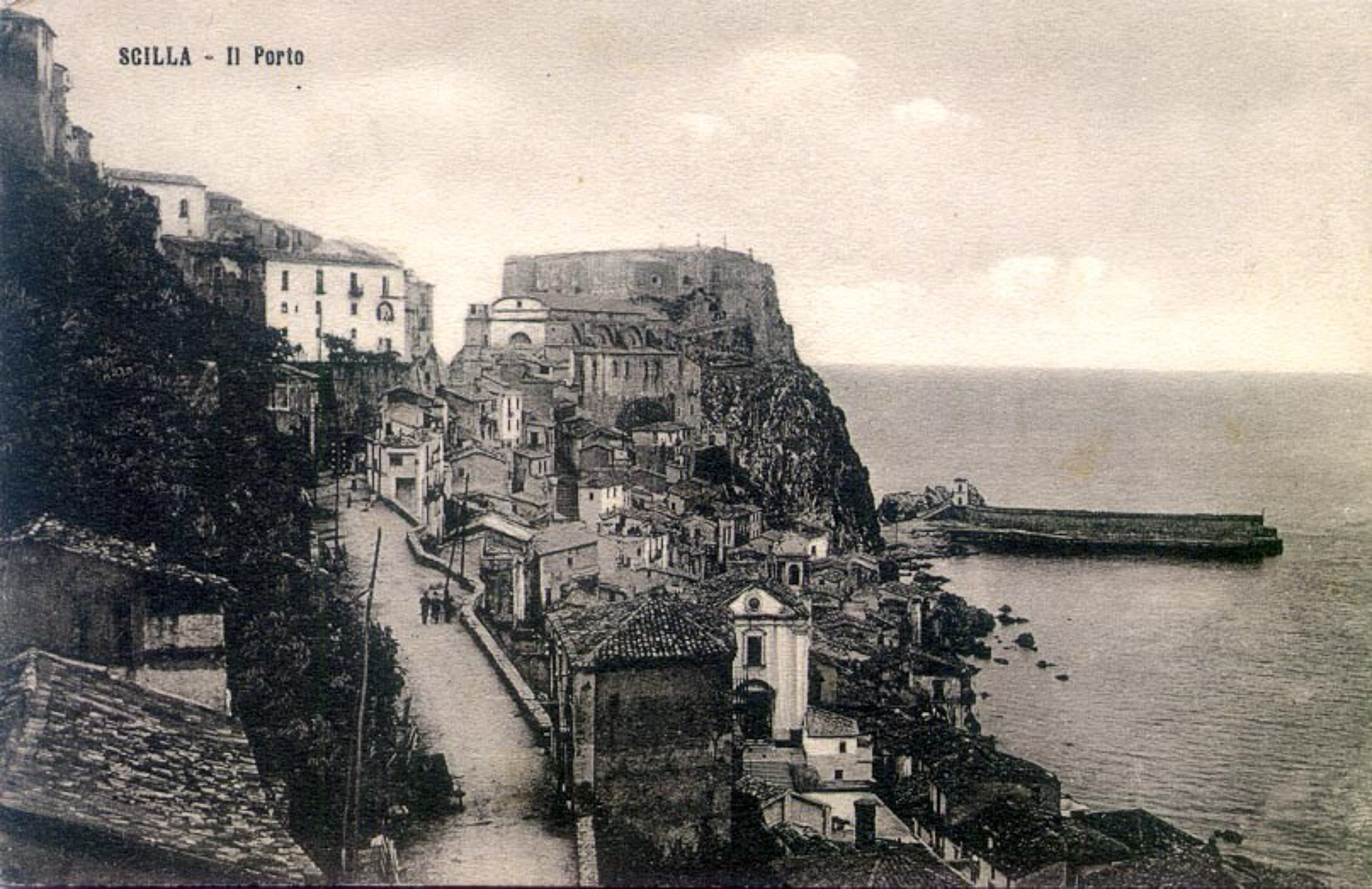
Luigi Gaetano Gullì, the youngest of nine children, was born on 16 June 1859 to Giuseppe Gullì and Annunziata Delfino. His father Giuseppe loved music and devoted part of his time to it. He enjoyed drawing harmonious melodies from the family harpsichord, on which his eldest son, Domenico, also practiced. The latter became a music teacher and composer and cultivated musical taste among many young people of Scilla, who became skilled instrumentalists. Together with them, he founded the Scilla town band, which became widely known and appreciated. From a very early age, young Luigi spent his hours at the piano, becoming so accomplished that, at the age of seven, he performed in a highly acclaimed concert in the city of Reggio. The admiration he aroused among the audience led to his being sent, at the Province’s expense, to the Conservatory of San Pietro a Maiella in Naples, where he became a pupil of the great masters Beniamino Cesi and Lauro Rossi. After completing his studies at the Neapolitan Conservatory, Luigi moved to Rome at only nineteen years of age, where he completed the formation of his versatile intellect, enriching his knowledge and acquiring mastery of many languages. At that time, the Roman artistic world was dominated by distinguished masters such as Tosti, Sgambati, Monachesi, Mancinelli, Marchetti and Consolo. Nevertheless, the young pianist won over the most refined Roman audiences through the simplicity of his distinctive artistry. Evidence of this is found in the journalistic writings of the poet Gabriele D’Annunzio, who actively participated in the artistic life of Rome and came to know and appreciate Maestro Gullì. He wrote about him in the newspapers for which he served as correspondent: *Capitan Fracassa*, *Fanfulla*, *Cronaca Bizantina* and *La Tribuna*, often using various pseudonyms. In a correspondence dated 12 January 1888, signed “Duca Minimo,” one of his pseudonyms, D’Annunzio wrote:
“The concert given last evening in the Palestrina Hall by Luigi Gullì and Ernesto Consolo—with the participation
of Vico Ridolfi—was truly marked by a seriousness worthy of the great masters of old.
No concessions were
made to the crowd: no perpetual motions, no Carnivals of Pest, no transcriptions, no rhapsodies, nor any other
similar amateurish trinkets.
The programme consisted of two Bach concertos, a Mozart sonata, and an improvisation
by Reinecke on a gavotte by Gluck. It was performed from beginning to end, with two or three harpsichords
and string accompaniment, magnificently.”
Later, recalling the musical gatherings held in the salon of her palace on Via del Quirinale, Donna Sofia Durand de la Penne mentioned Luigi Gullì among the participants and added:
“The finest pages of classical music were performed with such warmth, such love, such harmony, and such patience that I do not remember ever having experienced elsewhere greater or more refined delights for both ear and spirit.”
He achieved great success not only in Italy but also in France, Germany, Denmark, Norway and the United States. Newspapers throughout the countries where he lived and performed wrote extensively about his art. Among them were *Musical America*, *Dallas Daily Times Herald*, *Dallas Morning News*, and *Verdens Gang* of Kristiania.He became acquainted with all the leading composers and musicians of his age, who quickly became his friends. In particular, he enjoyed a close friendship with Edvard Grieg. Gabriele D’Annunzio also formed a friendship with the Scilla-born maestro and left a literary remembrance of him in his 1899 novel *Il Piacere* (*The Child of Pleasure*). He wrote:
“Luigi Gullì, a young maestro who had come from his native Calabria in search of fortune, dark and curly-haired,
performed Beethoven’s Sonata in C-sharp minor with great feeling.
The Marchioness of Ateleta, his patroness,
stood beside the piano, watching the keyboard. Little by little, the grave and gentle music drew all those
light spirits into its circles, like a slow but profound whirlpool.”
At the height of his career, Gullì also performed for the Italian royal family. He received as a gift a pipe bearing
the coat of arms of the House of Savoy, while Queen Margherita presented him with a diamond brooch in the
shape of the letter “M.” He was also the recipient of several honours.
He became an honorary member of the Royal Academy of Santa Cecilia, and in Norway he received the rare
distinction—granted to very few foreigners—of being entered into that nation’s Golden Book.
An accomplished and highly respected concert pianist, he founded the famous Gullì Quintet with talented
young musicians such as Fattorini (first violin), Zampetti (second violin), Marengo (viola), Benetti and later
Rosati (cello). He devoted all his energies to the ensemble, and through it achieved international fame.
The artistic activity of Maestro Gullì was highly meritorious not only because it spread and reinforced the prestige
of Italian musical art throughout the Western world, but also because, through the charm of his performances,
he succeeded in cultivating appreciation for a genre of music that was often neglected.
He was also a notable composer of many musical works, which he never wished to publish and largely destroyed
before departing for America. Some pieces survived, perhaps because they remained in the archives of the Academy
of Santa Cecilia. His great-nephew Giovanni Gullì later stated that he found and had transcribed several
of his uncle’s compositions, including piano pieces entitled *Album Leaf* and *To You* (perhaps dedicated to
a young German friend), as well as a waltz.
During brief moments of rest, nostalgia for his family and his native town would emerge. He longed for peaceful
relaxation in his country house among the woods of Melia. This longing was a recurring theme in the affectionate
letters he wrote to his sisters, especially Antonia, who occasionally accompanied her brother’s performances
with her beautiful mezzo-soprano voice.
At the beginning of 1912, Gullì decided to leave for America. He embarked from Naples on 2 February aboard
the steamship *Hamburg* and arrived in New York on the 17th. There he became director of the Kidd-Key Conservatory
at the North Texas College in Sherman.
After a couple of years, he was appointed professor at the Chicago College of Music and gave numerous piano
recitals that met with extraordinary success.
His triumphant artistic activity, however, was not supported by equally strong health. As time passed, his condition
became increasingly fragile. He therefore decided to return to Italy, and especially to Scilla.
On 5 March 1918, he embarked in New York aboard the steamship *Dante Alighieri*, bound for Genoa. After
a week at sea, on the morning of 12 March at seven o’clock, Gullì suffered an attack of uremia that caused his
sudden death.
Around midnight, he was buried at sea, in accordance with the maritime regulations then in force for long ocean
crossings.
Giuseppe Ribuffo
