
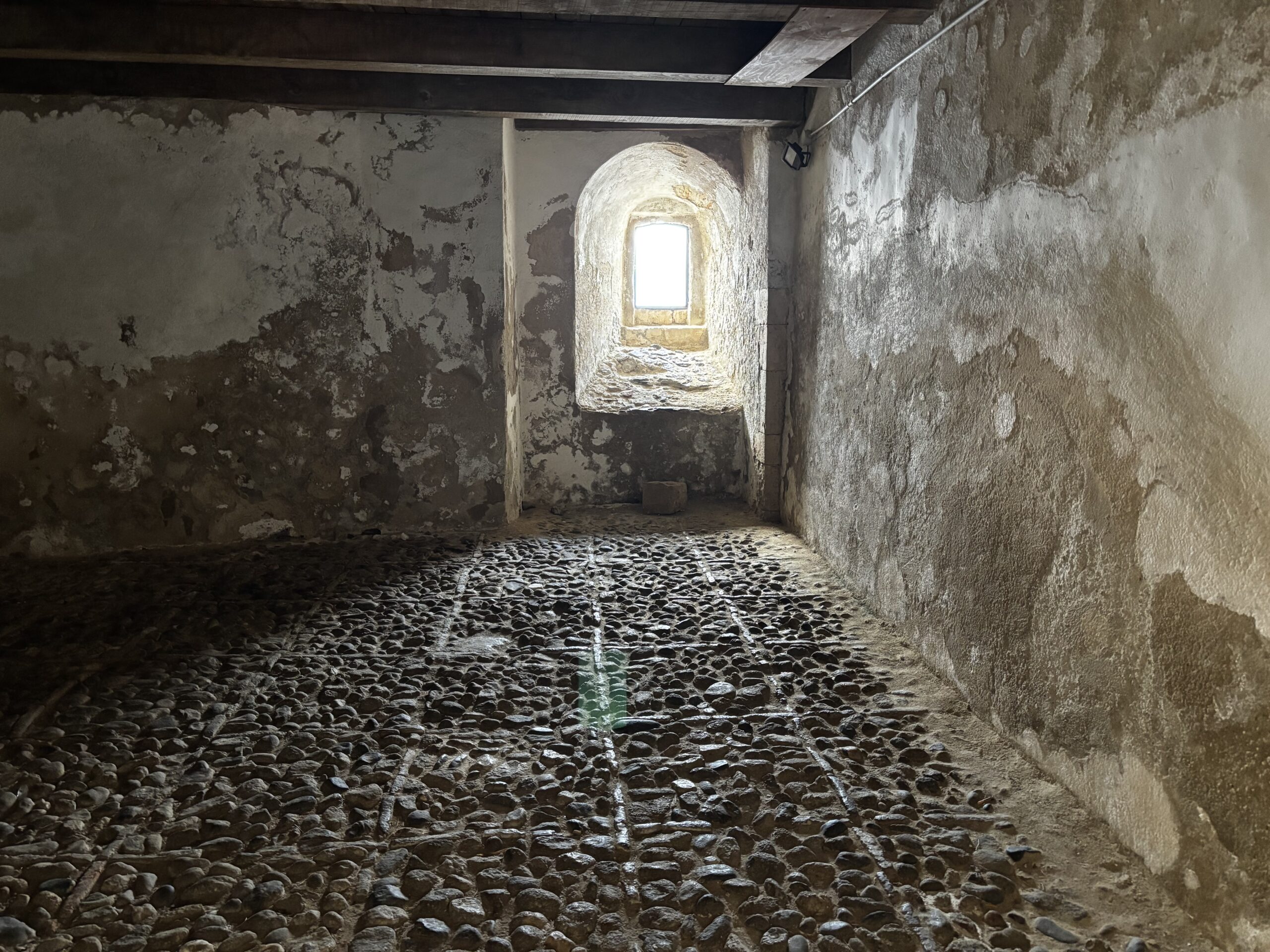
Among the oldest parts of the Castle that can be visited today, this underground space constitutes part of what was once the ancient fortified Monastery of Saint Pancras, built on the rock of Scilla in the 9th century by Basilian monks.
Arriving from the Greek Levant, these men of faith were the precursors of Benedictine monasticism, founded on the motto ora et labora, leading a life marked by the silent rhythm of ascetic prayer and daily work. Right here, in this intimate, silent and isolated space, the monks gathered to pray, far from the world and its distractions.
This modest, square-shaped space is located below the current floor level, accessed via a small stone staircase.
A small window opens onto the only wall not buried underground, the one facing east, which provided light and ventilation.
Originally, the space was surmounted by other buildings, also part of the Monastery, which were lost over the centuries by the earthquakes that have ravaged this area.
The most interesting and evocative part of this place is, without a doubt, the floor.
It is composed of an orderly geometry of bricks arranged in squares around granite pebbles collected on site; the bricks themselves were fired by the monks in the small kilns that once stood inside the castle.
The extraordinary thing is that the floor in question dates back to the original structure of the Monastery, dating back to the 9th century. It has survived perfectly preserved to this day; walking on it means walking on more than a thousand years of history.
The room was unearthed and restored during excavations carried out in the mid-1980s.
Dott. Rocco Panuccio
