
From the origins to the fall of the Western Roman Empire (493 B.C. – 476 A.D.)
The geographer Strabo, in his work *Geography* (23 A.D.), reports that as early as 493 B.C. Scilla was fortified by Anaxilas, tyrant of Rhegium, who also established a naval station there. He thus provides one of the oldest and most valuable topographical and historical descriptions of the site, attesting to the permanent human presence and the existence of defensive structures; presenting Scilla, for the first time, as a real and inhabited place, home to sailors and fortified works, no longer merely a geographical location associated with myth.
“Here follows the Scyllaean promontory, a very high rock projecting into the sea, connected to the mainland by a narrow isthmus, where ships may land on both sides. Anaxilas, tyrant of the Rhegians, fortified it against the Tyrrhenians, making it a naval station; thus he prevented pirates from crossing the Strait.”
In these lines, Strabo describes the shape of the promontory of Scilla: a high and imposing rock projecting into the sea, connected to the mainland by a small isthmus that allowed landing on both sides. But he does not merely describe its morphology. The geographer recounts that as early as 493 B.C. Scilla was fortified by Anaxilas of Rhegium, a tyrant who lived at the beginning of the 5th century B.C., who had the promontory of Scilla fortified and transformed it into a naval base to defend against the Tyrrhenian pirates who infested the area and attempted to cross the Strait. From then until the fall of the Western Roman Empire, Scilla remained under the control of Rhegium, whose changing fortunes were closely linked to its own history. Rhegium remained independent from Syracuse for about a century, until its conquest by Dionysius in 386 B.C. Scilla, by then completely weakened and deprived of defenses, once again fell victim to the Tyrrhenians, who were defeated in 340 B.C. during the liberation of Syracuse and other cities of Sicily and Magna Graecia from tyranny. Having regained its independence, it returned under the rule of Rhegium until both cities were absorbed into the Western Roman Empire. The first true fortification on the rock of Scilla dates back to Roman rule, when Rome, coming to the aid of Rhegium, sent the Consul Genucius Clepsina in 271 B.C., who, after liberating it from the Tarentines, left a strong garrison under the command of Marcus Censius. To secure control of the access routes to the Strait of Messina, he fortified Scilla and stationed a powerful garrison there, which withstood both the First and Second Punic Wars. Subsequently, the Roman garrison established at Scilla was, in all probability, greatly reduced. In fact, as Plutarch and Florus relate, in 73 B.C., following the slave revolt, Spartacus landed at Scilla pursued by Marcus Crassus and, although Crassus had built a massive wall to prevent his escape, Spartacus managed to evade him and make his way to Lucania, where he was eventually defeated. Once the Servile War had ended, Scilla enjoyed a period of peace and tranquillity until the outbreak of the conflicts between Pompey and Octavian during the Roman civil war (42 B.C.–36 B.C.). Before these fierce struggles began, the coastline was placed in a state of defense by Octavian, both to counter Vetulinus, who, leading those proscribed by the triumviral regime together with fugitives, was causing serious problems for the Roman centuries, and to keep Sextus Pompey at bay, who had occupied Sicily and threatened to block Rome’s grain supply, thereby challenging the power of the triumvirs. Scilla, like Rhegium, was once again fortified and, although Pompey wished to seize it and sent reinforcements to Vetulinus to encourage him to fight against the courts of the triumvirs, he failed to carry out his plan. When the triumvirs dispatched (42 B.C.) a large fleet under the command of Salvidienus against Pompey, the latter, having learned of this, sailed out of the port of Messina with his ships and, encountering the enemy near the rock of Scilla, attacked with great force. He quickly defeated him, capturing and sinking many ships.
Had Scilla not been protected by a strong garrison, Pompey could have taken advantage of that favorable opportunity to occupy it, since that fortified position would have been extremely useful in closing the Strait; instead, despite his victory, he immediately returned to Messina. The strengthening of Scilla during that period is also confirmed by another episode that occurred four years later in the same bay.
After Cassius and Brutus had been defeated (38 B.C.), and Octavian had returned from Taranto to Rhegium, he did not consider it wise to provoke a battle against Pompey, who was stationed in the port of Messina with only forty ships; instead, he chose to wait for Calvisius Sabinus, who was due to arrive from Etruria with another fleet. But when he learned that Calvisius had been defeated in the waters off Cumae by another of Pompey’s naval forces under the command of Menecrates and Demochares, he decided to go to his aid. He was about to cross the Strait when Pompey, noticing his movements, sailed out of the port of Messina with his fleet to confront him. Octavian, wishing to avoid a battle that might have proved fatal, quickly headed toward Scilla and remained there in a defensive position until Calvisius, having hastily repaired his ships, appeared in those waters. Although Pompey attacked Octavian’s ships by every means possible, he failed to capture them, something he could easily have done had Scilla not been so well fortified. Once Pompey had withdrawn, Octavian put out to sea, joined Calvisius and, after landing at Vibona, continued on to Rome, postponing operations against Pompey until the following year. He did not, however, neglect to strengthen the garrison at Scilla even further, having personally experienced its great strategic importance against any possible attack by Pompey. After so many great struggles fought with equal valor, Pompey and later Antony were defeated, and Octavian remained the sole ruler of the Roman Republic. It is therefore reasonable to conclude that during this period Scilla possessed a harbor for the docking and protection of ships, as demonstrated by the episode of Octavian’s retreat to Scilla, chosen as a safe haven to avoid confrontation with the pursuing Pompey. If Pompey was unable to capture Octavian’s ships, it is certain that they found refuge in a harbor from which, with the assistance of the pier, the soldiers, and the rocky defenses of the garrison, they were able to repel the enemy fleet. Further confirmation of this hypothesis is provided by the historian Polybius who, in the 2nd century B.C., in his work *The Histories*, describing the swordfish fishing practiced beneath the rock of Scilla, mentions the existence of a “naval station,” that is, a harbor located in the bay of Scilla. As further confirmation, it should be recalled that in the bay of Scilla, on the side facing the sirocco wind, along the rocky shoreline between Monacena and Capo Pacì, ancient masonry structures covered by countless rocks are still visible on the seabed.
Dr. Rocco Bova, a native of Scilla, maintained that these structures were in fact the remains of the ancient harbor, destroyed by the collapse of large and numerous boulders, now scattered throughout the bay, which had fallen from the rocky mountain above, prone to landslides, as can still be seen today. Even setting aside Bova’s well-founded opinion regarding the cause of the destruction, it can be added that a harbor at that location could not have endured for long, being exposed in winter to violent storms, especially to the westerly-maestrale and westerly-libeccio winds, which frequently caused shipwrecks. This episode not only confirms that the rock of Scilla must have been well fortified and garrisoned, but also attests that it was served by an artificial harbor where Octavian’s ships were able to dock and find shelter. The fortification of Scilla continued to be garrisoned by the Romans throughout the period of Mediterranean conflicts until the collapse of the Western Roman Empire (476 A.D.). During the continuous barbarian invasions, Scilla appears to have been invaded only by the Vandals. The reason lies in its distance from the Via Popilia, the principal military route, which, in the section crossing the territory of Scilla, ran across the uplands, first through the forest of Solano and then across the plains of Melia before continuing toward Fiumara di Muro and finally Catona and Rhegium. Scilla was connected to this route by two paths: one crossed the mountains and reached the military road on the plains of Melia; the other followed the coast to Bagnara before climbing toward the plains of Corona, where it joined the military road. Both paths were almost impassable for an army. Scilla was therefore not easily accessible by land. For the same reason, it was not suitable for use as a bridgehead for further campaigns of conquest. This was perhaps why the barbarians did not regard Scilla as a desirable conquest. Scilla instead constituted an excellent base for controlling the coastline, an important strategic point for both attack and defense in conflicts fought at sea. Its difficult accessibility made it virtually impregnable and therefore invaluable for defensive purposes.
The foundation of the fortified Monastery of Saint Pancras (9th Century A.D.)
After the decline of the Western Roman Empire, Calabria assumed greater importance under Byzantine rule. Following the temporary Arab conquest of Sicily (902 A.D.), Byzantium was forced to reorganize the civil and religious administration of all its dominions in Southern Italy, concentrating it primarily in Calabria. At first, the seat of military power was established in Rhegium, but due to the continuous Arab incursions it was later transferred to Rossano.
The seat of religious authority, on the other hand, was moved from Syracuse to Santa Severina. As a result of the continuous migration of monks fleeing from Sicily to Calabria, all religious institutions were strengthened, and four new bishoprics were established in the province of Rhegium. The region’s defensive system was reorganized through the adaptation of the ancient fortifications which, before the fall of the Western Roman Empire, had consisted of a series of fortified outposts, mostly located along the main roads and partially destroyed during the barbarian invasions. Numerous concessions were also granted for the construction of new towers and castles, no longer conceived as strategically placed structures along carriage routes, but designed instead as an integrated defensive network capable of protecting entire portions of territory.
Thus, a series of fortified centers was established, each completely independent of the others.
However, the fragmented Calabrian defensive system proved entirely inadequate and powerless against the Saracen attacks, which struck mainly the coastal towns but also the inland areas. This led to a shift in the region’s defensive centers, moving from the coast to the interior, generally around a castle or a monastery, giving rise to new fortified settlements that later developed into villages. Completely detached from the existing inhabited centers, they gradually gave life to what would later become the feudal system, while some already fortified sites were further strengthened. As is well known, from the eighth century onward, in order to escape the Iconoclastic persecutions, many Eastern monks settled in Southern Italy, particularly in Apulia, Sicily, and Calabria, intensifying their presence especially after the Saracens conquered Sicily. The monasteries founded during the late medieval period became known as “Basilian,” based on the mistaken assumption that these Greek-rite monks were followers of and lived according to the Rule of Saint Basil the Great. In reality, these monks, originally hermits, did not follow a monastic rule established by Saint Basil but simply used the ascetic writings composed by the saint as sacred texts. Within this historical context, under the government of Theodora, wife of Emperor Theophilus, and through her direct intervention, the Basilian Monastery of Saint Pancras was founded on the rock of Scilla during the ninth century. The historian Giovanni Minasi of Scilla, taking into account that the Iconoclastic persecutions, begun under the Byzantine Emperor Leo III the Isaurian in 726, continued under Constantine V Copronymus and Theophilus, and considering that the rock of Scilla was a fortified site requiring imperial authorization for the establishment of a monastery, ruled out the possibility that such permission had been granted by these emperors. Minasi considered it much more plausible that the Basilians had obtained the concession from Empress Theodora, under whose reign the Saracen occupation, which had forced many monks in Sicily to seek refuge in nearby Calabria, also began to affect Calabria itself. It was then that numerous imperial concessions were granted to the monks, providing them with fortified places where they could take refuge. According to Minasi, during the second half of the eleventh century, the Normans not only confirmed the monks’ right of residence but also granted them new privileges, including the right of castellany. The historian challenged the prevailing opinion of his time, which attributed the foundation of the monastery to the eleventh century, arguing that it stemmed from the late publication of two charters which he considered of doubtful authenticity. The first, published at the end of the eighteenth century (5 December 1792), would supposedly be the deed by which Count Roger, in January 1102, approved the foundation of the Monastery of Saint Pancras, accepting a request made by a certain Nicholas of Mesa. The second, dated June 1104 and published in 1882, records the donations, privileges, and exemptions granted by Count Roger to the monastery. Regarding the first document, the historian observed that the date placed beside Count Roger’s signature, the tenth indiction, corresponds to the year 1102 and is therefore later than the Count’s death (July 1101). According to Minasi, the falsification of these two documents can be traced back to the Ruffo family, who had been accused by the people of Scilla of having unlawfully claimed the title of feudal lords of Scilla for centuries. Indeed, since the donations, privileges, and exemptions allegedly granted by Count Roger to the monastery were those normally bestowed upon feudal lords, the two charters were intended to prove that the Basilian monks were the feudal lords of Scilla and, consequently, that the Ruffo family, by acquiring the castle, were the legitimate heirs to that fief. To the observations expressed by Minasi, which we share, demonstrating that the monastery was founded during the Byzantine period rather than the Norman period, we may add that it seems highly improbable to attribute its foundation to the Normans, since the rock of Scilla formed part of the precise military organization they established in Calabria, where it represented an important stronghold.
Consequently, it appears unlikely that the Normans would have authorized the foundation of a monastery in a place intended primarily for military purposes, only then having to reconcile that function with the presence of a religious community.
It seems far more plausible that the Normans found the monastery already established on the rock and maintained it, adapting their military-defensive planning to the pre-existing structure.
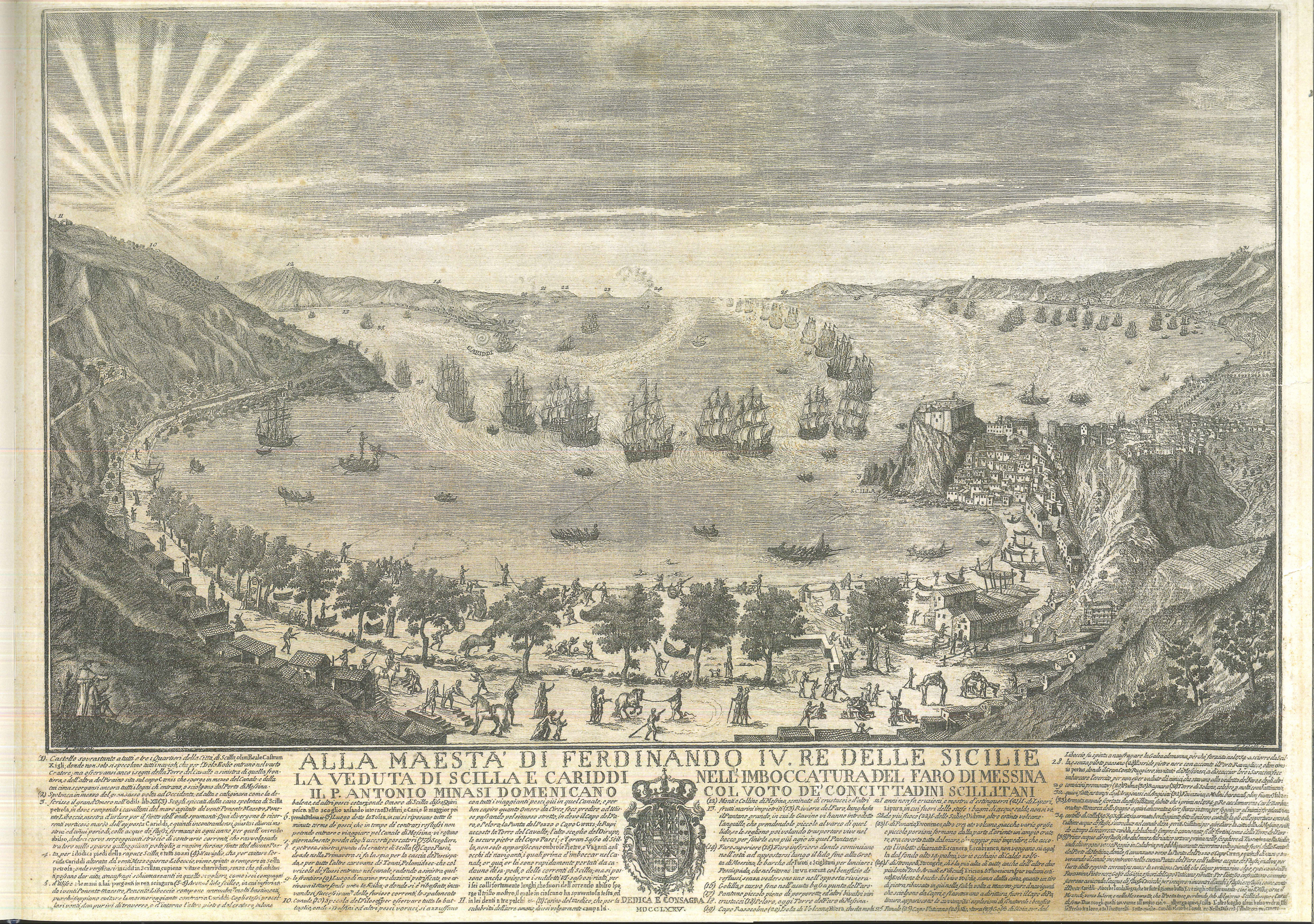
No direct documentary evidence concerning the original layout of the monastery has survived that would allow us to reconstruct its architectural configuration. It has, however, been possible to identify the location and plan of the Church of Saint Pancras, attached to the monastery, through the comparative study of the available documentation. First of all, the captions accompanying two engravings by the Scillese scholar Father Antonio Minasi, dating from the second half of the eighteenth century, not only attest that the ancient Basilian church had survived until that time but also provide information regarding its location.
The first, in chronological order, entitled *The Southern View of the Town of Scilla* (1773), at point no. 15 states: “When the Basilian Church of Saint Pancras was demolished, this carved summit, forming the head of the great rock, was observed”; the second engraving, *Scilla in the Storm*, executed before the earthquake of 1783, at number 1 reads: “This summit was indeed observed when, together with the Church of Saint Pancras built there by the Basilian monks, it was demolished by the present Count of Sinopoli. Therefore, the ancient legend arose from the natural shape of the great rock, not only because its upper part appeared from afar almost to bear a human likeness, but also because below it still preserves many sharp rocks.”
From these indications, it is also evident that the “head of the great rock” corresponds to the outcropping rock formation represented in the Montemar map dating to 1734, upon which the church, with its longitudinal plan, is shown.
.
The fortified Monastery of the Norman-Swabian period (11th–13th Century A.D.)
At the end of the first millennium, Calabria, because of the continuous invasions it had suffered, was completely disorganized and weakened. The old fortified centers that had survived the barbarian invasions and the repeated Saracen raids, together with the newly established settlements that had arisen as places of refuge, were entirely autonomous and had no connection with one another. The Normans completed the conquest of the peninsula by occupying the centers one by one, implementing a comprehensive administrative and military reorganization. For the first time, feudal lands were distinguished from state-owned territories. The fiefs were listed, identifying the fortified sites and the corresponding number of *milites* belonging to each fief, thus providing a clear overview of the various fortifications and their importance. From an architectural point of view, many fortresses were adapted, while others were newly constructed. The fortification of Scilla, by then the Monastery of the Basilian Fathers, must certainly have been one of the safest in Calabria. Indeed, in 1060, when the Normans, led by the brothers Robert and Roger Guiscard, conquered Reggio and brought all the cities and castles of the region under their rule, the Castle of Scilla, where many Greeks had taken refuge, was the only one capable of repelling repeated attacks and, in the end, was forced to surrender only because it had run out of provisions. Under Norman rule, the Castle of Scilla thus became a military stronghold and was provided with a garrison commanded by Costa Condomicita. The commander, left alone to guard the castle, attempted to make himself independent from the sovereign by establishing himself as the lord of Scilla. The people of Scilla not only drove him out of the town, but also hastened to reach the king in nearby Sicily to inform him of what had happened. King Roger, in keeping with his political policy, rewarded the loyalty shown by the people of Scilla by granting them numerous privileges and exemptions. Commander Costa, after reconciling with the sovereign, was once again entrusted with command of the garrison at Scilla. The military organization established in Calabria by the Normans was further improved under the rule of the Swabian dynasty. Frederick II strengthened the defensive system by creating a dense network of castles. Concerning the Castle of Scilla during the reign of Frederick II, however, no information has survived. From the documentation relating to the temporary administration of his son Manfred, it emerges that the castle, inhabited by the monks, continued to fulfill its function as a fortress. During the revolt of the Sicilian Vespers against Pietro Ruffo, Viceroy of Sicily and Calabria, who was forced to negotiate with the people demanding the immediate surrender of the nine castles of Sicily and those of Reggio and Calanna in Calabria (in return, the people of Messina undertook to respect his properties), Ruffo, having reached Calabria and learned that the Messinese had not honored their agreement, entrenched himself in the Castle of Calanna and placed it under siege, holding the plenipotentiary of Messina himself as a hostage. It was on that occasion that he had the fortifications of Scilla strengthened and established a permanent garrison there.
It has been possible to establish, through a series of documents, that during this period the Monastery of Saint Pancras continued to exist and to carry out its functions, coexisting with the military stronghold.
From the Angevin-Aragonese Castle to the acquisition by Count Paolo Ruffo (1266–1543)
The organization of the Kingdom under the Angevins maintained the general structure established by the Normans and continued by the Swabians, introducing administrative modifications through the transformation of the *giustizierati*, created by the Normans, into provinces. Furthermore, the monastic organization, which during the Norman-Swabian period had relied both on the cities and on the feudal system, came to depend exclusively on the feudal structure, composed almost entirely of the French nobility; only a few local feudal lords were promoted by the Angevins after the conquest of the Kingdom. Charles of Anjou, moreover, had been supported by the French nobility as well as by Pope Urban IV, who wished to replace the Swabian dynasty with a sovereign devoted to the Church. After Manfred’s defeat at the Battle of Benevento, the local feudal lords, generally loyal to the Swabian dynasty, were deprived of their fiefs, which passed into the hands of the French nobility. Only a few local families supported the Angevin cause; among the most prominent were the Sanseverino and the Ruffo families. During the War of the Sicilian Vespers, which opposed the Angevins established on the mainland of the Kingdom of Naples to the Aragonese who controlled Sicily, continuous efforts were directed toward strengthening the defense of the territory, especially the coastal areas that formed the frontier between the two rival powers. Castles and fortifications were repeatedly reinforced and improved, both by the Angevins and the Aragonese, during the continual alternation of power. The fortified monasteries, temporarily entrusted by the Church to the sovereigns for the defense of the territory, assumed a fundamental role within the regional defensive system. The fortress-monastery of Saint Pancras, the principal point of connection with Sicily, became a key stronghold during the continuous conflicts and was repeatedly occupied by one power and then the other. From the numerous documents contained in the Angevin and Aragonese Registers, published between the second half of the nineteenth century and the beginning of the twentieth century, it has been possible to recover valuable information concerning the Castle of Scilla.
Through a comparative analysis, it has been possible to reconstruct how, during this period, the monastery-fortress of Scilla gradually lost its monastic function, increasingly serving only as a fortress, an intermediate stage in its transformation into a feudal castle. Naturally, this change of function corresponded to a transformation of its architectural structure. It has been documented that in 1422 Guttiere de Nava was entrusted by Alfonso of Aragon with the defense of the fortress. Let us therefore reconstruct how and why the monastery-fortress, belonging to the Royal Curia, temporarily came under the authority of the Royal Crown, as attested by several measures issued by Pope Martin IV in 1282 and by King Charles himself the following year. The War of the Sicilian Vespers had only recently begun, and Charles of Anjou, fearing an invasion of Calabria, issued a series of orders aimed at strengthening the defensive system of the entire kingdom through a decree dated 13 July 1282, ordering the construction of six new castles in the region. From the Angevin Registers we also learn that, on 12 November 1282, King Charles formulated a further comprehensive defensive plan, ordering that all the castles of the Kingdom be fully equipped and kept ready for defense, threatening that any negligence would be severely punished through the confiscation of the castellans’ property. In this situation, Pope Martin IV intervened in favor of the Angevins with an ordinance dated 10 December 1282. Among the provisions contained therein was the concession to King Charles of the right to garrison all ecclesiastical fortresses within the Kingdom, on the condition that they would later be returned. Thus Charles temporarily took possession of the fortresses belonging to the Royal Curia. These military measures, however, proved to be of little value.
In the summer of 1283 the Aragonese attempted to conquer the Kingdom both by land and by sea: Roger of Lauria, the Aragonese admiral, threatened all the coastal settlements as far as the Gulf of Naples with his fleet. Many places in Calabria were occupied by Aragonese forces. Charles of Anjou continued issuing orders to strengthen the defensive system and, in particular, through an ordinance dated 21 October 1283, ordered the reinforcement of the Calabrian castles, especially those facing Sicily, with particular attention to the Castle of Scilla. After the Peace of Caltabellotta (31 August 1302), which divided the Kingdom of Sicily into two separate entities—the island of Sicily remaining under the Aragonese, who had supported the Sicilian rebels against the Angevins, while the Kingdom of Naples remained under Angevin control over mainland Southern Italy—the ecclesiastical properties that the Church had temporarily entrusted to the Angevins were returned, and the monks went back to their former monasteries. The Monastery of Saint Pancras also returned to the monks, who continued to depend upon the Monastery of the Holy Savior in Messina. The Archbishop of Reggio, on the pretext that the Holy Savior was located in Sicily and therefore under the authority of Frederick of Aragon, occupied the Monastery of Saint Pancras, claiming that it should instead remain under the authority of Reggio, governed by the Angevins. For this reason, on 7 March 1303, the Archimandrite of the Holy Savior initiated legal proceedings against the Archbishop of Reggio, ordering him to restore the monastery. This dispute, however, soon lost its significance, since the monastery, also serving as a fortress, quickly became involved in other conflicts. Indeed, in 1313 the Castle of Scilla was occupied by Frederick of Aragon, who in 1317 restored it to the Royal Curia, as attested by the document of 18 May of that year, by which Frederick II undertook to return to Pope John XXII, for the security of the Kingdom: “the city of Reggio, the castles of Niceto, Calanna, Montemuri and the fortresses of Scilla, Catona, and all the other places and fortresses that he held and possessed in Calabria, together with their lands, districts, rights, appurtenances, vassals, subjects, and the rights of the vassals... according to the ordinance and disposition of our Supreme Pontiff.” The Monastery of Saint Pancras remained under the administration of papal legates until 1321. Subsequently, on 1 May 1323, Pope John XXII granted King Robert of Anjou permission to retain the Castle of Scilla, together with other fortifications belonging to the Monastery of the Holy Savior in Messina, for a period of four years. The following year, fearing that the castle might once again fall into Aragonese hands, the King decided to remove the monks in order to enjoy greater freedom in military operations, assigning them a residence elsewhere within the territory of Scilla. From the document dated 10 October 1324, from which this information is derived, it appears that the monastery was governed by Abbot Neophytus and inhabited both by monks and laymen obedient to the same order. We also learn that, despite the decree ordering their removal, the monks continued to bear responsibility for maintaining the castle; records of the related payments survive in numerous documents until 1418. The decision to remove the monks from the monastery was certainly not dictated solely by contingent circumstances, but rather represented the first clear intention to bring the castle completely under the authority of the Crown, an intention that would become increasingly evident over time. This appears to be the key to interpreting the various measures found in the subsequent documents examined, culminating in the orders and counter-orders issued by the sovereign on 12 September 1422, which ultimately led to the compromise of providing the monks with a new residence in order to silence the Royal Curia regarding the failure to return the castle. Between 1324 and 1422 it is possible to document that the castle was entrusted on at least four occasions to individuals appointed directly by the Royal Crown. A first document from 1325, the year following the removal of the monks from the castle, informs us that it served solely as a fortress and that its custody was entrusted to Carlo Guglielmo Longastreve
“Since we place such trust in you, we entrust to your custody the said Castle with its arms, provisions, munitions, and all other property of the Curia kept therein, as well as the prisoners.”
Subsequent documents of 1422 from the Aragonese Registers attest that the castle was entrusted first to a certain Giacomo Papa and, after his death, to Betulo Papa. Also belonging to that same year is a series of provisions by which King Alfonso entrusted the castle to Guttiere de Nava. It should be specified that King Alfonso of Aragon first appointed Guttiere de Nava Admiral of the Duchy of Calabria and the surrounding maritime districts, with the task of supervising and protecting the coasts, as we learn from a document dated 3 September 1422; on that same date he also appointed Rodrigo of Santo Giovanni as Superintendent of the castles and fortresses of the Duchy of Calabria, entrusting him with the task of bringing the castles to full military efficiency. Subsequently, by a letter dated 12 September 1422, the Viceroy Giovanni di Ixar revoked the previous day’s order to hand over the Castle of Scilla to the Royal Curia, having received instructions from the sovereign to entrust it instead to the Royal Admiral Guttiere de Nava, through the Royal Portolano Alvaro di Santacroce. Meanwhile, the Kingdom was once again preparing for major political upheavals. Joanna II revoked the adoption she had made in favor of Alfonso of Aragon, transferring the rights to the Kingdom to Louis III of Anjou, who reigned until his death in 1434. The following year Joanna also died, leaving the throne to René of Anjou, brother of Louis III. Alfonso of Aragon therefore resumed his claim to the Kingdom and, after various events, recovered it in 1440. During the struggles for the Kingdom, Alfonso was supported in Calabria by Nicola Melissari and Alfonso Cardona; it was Cardona who conquered Reggio. Melissari, after subduing all the towns and castles from Palmi to Capo Spartivento, continued on to conquer Scilla. The people of Scilla, who had always remained loyal to the Aragonese, offered no resistance; indeed, they joined Melissari’s forces in the conquest of Calanna. From a document dated 19 June 1445 we learn that on that date the Monastery of Saint Pancras was granted *in commendam* to Condisalvo de Nava, heir of Guttiere (according to Minasi, his brother), “…within which the King of Sicily has erected a castle or fortress...” This is the only document informing us of the construction of the castle during the Aragonese period. We do not know whether this refers to a completely new construction or to works carried out on the existing structure, nor the exact year in which this occurred. What is certain is that, from the beginning of the War of the Sicilian Vespers until the date of that document, the castle had repeatedly played a central role in numerous military events and therefore had very likely suffered damage. Furthermore, it is well known that during the Angevin-Aragonese period the Kingdom’s fortresses underwent significant architectural transformations as a result of the innovative defensive techniques introduced through the use of gunpowder. Moreover, the emerging culture of the residence as a symbol of the lords, castellans, and feudal rulers, to whom the sovereign granted or entrusted a castle, led to the development of architectural types that differed substantially from the traditional defensive typologies of a castle. All this further confirms that, even if the works did not involve the construction of an entirely new building, they must nevertheless have brought about a profound transformation of the previous architectural structure. A document of 1450 ordering Condisalvo de Nava to recover the property belonging to the Monastery of Saint Pancras that was located in Messina at the Monastery of the Holy Savior attests that Condisalvo continued to be lord of the fortress and procurator of the monastery. After the death of Alfonso of Aragon (1458), Ferdinand I ascended the throne and renewed the right of castellany to the de Nava family. In 1469, upon the death of Condisalvo de Nava, Alfonso, Duke of Calabria, confirmed the castellany of Scilla to Guttiere, son of Condisalvo. In 1485 the revolt of the barons against Duke Alfonso broke out and, after one year, peace was reached. Among the conditions of the peace agreement was Alfonso’s promise to grant full pardon to the barons who had rebelled against him, a condition that was never fulfilled. From a series of documents of the period, it can be deduced that the de Nava family had most likely taken part in the revolt and that, at the time, the castellany was held by Pietro, son of Guttiere. Another document from the archives of the Royal Chamber informs us that the property of the de Nava family had been confiscated:
“the collection of revenues in Scilla carried out by the Royal Treasury in 1494, seized for the felony of that baron.”
Pietro de Nava succeeded in recovering the castellany of Scilla after the death of Frederick I. In 1518 Pietro de Nava was succeeded by his son Guttiere, who, on 26 December 1533, sold it for thirty thousand ducats to his brother-in-law Paolo Ruffo, Count of Sinopoli.
From that moment onward, the fief of Scilla and its castle became permanently associated with this historic family, which, after carrying out important Renaissance restoration works, resided there until the abolition of feudalism at the beginning of the nineteenth century.
Dott.ssa Maria Fiorillo
From the french decade to the unification of Italy (1806–1861)
The French occupation of Scilla must be understood within the broader context of the French Decade (1806–1815) in the Kingdom of Naples, during Napoleon Bonaparte’s campaigns across Europe. After the French invasion of the Kingdom of Naples in 1806, led by Marshal Masséna, the Bourbons took refuge in Sicily under the protection of the British fleet. Scilla, with its castle strategically overlooking the Strait of Messina, was a key position. Although the French occupied most of Calabria in 1806, the Castle of Scilla, defended by the British and Bourbon loyalists, remained unconquered for a considerable time.
The first French capture of the fortress dates to the spring of 1806, when, having occupied Scilla, they established themselves within the stronghold, which, together with Amantea and Crotone, represented a key point in the defensive network of the region. The French were later attacked by overwhelming British forces and, after twenty-three days of fierce resistance, were forced to abandon it on 16 July.
The setback greatly enraged Emperor Napoleon Bonaparte who, in a letter dated 7 February 1808 addressed to his brother Joseph, then King of Naples (1806–1808), described Scilla as *le point le plus important du monde* and urged his brother to act without delay. How could he tolerate the disgrace of allowing the British to remain in that land?
He was to recapture it by November at the latest and ensure that no British presence remained on the mainland. An important role in the delicate phase of the French reconquest of the fortress was played by General Reynier who, after a difficult siege, succeeded on 17 February 1808 in driving out the British, who retreated by sea to the Lighthouse of Messina.
The recovery of the stronghold prompted De Rivarol to state that, together with Reggio, it secured complete French control of the region. Yet the British, dissatisfied with their defeat, returned to the attack several times during 1809: three major naval engagements took place in the waters of Scilla between June and September. They never again set foot on land. The troops quartered within the castle remained on constant alert, their monotonous routine interrupted only on 12 July 1812, when lightning struck the powder magazine, destroying several internal buildings and causing the deaths of Captain Bonavita and Lieutenant Emanuel. However, this was not the only event to bring tragic notoriety to the fortress, for a similar incident occurred on 14 January 1815. On that occasion the lightning caused even more serious damage.
The explosion of the ammunition magazine resulted in extensive destruction of the structures and the death of 48 non-commissioned officers and soldiers of the 4th Light Infantry Regiment. Moreover, massive blocks of masonry crashed onto the town below, destroying 10 houses, damaging another 33, and causing the deaths of 27 inhabitants.
Marshal Desvernois arrived with several officers, and recovery operations immediately began. On 3 May 1810 Scilla and its castle solemnly welcomed Joachim Murat, King of Naples (1808–1815), who came personally to inspect the situation in preparation for a planned attack on Sicily.
The King’s visit clearly demonstrates the importance attributed at the time to Scilla and its castle in comparison with neighboring towns, as well as the strategic significance of the site.
Nevertheless, the advance of the French army, which had reached Scilla and established itself in its castle, met its natural and strategic limit there; despite repeated attempts, the Strait marked the impassable frontier of the advance, preventing passage toward the Lighthouse, Messina, and Sicily in general, which remained firmly under British control.
After the departure of the French, the Restoration returned the old Bourbon rulers to the throne; however, the apparent calm did not last long...
Consensus toward the monarchy weakened. After all, new demands had by then matured; there had been plenty of time for secret lodges to form in the aging Kingdom, which welcomed people of all walks of life eager to change the direction of the national community.
The idea of uniting many states into a single entity was not yet in the cards, but a change of direction was being sought with the granting of the constitution, the foundational act for the construction of a modern state.
On September 1, 1847, the anti-Bourbon uprising began in Messina and spread the following day to all other towns, including Scilla.
We know what happened in the town from a report dated September 17th that the local judge compiled for the superintendent, and from another drafted on September 29th by the district guard for Lieutenant Colonel Don Pasquale Ranieri, as well as from communications sent by Acting Mayor Raffaele Gioffré to the superintendent dated October 2nd, 1848.
Since Scilla and its castle still remained a stronghold for defense, a resolute intervention was considered against any armed attackers who might approach it. Indeed, since the town had "a few officials full of determination and courage; docile, cultured, and obedient inhabitants who facilitated the undertaking," the artillery adjutant Don Giovanni Palmieri threatened to turn the fort's cannon against it.
In this he was supported by the head guard, Don Francesco Sorbo, and then by the entire squad of "coastal artillerymen." Encouraged by this behavior, Judge Giuseppe Corrado gathered in Piazza San Rocco the mayor, the chief and deputy chief of the city, and several honest citizens, the best individuals and the most elite city guards, warning them that, if necessary, the castle's weapons would reduce everything to ashes, and the first to move would undoubtedly be sacrificed.
Corrado subsequently took up residence on one of the frigates arriving from Messina and, after a stop in Reggio, returned to his headquarters. The mayor's words at the end of the uprising were emphatic: "The people of Scilla were the only powerful barrier that stemmed the torrent of revolution."
The Duke of Aquila, however, was not so emphatic, as he addressed the deputation as follows: "Thank Scilla, on behalf of His Majesty the King, my august Brother, for her faithful attachment to the Royal Throne."
The fact remains, however, that the artillerymen received a compensation of 20 ducats, and only two were prosecuted for the events that occurred in the town: Pasquale Macri and Giuseppe Paladino.
As is well known, the uprisings culminated in the surprise granting of the constitution by King Ferdinand on January 29, 1848.
This paradox did not last long, and after participating alongside the other co-belligerents in the anti-Austrian war, the unpredictable monarch put an end to the patriots' dream only the following May. Between 1847 and 1848, the Scilla fort effectively represented one of the key points of the military campaign of that period, which must have seen a significant coming and going.
On February 7, 1848, Mayor Giuseppe Gullì, alerted by Petrello's telegraph, immediately set about providing accommodation for 60 officers and 1,500 soldiers, along with 80 carriages and suitable straw, and proceeded to do so as quickly as possible. On August 5th, the steamer "Ferdinando II" recorded the disembarkation and loading of war munitions for General Nunziante's column, followed by the disembarkation of General Nicoletti's column, with crews, munitions, and horses, and their transportation to the Castle.
A renewed sense of national unity began to spread throughout the peninsula.
On May 11, 1860, Giuseppe Garibaldi, departing from Quarto (near Genoa) at the head of several thousand volunteers aboard the steamships Piemonte and Lombardo, landed at Marsala. After a journey across Sicily, he reached Messina on July 27.
On the evening of July 27, Garibaldi ordered the flotilla assembled in the port of Milazzo to head for Torre di Faro, carrying cannons, ammunition, and a detachment of approximately 60 men from the steam corvette Tukery. On the morning of the 28th, the flotilla reached Torre Faro and disembarked cannons, ammunition, and men. Immediately thereafter, under the direction of the military engineers, the men set about building two batteries at the end of the beach facing Scilla. The two batteries were completed and armed in just a few days.
Everything was being prepared in earnest for the expedition to Calabria. Garibaldi reached Torre Faro, which for him represented a position of primary strategic importance: facing the three forts of Scilla, Torre Cavallo, and Alta Fiumara on the Calabrian coast, he could cross the fires of Torre Faro with those of the three forts, should Garibaldi's men manage to land in Calabria and capture them. It was also crucial for Garibaldi to disguise his true intentions, making it appear that his objective was to consolidate his position in Sicily.
On August 8, General Garibaldi informed Sacchi of his intention to send a contingent of soldiers into Calabria that same night to surprise Fort Cavallo.
On the evening of August 8th, these soldiers were deployed in groups of ten or fifteen per boat, and thus crossed the Strait within cannon fire of the Neapolitan frigates.
After everyone had embarked, Garibaldi sailed with them to the middle of the Strait. However, since it was late at night, the last boats were unable to maintain their course, and many of them headed too close to Scilla. The royal garrisons at the fort spotted it, raising the alarm just as most of the men were completing the disembarkation.
The Scilla fort signaled the alarm with a cannon shot; The boats that had landed Garibaldi's men quickly moved away from the Calabrian coast without waiting for orders. As they retreated, they encountered the last boats still loaded with volunteers. Confused by the alarm and the boats' hasty return, they also retreated, feeling uncertain.
The Neapolitan frigates, which had been in the Scilla harbor for several hours, headed for the landing site of Garibaldi's men. When they landed, they did not find the men who were supposed to be their guides to lead them up Fort Cavallo.
Discovered, without guides, in the dead of night, between two forts, and with numerous enemies on all sides, it was impossible to attack; to avoid surprise, they decided to take the mountain.
A patrol leaving the Scilla fort encountered the scattered squadron, exchanged gunfire, and wounded a few, but lost two men taken prisoner.
Throughout the night, gunfire could be heard from various directions: Garibaldi's men were clashing with Bourbon soldiers emerging from the forts of Scilla and Torre Cavallo.
From that moment on, the Bourbon troops intensified their surveillance of the coast between Scilla and Punta Pezzo, deploying a dense chain of sentries along the coast between one fort and another, thus preventing a new landing and cutting off all communication with Sicily.
Meanwhile, Garibaldi, who had skillfully managed to divert the attention of the Army of the Two Sicilies by concentrating it on those points, departed for Taormina, where the Bixio and Bertani divisions were stationed, and then moved on to other locations in Calabria, particularly Melito Porto Salvo. The expedition set sail from Taormina on August 18th at 10:00 PM, with the men aboard two steamships, the Franklin and the Torino.
The following morning, around 2:00 AM, the expedition reached the beach at Melito Porto Salvo.
Upon receiving news of Garibaldi's landing at Melito, General Cosenz, who had been entrusted with command of Torre di Faro, felt the urgency of crossing the Strait and landing in Calabria, to the left of Reggio, with his division. The goal was to create a diversionary maneuver against the Bourbon troops
concentrated in that city and its surroundings, effectively placing them between himself and Garibaldi. It was therefore decided to land at Favazzina, north of Scilla.
The choice of that point also took into account the fact that Cosenz, advancing from Favazzina toward Reggio, might have the opportunity to capture the fort of Scilla.
On the night between August 20th and 21st, at 2:00 a.m., arrangements were made so that the operation would be carried out unnoticed by the Royal Army troops stationed at the Scilla and Altafiumara forts.
At 3:00 a.m., the order was given to launch the vessels, and the four divisions were deployed, with five gunboats at the head of the column.
At 4:00 a.m., the canal was scouted and found free of enemy vessels, and the fleet set sail.
The flotilla, heading toward Favazzina, was supposed to sail north, but the Scilla fort, located at the mouth of the lighthouse, would have damaged it, so it was directed northwest so that, by making a semicircle, it would always be out of range.
The strategy proved effective: the Scilla fort opened intense artillery fire, but the flotilla, safe in the knowledge that it was safe, was able to continue undisturbed. Having passed the point where the fort's operations could be feared, the flotilla turned right and headed north.
Approaching the beach of Favazzina, the five boats were ordered to position themselves on either flank, leaving enough space in the center to allow the flotilla to easily disembark and, if necessary, to clear the area of any enemy troops with crossfire.
Following the earlier alarm raised by the Scilla fort, royal army patrols from the same fort had begun advancing toward Favazzina along the military road; then the three gunboats on the port side opened fire on them, forcing them back.
Confidently, Commander Castiglia ordered the flotilla to advance and begin disembarking the troops. The first divisions had already disembarked their troops when the thunder of the guns from the Torre di Faro batteries was heard. A signal that the Royal Navy ships, attracted by the shelling of the Scilla fort, were forcing their way past the lighthouse to meet the flotilla.
And indeed, the four divisions had already put to sea when four enemy frigates were sighted.
Nonetheless, the five gunboats continued their fire to give General Cosenz and his troops time to move away from that beach.
The complete lack of wind meant that the retreating flotilla was overtaken by enemy frigates, which, after firing a few cannon shots at the boats, captured about 30 of them, taking their crews prisoner along with 11 officers, including Tilling.
After a few hours, the captured sailors were led to the Scilla Fort. As soon as Garibaldi landed in Calabria, he and his volunteers took the mountain route to surround the positions the Sicilian duo had taken up nearby.
After giving the necessary instructions, he finally headed towards Reggio, where Missori was waiting for him, and a plan of attack was agreed upon.
It was agreed that General Bixio should attack the city opposite, while Garibaldi and Missori outflanked the fort, catching the royal army between two fires.
The columns set out and, protected by the silence of the night, surprised the royal troops on the main road to Reggio. It was 3:00 a.m. when the Sicilian duo retreated en masse to the citadel.
Meanwhile, Garibaldi and Missori had arrived within rifle range of the fort, and the attack on the fort began.
It was nine o'clock when the fort ceased fire; The royal troops were discouraged and surrendered shortly thereafter.
The fall of Reggio and the defeat of the Bourbon troops placed Garibaldi in the fortunate position to continue his marches and extend the revolution to Calabria.
The Neapolitan generals Gallotti and Briganti, who commanded in the far reaches of Calabria, found themselves in the hands of the victor. Leaving the enemy uncontested, he gained the mountains overlooking the forts of Alta Fiumara and Scilla, joining up with Cosenz, who had arrived the day before at Solano, where Colonel De Flotte, famous for his defense in 1848 of the barricades of the suburbs that had risen against the French Constituent Assembly, had lost his life.
Garibaldi, having just joined up with Cosenz's corps, which in the meantime had conquered considerable positions on the hills above the two forts, decided to descend towards Alta Fiumara to surround the forts and take them at the same time. At one point, he took a position against General Meléndez's brigade, which was moving from Scilla to meet him. Meléndez opened fire on the column descending from the mountain but failed to stop it.
Garibaldi's strategic move had been a complete success; Meléndez had lost his communications with the forts; he was finally forced to capitulate, and Alta Fiumara, Torre Cavallo, and Scilla fell to Garibaldi. The garrisons of these fortresses were embarked without weapons and sent to Naples; some deserted, others scattered across the countryside.
On October 21, 1861, the plebiscite sanctioned the definitive union of the ancient southern kingdom with the rest of the peninsula, thus achieving the long-awaited unity of the Italian people. The thorniest issue facing the newborn Italian state was that of Rome, unresolved primarily because of France, which had assured the Holy See of its armed protection.
They could not, at this point, be satisfied with what Garibaldi and his followers had accomplished! Without Rome, the nation born from the defeat of so many small states was a headless body. Thus, the man who had dealt a decisive blow to the Risorgimento, unable to sit idly by, decided to repeat the campaign that had seen him victorious.
In July 1862, he arrived in Palermo, and on August 25, he was welcomed once again by the beach of Melito Porto Salvo, and then by the Aspromonte. Here, however, on August 29th, a violent encounter occurred with a contingent of the Royal Army sent by the newly formed Italian government, which feared the consequences of a new insurrection, with the aim of halting its advance.
As is well known, Garibaldi bore the brunt of it, being wounded in the leg following a brief firefight.
Garibaldi was thus treated as best he could and respectfully placed in the custody of the Royal Army.
Half an hour before the evening of August 29th, he was carried on the shoulders of eight staff officers, who, on a stretcher made of branches and accompanied by a contingent of sharpshooters, began the journey that would take him to Scilla, which he reached on August 30th at 2:00 PM.
The general was first taken to the Castle of Scilla, where he stayed for a short time, after which he was once again lifted on shoulders and taken to the beach of Marina Grande in Scilla.
Here the entire population of Scilla awaited him, having gathered to support and salute the Hero, shouting:
"Long live Garibaldi, long live Rome, capital of Italy!"
Garibaldi expressed his wish to be embarked on an English ship, but his request was refused because he was considered a prisoner of the Kingdom. of Italy.
He was thus put on board the steam frigate Duca di Genova of the Royal Navy, which took him to the fortress of Varignano, near La Spezia, where he remained for three months to recover from his wound.
Shortly before the events that led to the General's wounding, Scilla wrote some beautiful pages: the population reached the Carabinieri, who were bringing arrested Garibaldi's men from Reggio, freeing them and then refusing to hand them over to the infantry company that had marched out from Scilla Castle.
This action resulted in the arrest of Costantino Melidoni, Mayor Mariano Idone, and Judge Gioacchino Lo Presti, guilty of having brought aid to Garibaldi's troops and freed political prisoners held by the Carabinieri.
Giuseppe Garibaldi, having learned of this, wrote a letter from the Aspromonte camp, thanking the citizens of Scilla for their logistical support to the Risorgimento cause as well as for their sincere patriotic spirit.
To the citizens of Scilla:
Friends, I thank you for your gifts and even more for the generous courage with which you freed our prisoners. Populations such as yours, ready for every sacrifice for freedom, will make the fulfilment of our undertaking easy and certain.
I greet you with affection: Yours, G. Garibaldi.
In 1913, the Royal Italian Navy established a lighthouse within the Castle (on the parade ground), serving as the eastern navigational beacon marking the northern entrance to the Strait of Messina. Its construction was made possible also through the determined efforts of the political leaders of Scilla at the time, deeply concerned by the long series of shipwrecks that had for years afflicted this difficult stretch of sea, prompting them to submit a detailed and heartfelt appeal to the Royal Civil Engineering Department concerning the frequency and severity of these maritime disasters.
Standing upon this legendary rock, together with the Lighthouse of Capo Peloro (Charybdis), which faces it on the Sicilian shore of the Strait of Messina, it has for more than a century watched over one of the oldest, most celebrated, most frequented, and most treacherous maritime passages of the Mediterranean: an ancient crossroads of commercial routes, military fleets, and mythological heroes, the silent guardian of a liquid frontier where geography, history, and myth have intertwined for millennia. Through invasions, sieges, and revolutions, thousands of years of history have accumulated within its walls, transforming the Castle of Scilla into something far more than a simple fortress. Although in recent years it has become one of the most visited tourist destinations in the Mediterranean, it has never ceased to be what it has been since its origins: a natural military stronghold of extraordinary importance. Perched upon the legendary rock, already known, described, and celebrated at the time of the Trojan War (circa 1200 B.C.), during the Late Bronze Age, overlooking the Strait of Messina, it has preserved its strategic and military significance intact, continuing even today to perform the role of surveillance and control that has shaped its destiny throughout the centuries, reminding us that certain places are destined, by nature even before by mankind, to write history.
