
Procopius of Caesarea (Caesarea Maritima, c. 490 – Constantinople, c. 560) was a Byzantine historian, jurist, and military official.He may have studied rhetoric, philosophy, and law in Gaza, where he deepened his knowledge of the works of the classical Greek authors, such as Herodotus and Thucydides. He later moved to Constantinople during the reign of Anastasius I.
In 527, when the general Belisarius became commander of the troops at Dara against the Persians, Procopius was appointed his adviser. In this role he took part in the Iberian War (526–532) against the Sassanids and in the Vandalic War (533–534) against the Vandals.
In 534, following the conquest of Africa, he did not accompany Belisarius to Constantinople but remained on the African continent. When a revolt broke out among the Byzantine army in Africa, Procopius was forced to flee to Sicily and seek assistance from Belisarius, who had recently wrested the island from the Goths.
Although Belisarius inflicted a defeat on the rebels, he was unable to secure a definitive victory and was soon compelled to return to Sicily. Procopius followed him, once again becoming his secretary and taking part in the campaigns against the Goths in Italy (535–540).
Returning to Constantinople with Belisarius in 540, he witnessed the great plague epidemic that struck the capital in 542 (the Plague of Justinian).
As court historian to Emperor Justinian, Procopius is the author of the History of the Wars (550), a historical work in eight books dealing with the military campaigns conducted under the emperor, in which he himself had participated as legal adviser and secretary to General Belisarius.
The work represents the account of Justinian’s attempt to reunify the ancient Roman Empire: a vast project of expansion spanning three continents and decades of bloodshed.
The work opens with the first two books devoted to the Persian War, a war of attrition along the eastern frontier against the Sassanids, in which Byzantine strategy alternated between pitched battles and fragile truces.
This phase is followed, in Books III and IV, by the events of the Vandalic War: a rapid campaign that, in only two years, restored North Africa to the control of Constantinople.
It is, however, in the subsequent books, from V to VII, that Procopius reaches the height of his narrative, describing the long and devastating Gothic War for control of Italy against the Ostrogoths.
What was intended to be a lightning campaign turned into a brutal and prolonged conflict that reduced Italy to ruins.
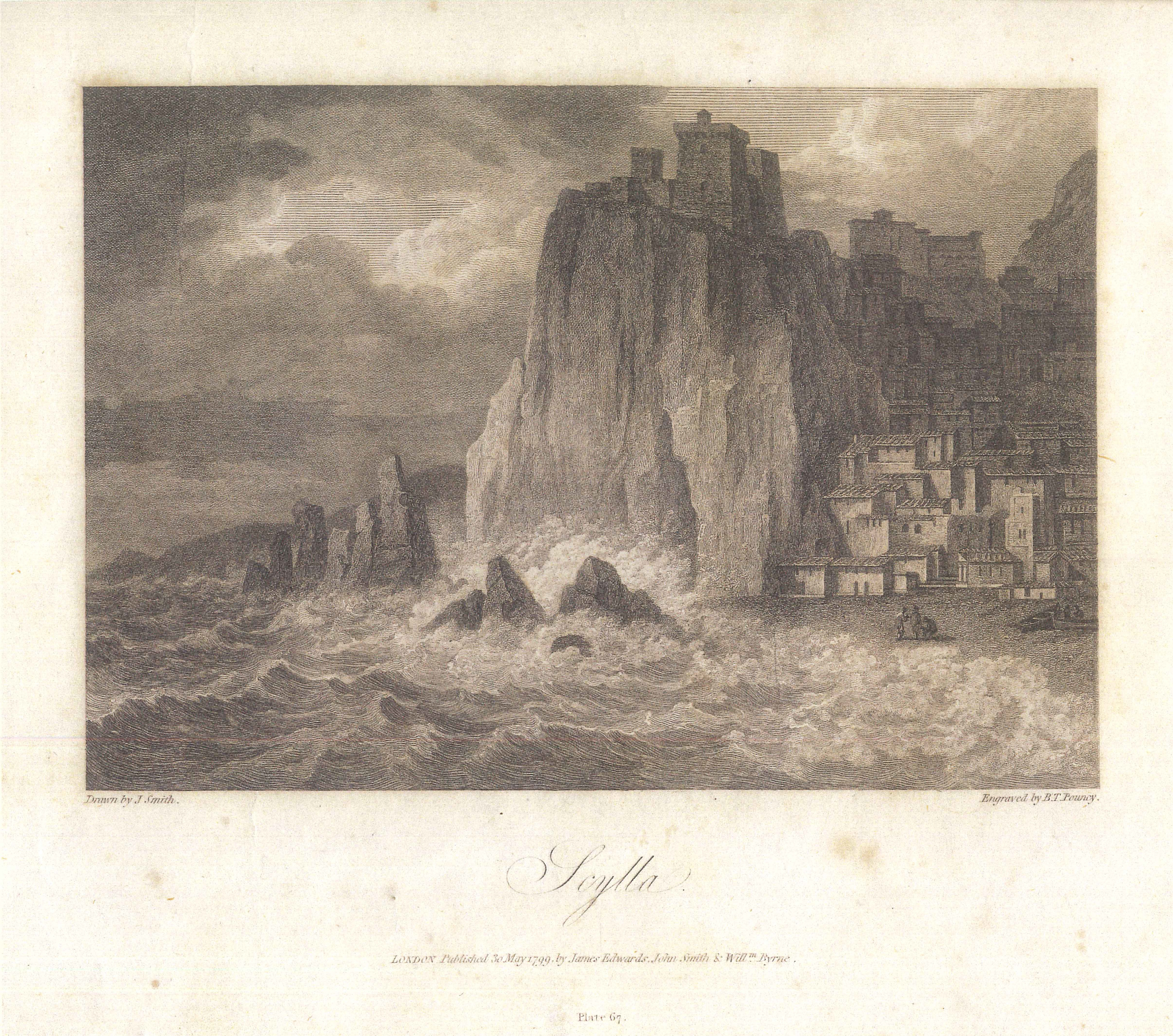
It is precisely in Book VII, where he describes the geography of the regions crossed by the armies, the movements of fleets along maritime routes, and the extension of the conflict toward the south of the peninsula, that the author inserts a geographical and mythological digression of great evocative power, mentioning Scilla while describing the strait separating Italy from Sicily, drawing upon classical memory to confer solemnity upon the passage traversed by the armies of Belisarius and to emphasize the strategic importance of the city.
“Meanwhile, Emperor Justinian had written to Belisarius to inform him that he had sent him a substantial contingent of forces, with which he was to join in Calabria in order to move together against the enemy.
Indeed, Valerian had already arrived on the shores of the Ionian Gulf, but he thought it unwise for the moment to make landfall, because at that season of the year (the winter solstice was already approaching) he would not find sufficient provisions for the men and horses.
[…] Belisarius, having read the emperor’s message, selected nine hundred men distinguished for their valour, of whom seven hundred were cavalrymen and two hundred infantry soldiers, and, leaving all the others to guard the region around Rome, appointing Conon as their commander, immediately set sail for Sicily.
From there he departed again, intending to reach the harbour of Tarentum.
He kept on his left the place called Scilla, where the poets say that Scylla once lived.
But it is not true that there ever existed a woman in monstrous form, as they claim: rather, it is true that in that sea, from ancient times and still in our own day, there exists in great abundance a fish which was once called scylax and is now called cyniscus.”
In this passage, Procopius recounts a crucial and dramatic phase of the Gothic War: the moment when Italy had become a battlefield and Emperor Justinian, from Constantinople, was attempting to coordinate his forces against the Goths.
The element that immediately stands out is the tension between imperial orders and the geographical and climatic realities of the time. Justinian instructs Belisarius to join the reinforcements led by Valerian, but ancient logistics imposed precise limitations.
Valerian, although he had reached the shores of the Ionian Sea, decided not to disembark: a decision dictated by prudence, since the winter solstice was approaching, a period during which the land could not provide sustenance and ships could not guarantee constant supplies.
Within this scenario emerges the figure of Belisarius, a general compelled to operate with limited resources.
He receives the message and makes a carefully considered strategic decision: he does not move the entire army, risking the loss of territorial control, but instead selects an elite force.
Entrusting the defence of Rome to Conon, he embarks for Sicily and then heads toward Tarentum. The episode reaches its greatest evocative power in the moment when the Byzantine fleet passes close to the Rock of Scilla.
Here military chronicle merges with classical memory: Procopius performs an act of intellectual rupture.
bserving the ships skirting Scilla and its legendary promontory, with the eye of a rationalist he strips the place of its ancient spectres, explaining that the danger of this promontory and its sea lies not in Homeric monsters but in the very nature of its seabed and marine life.
In this passage, through the evocation of Scilla, we find condensed the entire essence of Procopius’ work: on the one hand the painful chronicle of a war of attrition, on the other the pride of a culture that regarded itself as heir to the Greek and Roman tradition.
Belisarius, sailing through those waters, is not merely a general on campaign, but the symbol of an empire striving to restore order, both military and intellectual, to an Italy profoundly transformed by conflict, making the city of Scilla a solemn witness to one of the most significant military events in history.
Giuseppe Ribuffo
