
Alexandre Dumas (Villers-Cotterêts, 24 July 1802 – Neuville-lès-Dieppe, 5 December 1870) was a French writer and playwright, considered one of the greatest French authors of all time. A master of the historical novel and Romantic theatre, he was the author of memorable works such as the Musketeers trilogy, consisting of *The Three Musketeers* (1844), *Twenty Years After* (1845), and *The Vicomte of Bragelonne* (1848), as well as *The Count of Monte Cristo* (1846), *Queen Margot* (1845), *The Lady of Monsoreau* (1846), and *The Black Tulip* (1850).
Dumas was also a great traveler.
His descriptions are engaging, vivid, and remarkably modern, revealing the spirit of a keen observer of people and places. One of these journeys took him through Calabria, and the impressions he gathered were later published in the volume *Travel in Calabria* (1835). Dumas undertook the journey under a false name because he was officially forbidden from entering the Kingdom of Naples. He traveled through Calabria in the autumn of 1835, shortly after visiting Sicily, accompanied by the painter Jadin and his dog Mylord. Surprised by a sudden storm that prevented him from continuing his voyage north by sea, the writer decided to cross Calabria overland. The first and principal stop of his journey was Scilla. Through amusing anecdotes and colorful characters, Dumas’s stay in Scilla became an adventurous tale narrated with wit and irony.
“I set out toward Scilla in search of Jadin.
The distance from San Giovanni to Scilla is about five miles, though it seems much shorter because of the picturesque landscape, which almost always follows the sea and unfolds among hedges of cactus, pomegranate trees, and aloe plants, occasionally dominated by walnut or chestnut trees with dense foliage. Beneath their shade we often found a shepherd boy seated with his dog beside him, while the three or four goats under his care climbed whimsically over the nearby rocks [...] to reach the first branches of a strawberry tree or a holm oak.From time to time, I also encountered groups of two or three girls from Scilla, tall in stature, serious in expression, with hair adorned by red and white ribbons such as one finds in portraits of ancient Roman women. They were walking toward San Giovanni carrying baskets of fruit or jugs of goat’s milk upon their heads. They would stop and observe me as they might some unfamiliar animal; then they would burst into laughter, entirely without embarrassment, at my clothing, which, sacrificed wholly to comfort, must have seemed extremely eccentric compared to the elegant attire worn by Calabrian peasants.
Three or four hundred paces before reaching Scilla, I found Jadin seated beneath his parasol, with Mylord at his feet and the cabin boy beside him. They stood in the middle of a group of Calabrian peasants, whom he struggled to keep at a distance on the side facing the town. Their curiosity continually drew them closer until, every ten minutes or so, they formed a sort of curtain between the painter and the landscape. Then Jadin would do what a shepherd does: he would send Mylord in the direction where he wished the opening to be restored. The peasants, who were terribly afraid of the dog, would immediately scatter, only to resume the same position ten minutes later.
[...] The journey had sharpened my appetite, so I invited Jadin to interrupt his work and come dine with me in town. But Jadin, wishing to finish his sketch that very day, had taken precautions not to leave his chosen spot: the cabin boy had already fetched him bread, ham, and wine, and by the time I arrived he had just finished his meal.
I therefore decided to dine alone and set off toward the town with less prudence than Aeneas, trusting the ancient saying that Scylla is dangerous only to those who come by sea.
You shall see that I was grossly mistaken and that I would have done better to follow the advice which, three thousand years earlier, Anchises had given to another.
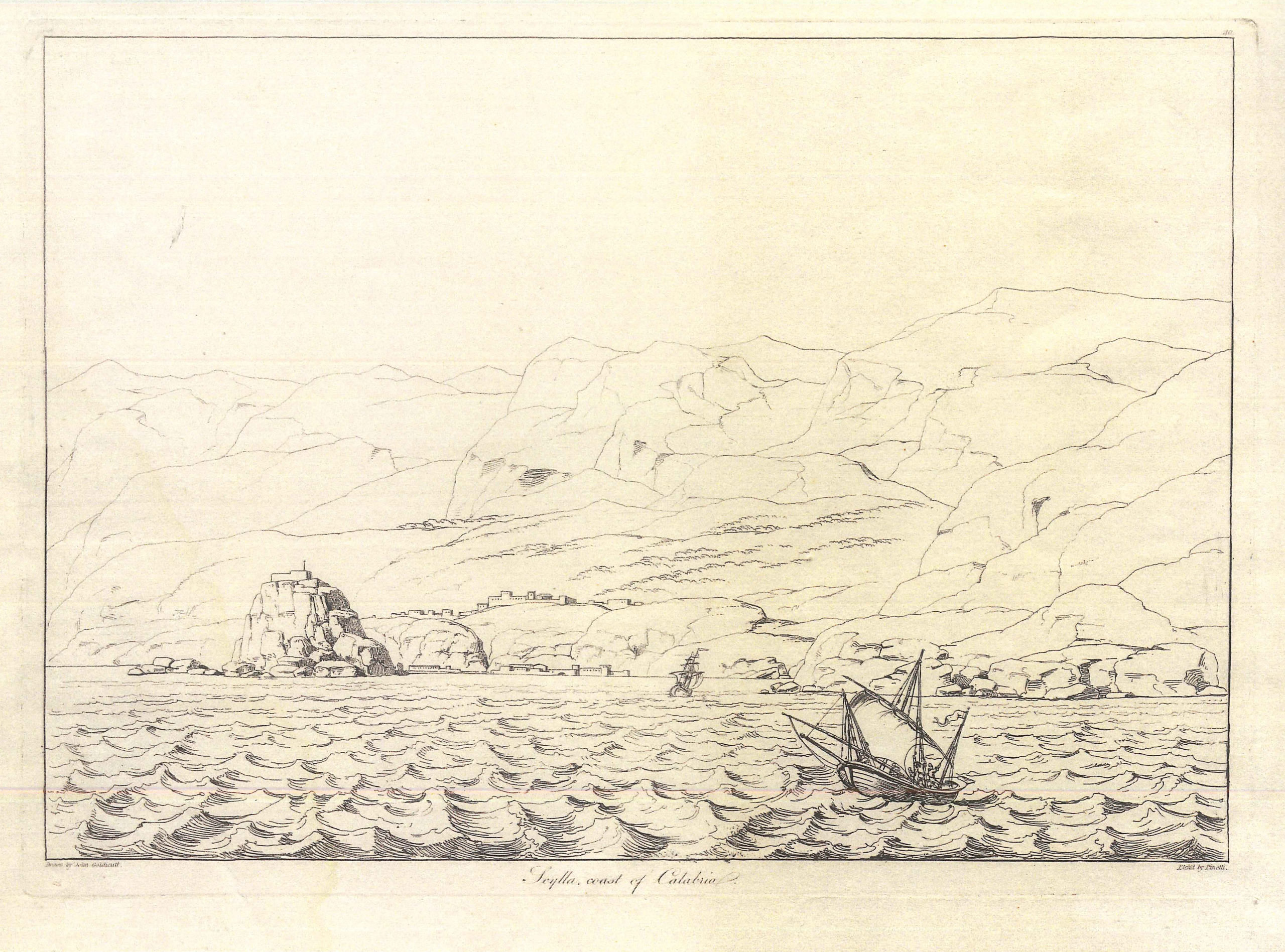
I arrived in town admiring its unusual position. Built upon a height, it descends like a long ribbon along the eastern slope of the mountain, then, curving in the shape of an S, stretches out along the sea. In the recess formed by its lower part lies a small roadstead where, it seemed to me, only fishing boats and light vessels of the spur-boat type could approach.
The harbor is protected on one side by a high rocky promontory, upon whose summit stands a fortress built by Murat, commanding a view over the sea.
At the foot of the rock, and for about a hundred paces around it, a multitude of bizarrely shaped rocks emerge capriciously from the waters. Some resemble dogs rising on their hind legs; it is probably from these that the legend originated which brought such terrible fame to the beloved of the god Glaucus.
From afar, thanks to the descending road, I had noticed a house whose sign depicted a red pelican hanging between the windows. The symbol of the bird opening its breast to feed its young seemed too direct an allusion to the obligations assumed by an innkeeper toward travelers for me to hesitate an instant before taking the bait.
Yet I should have remembered that there are pelicans and pelicans, just as there are bundles and bundles, and that a red pelican is not a white pelican. But the serpent-like caution that had so often been recommended to me regarding the Calabrians abandoned me that day, and I entered the trap.
I was received most graciously by the host, who, after asking what I wished for lunch and replying with the eternal Italian *subito*, led me upstairs to a room where a table was promptly laid.
Half an hour later, the host himself brought me a tray of chops and, seeing me seated at the table, eagerly taking the first advance upon my meal, asked me, in the same honeyed tone, whether I had a passport.
Failing to understand the significance of the question, I replied without concern that I did not, since I was not traveling at that moment but merely taking a walk; therefore, I had left it at San Giovanni, where I had temporarily established my residence.
My host responded with a most reassuring *benone*; I therefore continued ordering my meal, while he continued to serve me with increasing kindness.
When dessert time arrived, he went out himself to fetch me, so he said, the finest fruits from his garden.”
Giuseppe Ribuffo
