
Henry Swinburne (Bristol, 8 July 1743 – Trinidad, 1 April 1803) was a British writer and traveller from a noble Catholic family. He studied in Paris, Bordeaux, and at the Royal Academy of Turin, where he devoted himself to the study of literature and art, acquiring an excellent command of the Italian language; after his marriage in Great Britain, he continued his travels with his wife. He travelled extensively throughout Europe, but his most famous journeys were those in Spain and in the Kingdom of the Two Sicilies, which he described in two highly successful works: Travels through Spain (1779), and Travels in the Two Sicilies (1783). His passion for travel and exotic places eventually took him to Trinidad (West Indies), where he went as a vendue-master, and where he died at the age of sixty. On 7 February 1778, during his journey through the Kingdom of the Two Sicilies, Swinburne arrived in Scilla, sailing up the Strait by boat from Messina. With an Enlightenment background and endowed with a solid education that included considerable knowledge of economics, the English traveller observed places, the nature of the land, and the condition of settlements with a secular spirit, attentive to reality as it presented itself, without fanciful reconstructions, flights of imagination, or unnecessary displays of erudition. He noted the beauty of nature and lingered on the morphological description of its threatening rock, the source of the ancient legends associated with the dangerous passage through this turbulent stretch of sea.
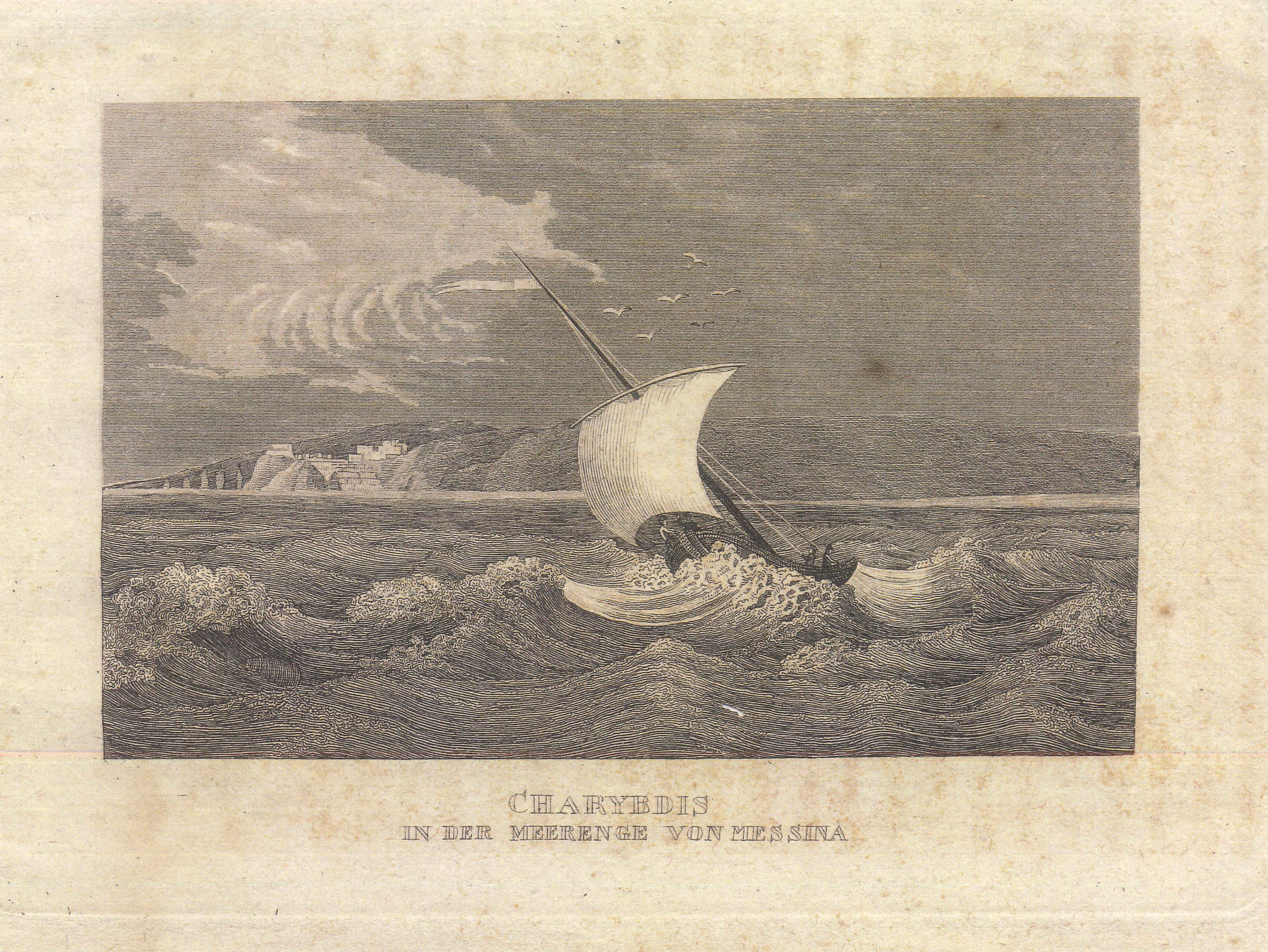
“On 7 February 1778, at three o’clock in the afternoon, I embarked with my two servants. […] With this ridiculous equipment we left Messina, skirting the shore of La Grutta, a famous place of pilgrimage, […] and reached Cape Peloro and the Lighthouse Tower, situated on a long strip of sand that extends into the sea for a mile and a half beyond the Calabrian coast, which here is very high and steep. […] Navigation at the entrance of the Strait is so difficult that pilots are always ready to put out to sea as soon as they sight a vessel offshore. […] I stopped for a few minutes to take a look at the panorama of Messina, which from this position appears most beautiful. I then rounded Cape Peloro, the promontory at the northern point of that triangle from which Sicily derives the name Trinacria, as its symbolic shape. We passed very close to the dreaded rocks of Scilla without danger, since the waters were calm and the waves neither broke at the foot of the cliff nor roared through its caverns. When a storm breaks, the violence and thunder of the waves crashing into these cavities are truly terrible, capable of striking terror into the bravest sailors if a vessel approaches this clash of elements. A great castle occupies the summit of this famous rock, from which two rows of houses descend, on one side and the other, to the beach, which is semicircular in shape, wooded and protected by very high rocks. The inhabitants of Scilla are industrious sailors and fishermen, reputed to be gentle and honest people, though not lacking in spirit when oppressed by the powerful. Recently they gave proof of their courage and determination in a dispute with the lord of the castle. The Prince of Scilla, who belonged to the Ruffo family, was accused of exercising the most odious tyranny over his subjects and of employing a band of ruffians to threaten not only the property but also the lives of the unfortunate inhabitants. The baron’s persistence in behaving in this barbarous manner drove them to an attempt quite unusual in a region where the power of the nobility was still so firmly established. They formed a committee and sent it by sea to present their grievances to the sovereign and implore his protection, the only person who could come to their aid. These patriotic citizens were in no way intimidated either by the arrogance of the barons, who would surely have united against anyone attacking one of their own, nor by the expenses they would have to face and the other troubles they might suffer should their initiative fail. They took into account only the injustices they had endured and the intensity of their resentment, and they pursued their goal with unwavering determination. During the dispute they found an able adviser in their fellow citizen Father Antonio Minasi, to whose intelligence and diligence they probably owed their victory over their adversary, a victory not as complete as the justice of their cause would have required, but certainly extraordinary considering the disparity between the parties involved, and one which reflects honour upon the sovereign, who must have encountered incredible obstacles before obtaining a clear and reliable understanding of the situation on which to base his judgement, which proved highly humiliating for the Prince of Scilla.”
Finally, Swinburne recalls an emblematic episode that sheds light on the social condition of Southern Italy during the eighteenth century. He recounts the rebellion of the inhabitants of Scilla against their feudal lord, Don Fulcone Ruffo, whose power is portrayed as arbitrary and oppressive. Through this episode, the author highlights the distortions of a system founded on the abuse of noble authority. What strikes him most is the reaction of the people of Scilla: simple men, tied to the labour of the sea, who nevertheless found the strength to recognize themselves as a community and to act collectively. The decision to form a committee and appeal directly to the sovereign, Ferdinand IV of Bourbon, represented a gesture of great significance for the time, since it broke with the custom of passive submission to baronial power. This behaviour reveals a profound civic consciousness and a strong sense of collective dignity. Fundamental to the story is the figure of the Scillese priest Antonio Minasi, who assumed the role of the city’s moral and intellectual guide. Thanks to his ability to direct the citizens’ actions, the protest was transformed into a rational and legitimate claim. Although the outcome did not entirely meet expectations, the affair concluded with a significant moral and political affirmation by the inhabitants of Scilla. Through this account, Swinburne presents the image of a vibrant and self-aware community, capable of opposing injustice and asserting its own historical and civic identity. The passage thus becomes a valuable historical and social testimony, giving voice to the inhabitants and to the everyday reality of a town in Southern Italy during the eighteenth century.
Giuseppe Ribuffo
