
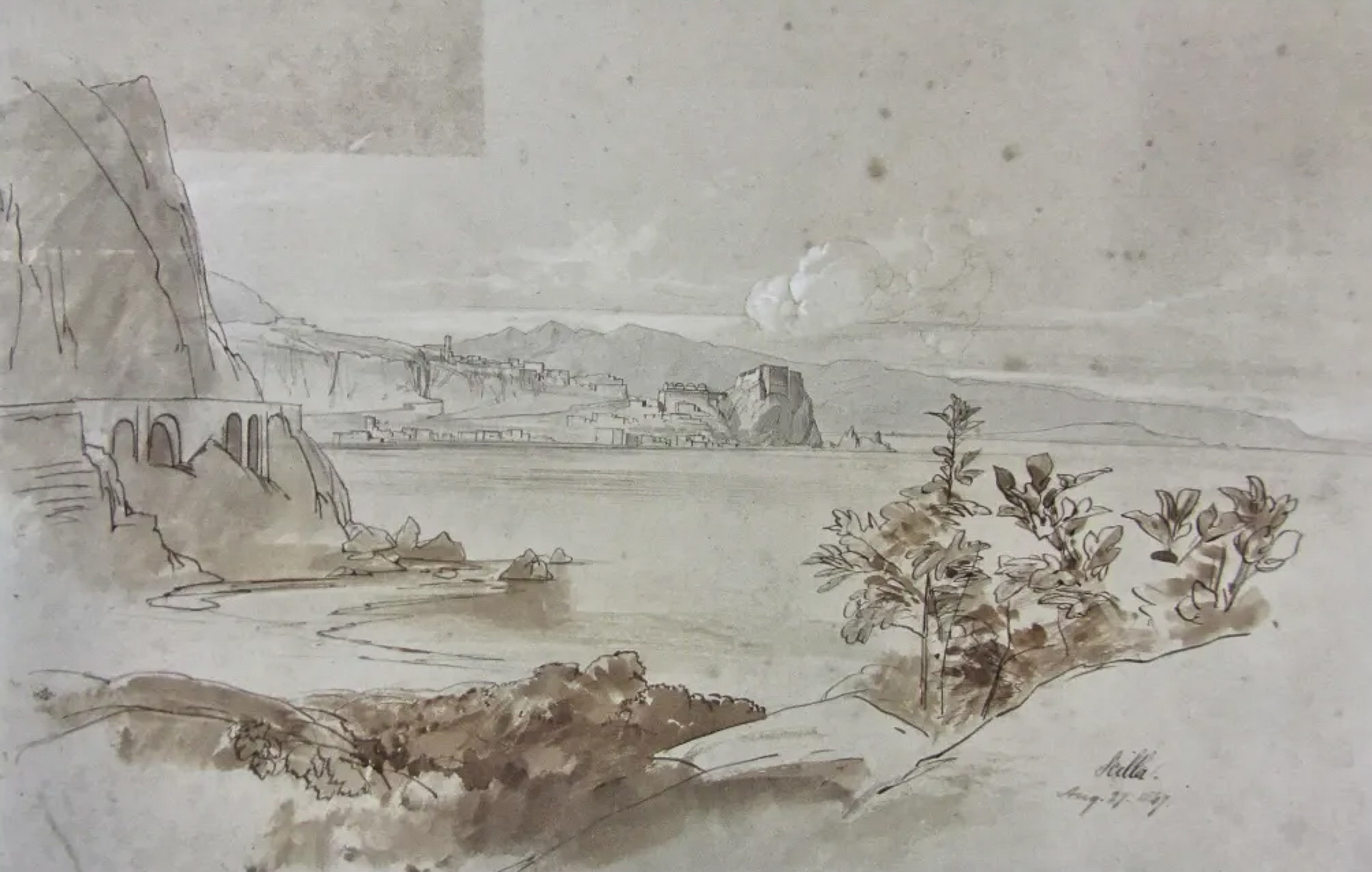
Carmine Pirrotta was born in Scilla on 1 April 1936, where from an early age he developed a natural inclination toward drawing and sculpture.After studying at the School of Art of Reggio Calabria, he emerged as an artist with a strong and immediate visual language, deeply connected to his homeland. Scilla, its fishermen, and the landscape of the Strait became the central subjects of his artistic inspiration.His artistic journey was influenced by the “School of the Artists of Scilla”, founded by Renato Guttuso in 1949 in the district of Chianalea. Although short-lived, that experience left a decisive mark on him, enhancing the light and colours of the village, refining his technique, and further developing his innate talent and abilities.From this experience Pirrotta drew a solid foundation, shaping a highly recognizable style: strong and plastic forms, figures sculpted through colour, essential perspectives, and a powerful line that privileged visual impact over the softness of sfumato.His friend and contemporary Vincenzo Paladino, in his work Calabria Ultima, described him as an instinctive and tormented artist, capable of creating works distinguished by their force and originality:
“He had no academic school behind him, but above all he possessed the claw-mark of a draughtsman, and he knew it; for him the object, the figure, the perspective always came first. Therefore he ignored sfumato, tonal patches, chromatic phrasing, and the informal, aiming instead at forms that were strongly, violently embossed, corporeal, aggressive. […] One glance was enough to say: that is Pirrotta.”
His life was intense, troubled, and deeply marked by suffering. The sudden death of his father, killed by the collapse of the cornice of the Church of San Rocco, together with a love story strongly opposed by others, profoundly affected both his emotional balance and his painting.In 1967 he was hospitalized for severe psychiatric illness, from which he unfortunately never fully recovered. Despite these hardships and conditions of extreme poverty, he continued to paint relentlessly, never interrupting his artistic production.Among his many works are the oil paintings on panel La televisione (1960) and Natura morta (1970); the oils on cardboard Autoritratto (1960), Fiori (1970), and ’u vapuri (1973); and the tempera on paper Ulivi (1965).Among his sculptures are the plaster Luntre, placed at the entrance of the Town Hall of Scilla, as well as the monuments dedicated to the fallen soldiers of the First World War located in Scilla (Largo San Giuseppe, 1960), Melia (Piazza San Gaetano, 1960), and Sinopoli (Piazza Municipio). Numerous paintings and sculptures by Pirrotta are carefully preserved today in private collections in Italy and abroad. He participated in collective exhibitions in 1959 in Reggio Calabria and held solo exhibitions in the same city between 1961 and 1963 and again in 1966. He also exhibited in Trieste during 1969–1970 and in San Benedetto del Tronto in 1970.He received several awards and distinctions, among which the most prestigious was the Gold Medal awarded in 1967.A certain human and cultural indifference contributed, in some way, to transforming what might have become a privileged artistic career into an unknown, cursed, and tormented existence, making him what, in literary terms, might be called a “cursed painter.”He spent the final years of his life withdrawn in solitude in his home in the district of Bastìa, in the San Giorgio quarter of Scilla, painting and drawing on every possible support and surface. The house itself, including its roof and walls, became the stage for his artistic expression. In this way he gave such intense form to his creativity that he transformed his home into a kind of small Sistine Chapel. To describe the inspiration of his immense art there are “neither eyes, nor hands, nor words for that icy, dark, delirious solitude,” while he continued obsessively to spread paint upon canvas and clay and to fresco the walls and vault — “the starless sky” — of his narrow and gloomy cell.The artist from Scilla possessed a gentle soul and undoubtedly deserved far greater recognition for his artistic gifts. Instead, he was devastated by profound solitude, consumed by an all-encompassing passion and by a deeply troubled existence.The regret for his spirit — which managed to create so much through solitude and suffering — has remained alive in all those who understood how, until the final day of his life, he desired only freedom and love. He died in Scilla on 3 March 1988
Giuseppe Ribuffo
