
Hans Christian Andersen (Odense, 1805 – Copenhagen, 1875) was a Danish writer and poet who, throughout his life, authored numerous plays, travel diaries, and stories; however, his name is above all associated with his literary fairy tales.
During his lifetime he wrote more than 156 fairy tales, divided into nine volumes.
Among the most famous are enduring classics such as Thumbelina (1835), The Princess and the Pea (1835), The Little Mermaid (1837), The Steadfast Tin Soldier (1838), The Ugly Duckling (1843), and The Little Match Girl (1845). Today his fairy tales are considered an integral part of the collective consciousness and constitute an important part of the cultural heritage of children throughout the world.
Eager to see the world and to go beyond the narrow confines of Denmark, Hans Christian Andersen succeeded in fulfilling his dream during the 1830s: to travel.
Between 1840 and 1841, at the age of thirty-five, supported by a scholarship, he finally managed to reach Southern Italy.
This same period of travel coincided with the most prolific phase of his fairy-tale production, with the publication of masterpieces that enchanted, and continue to enchant, generations of children and adults alike.
Some of his most celebrated fairy tales – The Little Mermaid, The Steadfast Tin Soldier, and The Wild Swans – had only recently been published, and Andersen granted himself a long pause in search of new inspiration in the magical and evocative world of the Bel Paese.
The long-awaited journey represented for Andersen an opportunity to provide new material for his poetic workshop. As in the tradition of the Grand Tour, the celebrated storyteller wrote and sketched, took notes and drafted impressions, forming, almost without realizing it, a kaleidoscope of inexhaustible inspirations.
The impressions gathered during this journey would become the literary material for A Poet’s Bazaar (En digters bazar), published in 1842, a work that presents the diary of the journey undertaken by the great Danish writer through Italy.
It is here that Andersen casts upon our country the gaze that most characterizes him: melancholic and capable of reading life as an extraordinary adventure, always permeated by a subtle nostalgia.
Profound reflections alternate with barely sketched drawings, yet remarkably eloquent, in an itinerary that descends from the Alps to Naples, before crossing the sea toward Sicily.
It is within this context that the passage dedicated to Scilla is situated, which Andersen reached by ship from Naples, and where the writer’s gaze becomes even more intimate and involved, presenting the place as a symbolic threshold between myth, nature, and memory.
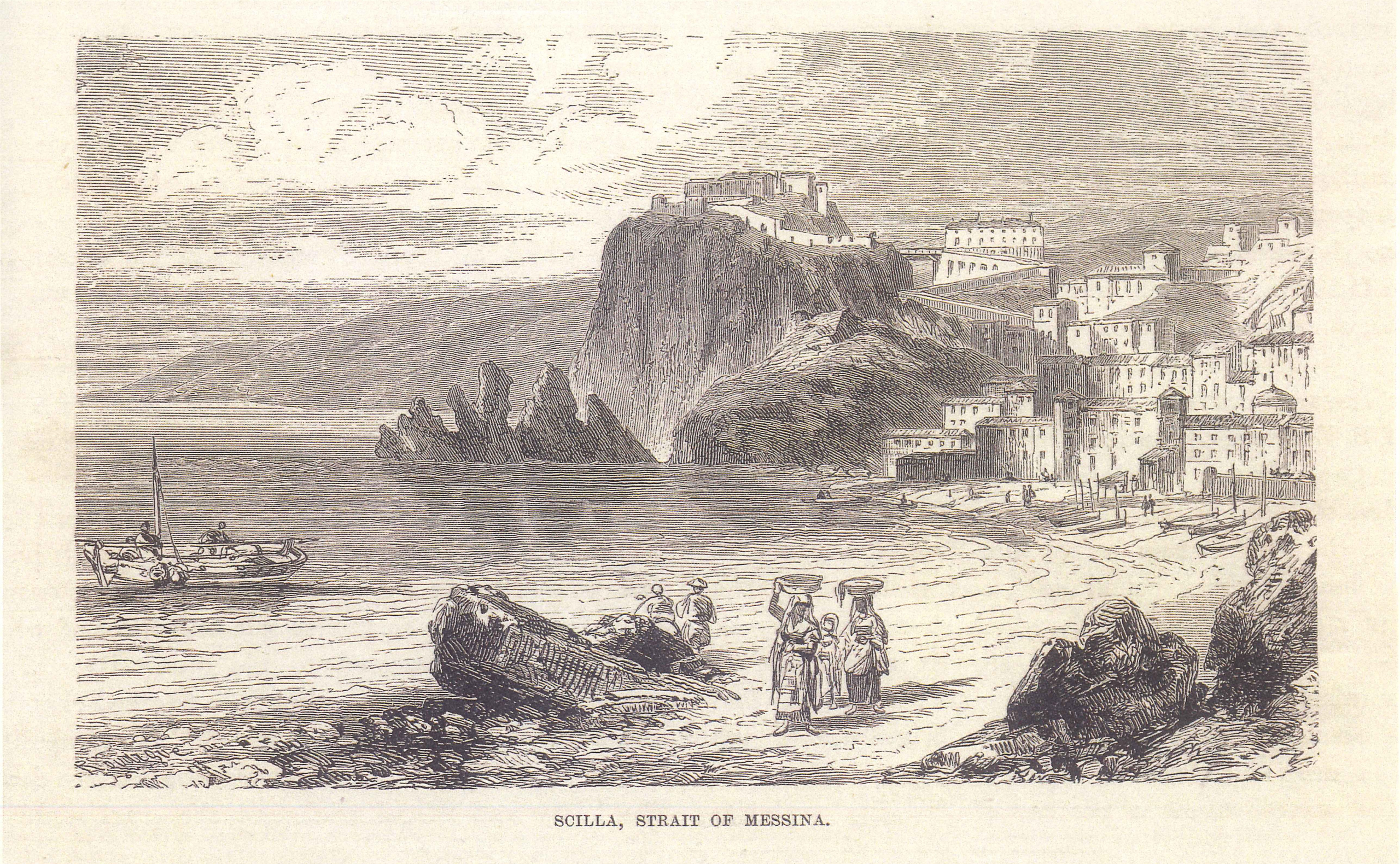
“Our ship glided past the swirling Charybdis, and we hardly noticed it! But what had become of the wild Maelstrom? They pointed out to us a stretch of sea very close to where we had passed, yet we could discern no particular movement of the waves.
And where is Scylla? ‘Oh yes, she is still alive!’ and they pointed out to us on the steep Calabrian coast a projecting rock with, above it, the gloomy ruins of a settlement; against it great breakers roared while the sea itself was fairly calm. Where the waves broke, blocks of grey-black rock emerged from the sea: they were Scylla’s howling dogs; when there is a storm, they can perhaps be heard as far as the sandy isthmus of Messina. We were approaching this city; to the northwest the Lipari Islands closed off the horizon.”
In this passage, Andersen describes the transit of his ship through the Strait of Messina, comparing ancient myth with the reality he observes.
The author immediately notices the discrepancy between the expectation of danger, evoked by the legend of the Maelstrom and the sea monsters, and the apparent calm of the sea, which diminishes the terrifying imagery handed down through books.
Nevertheless, Andersen does not completely eliminate the myth: the presence of Scylla is rendered vivid and tangible by the steep rocks and rocky outcrops emerging from the sea like “howling dogs.”
In this way, the myth does not disappear, but is integrated into the direct experience of the landscape, blending literary memory with real observation.
The passage also reveals the characteristic perspective of the Danish writer: melancholic and curious, capable of combining wonder and irony, poetry and realism.
The attention to natural details – the ruins of the settlement, the waves, the calm sea – gives the narrative a strong evocative and symbolic value: Scilla thus becomes a living place, a threshold between myth and reality, between past and present, between legend and personal experience.
In summary, the text is not merely a geographical description, but a reflection on the relationship between imagination, tradition, and lived reality, characteristic of Andersen’s travel writing.
His poetic vein appears irresistible, always seeking the fairy-tale element within the history and mythology of the places he visits.
Giuseppe Ribuffo
