
Girolamo Marafioti (Polistena, 1567 – Polistena, 1626/1630) was one of the most significant figures of Calabrian
historiography between the sixteenth and seventeenth centuries. A priest belonging to the Order of Friars
Minor, a mendicant order founded on principles of poverty and sustenance through work and almsgiving, Marafioti
combined his religious vocation with intense intellectual activity.
He taught theology in convents and cultivated a keen interest in ancient languages and literatures, as well as
in music.
His production was not limited to history: he also left a theological work and a Latin treatise on mnemonics, Ars
memoriae (Venice, 1602), which enjoyed wide circulation and was soon translated into Italian.
Information about his life is not always consistent and derives largely from his own works and later biographical
sources, but what clearly emerges is the profile of a scholar committed to the transmission of knowledge
and the preservation of Calabria’s historical memory.
His principal work, Croniche et antichità di Calabria, first published in Naples in 1596 and subsequently reprinted
in Padua in 1601, represents a systematic attempt to reconstruct the history of the region. Structured
in five books, the work continues the efforts of the humanist Gabriele Barrio, author of De antiquitate et situ
Calabriae (1571).
Marafioti explicitly states his intention to expand and make accessible in the vernacular language learned
contents that had previously been reserved for an educated audience, filling gaps and updating the historical
knowledge available. In this sense, his work assumes not only a historical but also a popularising value. Within
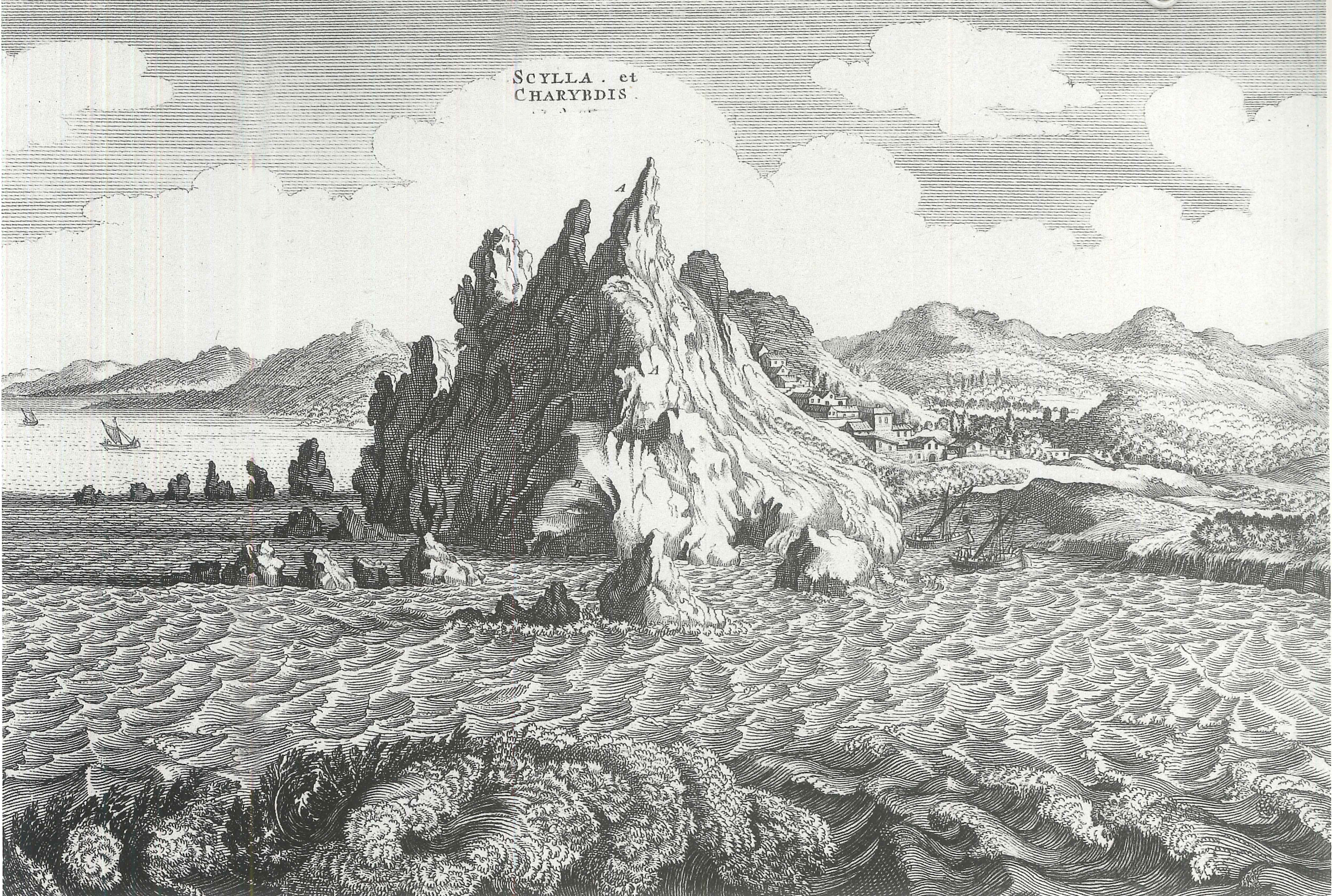
the Croniche, Scilla occupies a particularly important role, presenting itself as one of the symbolic places from
which to begin the narrative of Calabria.
Marafioti intertwines historical sources and mythological tradition, providing a complex image of the territory.
The village is described both as a strategic geographical point of the Strait and as a place rich in symbolic meanings,
linked to the Homeric myth of Ulysses, to Scylla and Charybdis, and to the narratives handed down by
authors such as Strabo and Plutarch.
The description begins with the famous Rock of Scilla, upon which, according to the sources he reports, there
stood a temple dedicated to Minerva built by Ulysses, bearing witness to an antiquity rooted in classical memory.
Among the most evocative elements reported by Marafioti is the description of the “Dragara”, a deep cavity
situated at the base of the rock:
“Beneath the aforementioned rock of Scilla there is a chasm, into which the sea water enters below and at times,
driven by storms, rises into the air to a height of thirty or forty palms.
This chasm is called by the townspeople ‘Dragara’, because it resounds with the outpouring of the waters more
loudly than a dragon; and if by misfortune a man were to fall into it, even if he were able to swim like a fish, it
would be impossible to save him because of the extraordinary depth of the rock.”
Alongside natural and mythical elements, Marafioti includes historical references of great importance, such as the barrier wall built by Marcus Licinius Crassus in 72 BC to halt the advance of Spartacus:
“In the vicinity of Scilla there is a large section of an ancient wall, called by the townspeople ‘the broken wall’, which Plutarch discusses in his Life of Marcus Crassus, where he says that it was built by Marcus Crassus in order to block the enemy army.”
The narrative is then enriched with direct observations of the life of the inhabitants, highlighting local skills
and economic activities.
The people of Scilla are described as expert sailors and skilled fishermen, particularly in swordfish fishing:
“Today Scilla is very well populated; particularly worthy of praise is that the men are strong sailors and navigate safely with great skill, even in adverse weather, and the women are kind and beautiful persons.” [...] “Various fish are caught in this sea, and at times species unknown elsewhere are taken. But the most ingenious fishing in Scilla is that of the swordfish, of which Strabo speaks in the first book.”
Particularly significant is also the description of agricultural and wine production, which highlights the variety and quality of the grapes cultivated in the territory:
“In that town almost everyone practises the art of the sea.
In Scilla there is an abundance of different grapes, such as moscatella, greco, insolia, vernaccia, malvasia, from
which an excellent wine is made, in no way inferior to the malvasia of Candia, and others abundant both in wine
and pleasant to eat; so that much profit is gained from the sale of grapes in the aforementioned town.
There is
also the tuna fishery and the silk industry.””
Finally, Marafioti also documents the surrounding territory, mentioning the ancient locality of “Mallea”, now
Melia, situated on the heights above Scilla and mentioned in Roman itineraries.
Together with Solano, another hamlet of the territory, this centre already played a strategic role in Roman times,
especially after the construction of the Via Annia Popilia, built between 132 and 128 BC.
“Directly opposite the aforementioned Cape Cenide, on the plain above the mountains, appear the ancient walls of a destroyed city called Mallea, which is mentioned in the itinerary of Antoninus Pius. I see no written account describing its destruction. Descending afterwards towards the sea, one encounters the town called Scilla, about six miles west of Cape Cenide.”
Through these testimonies, Croniche et antichità di Calabria presents an image of Scilla that is not merely a geographical place but a true privileged vantage point from which to understand Calabria as a whole.Through these testimonies, Croniche et antichità di Calabria presents an image of Scilla that is not merely a geographical place but a true privileged vantage point from which to understand Calabria as a whole. Marafioti’s work thus offers one of the oldest and most articulated narratives of Calabria, identifying Scilla precisely as one of the key places from which to read the historical identity of the region: a point of passage, encounter and stratification, where the past continues to be visible in the forms of the landscape and in the traditions of its inhabitants.
Giuseppe Ribuffo
