
Frederick Leopold of Stolberg (Bad Bramstedt, 7 November 1750 – Osnabrück, 5 December 1819) was a German
poet, jurist and translator, belonging to a cadet branch of the House of Stolberg, son of Count Christian
of Stolberg and Christiane Charlotte of Castell-Remlingen.
He attended the University of Halle in 1770 to study
the German legal system, as well as the classics of literature.
He later studied at Göttingen and became an influential member of the Hain or Dichterbund society, an association
of young men united by the ambition of unifying the German nation.
In 1777 he was appointed envoy of the Prince-Bishop of Lübeck to the court of Copenhagen, and later became
Danish ambassador to the Prussian court.
In 1789 he visited Italy and documented the journey in a series of letters.
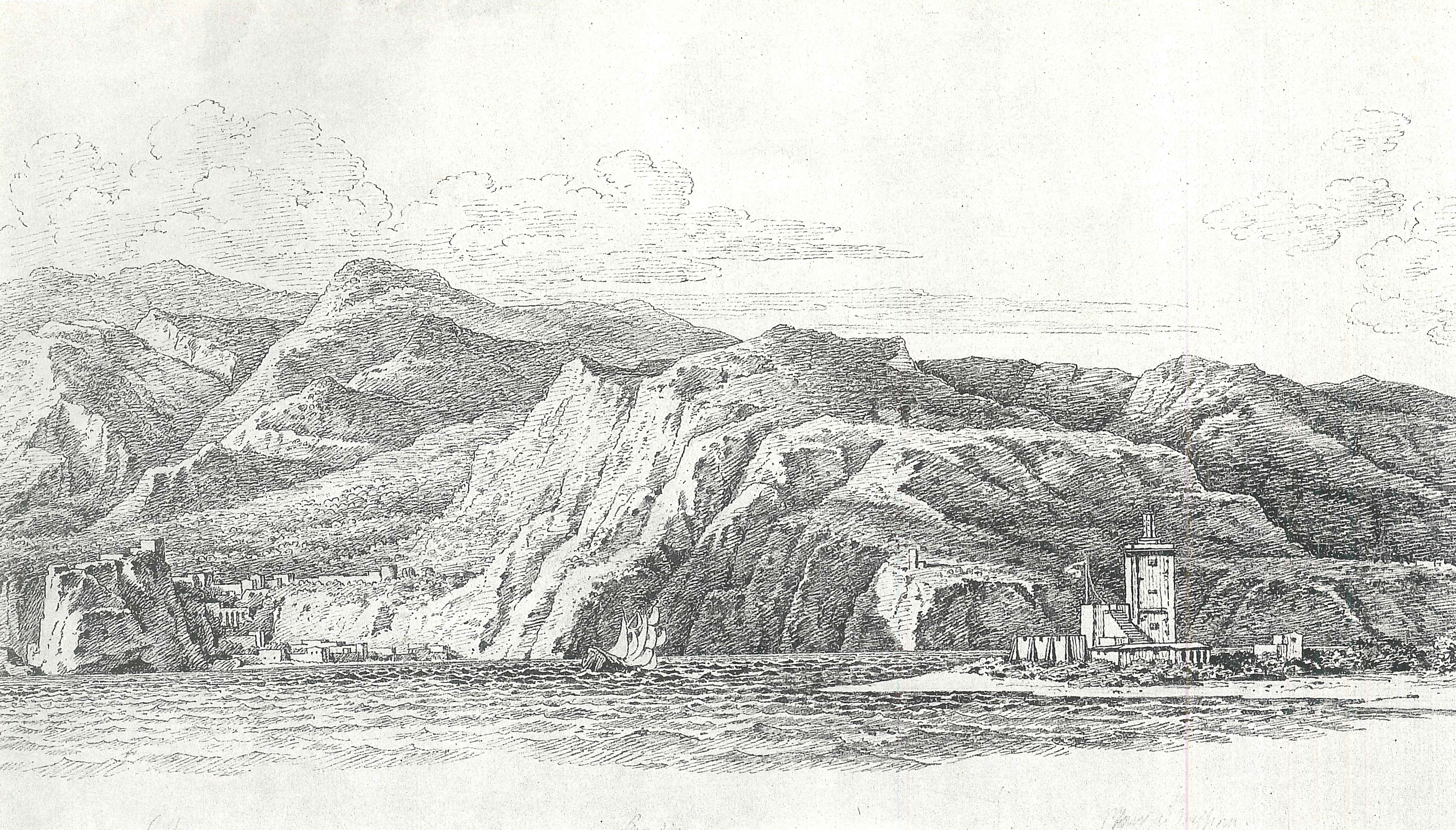
Stolberg arrived in Scilla on horseback, descending along the Calabrian coast.
In the passage, the author describes his first impression of the town, focusing on the rocky landscape and on
scenes of everyday life; references to the Scylla of classical memory naturally emerge as well.
“We resumed our ride toward Sciglio, or Scilla, following the seashore; partly we rode along the sandy beaches,
partly along narrow rocky paths beside the cliffs. The town takes its name from the famous rock celebrated by
Homer, upon which now stands the castle of the Prince of Scilla.
The town is built partly directly on the sea and partly upon the rocks of the shore. The streets within are very
narrow. Nine rows of houses are clearly visible, appearing to rest one upon another; above the highest row there
are another six or seven houses built somewhat crookedly in relation to the others. Higher still, a waterfall
springs from the rocks.
According to Cluverius, this would be the Kratais, the waterfall that Homer describes
as the legendary mother of the monster Scylla.
During the earthquake of 1783 some churches collapsed and
others were damaged; the houses were almost all spared. Nevertheless, this small town suffered a great number
of human losses.
The Homeric rock has a fantastic and terrible appearance. As soon as we arrived we went
to see it by boat.
Let us listen to the description of the great poet and admire with what insight he was able to
depict it with words! With what truth his poetry grasped things in their essence!
Circe warned Odysseus about the deceptive rocks. Near the rock of Scylla several jagged rocks rise from the
sea. The eye is deceived, and one may mistake the movement of the sea for the movement of these rocks: the
waves breaking over them cover them now more, now less.
A similar mistake is made on the North Sea, where,
as often happened to me, rocks intermittently covered by waves are mistaken for seals. Homer recounts that
the voyage was undertaken on a Phoenician or Greek ship; therefore it is quite likely that the sailors of his time
knew these coasts so little that they could truly believe the rocks were floating. [...] In this passage Homer calls
the sea “dark-blue-faced Amphitrite.” Here it is very deep, and never before, under a clear sky and at evening,
had I seen a sea so blue.
[...] The poet wished to create a daring tale about these rocks and therefore had to give it an adventurous tone.
Homer often gave a figurative meaning to his subjects, more than his commentators have imagined or understood;
and he did so in this case as well, even wrapping the rock in clouds. In reality it is not so high, at least not
high enough to be shrouded in clouds under a clear sky. Yet its appearance is indeed strange and terrible.
The
summit is no longer pointed because a castle has been built upon it; nevertheless, even today not a man with
twenty hands and twenty feet, as Homer says, could climb it. It rises like a cylindrical tower whose width is disproportionate
to its height. Toward the sea another rock extends from it, sharp and triple-toothed: these are
the three rows of teeth of Homer’s monster. The surrounding rocks lent themselves readily to the poet’s unleashed
imagination. In the poem it is told how the monster devoured dolphins, sea dogs and larger fish whenever
it could catch them; this part of the story is based on an admirable knowledge of the nature of these waters.
Indeed, this stretch of sea abounds in dolphins and in a species of large fish that Italians still call the “sea
dog.” From time to time a type of whale, called by the French a cachalot, is stranded upon these shores; a few
years ago this happened more frequently. Charybdis, on the other hand, is the cause of much disagreement:
as Homer describes it, it cannot be precisely located. Nowhere is there a small rock that, according to Homer,
should stand directly opposite Scylla. Yet, given the nature of this region, where so many natural phenomena
occur, earthquakes may have caused many changes. Is not the opinion of ancient writers and modern scholars
plausible, namely that an earthquake in a very remote age separated Italy from Sicily? Cluverius also agreed,
based on Homer’s account, on the position of Charybdis opposite Scylla, precisely near the promontory of Pelorus,
now called Capo di Faro. Yet he too was unable to locate it in the designated place, and therefore concluded
that the true Charybdis must be the whirlpool raging opposite the lighthouse of Messina, thus ‘justifying’
Homer’s error.
But why did Cluverius fail to find Homer’s whirlpool-monster? Every fisherman of Scilla, Capo
del Faro and Messina knows it.
And indeed it lies opposite Capo di Faro, directly facing Scilla. The sea current coming from the northeast generates
in the Strait its regular high and low tides every six hours; if the movement of the two tides is disturbed
by a strong wind blowing in the opposite direction, a whirlpool is still produced today directly in front of
the promontory. This ebb and flow has over time formed subterranean passages connecting Etna with the sea.
Aristotle describes it, like all other tides, in relation to the moon; the regularity of its alternation confirms this
theory. Since tides occur only in a few places in the Mediterranean, in Homer’s time they must have been an
entirely unknown phenomenon. Therefore he imagined: Charybdis swallows the waters three times a day and
spews them out as many times. A sailor in a small vessel unfamiliar with these waters might suffer the misfortune
of which Circe warned Odysseus: moving too far from the rocks of Scylla to avoid them, only to fall into
the whirlpool of Charybdis. Sailors call both this whirlpool and the one at Messina ‘Capo Faro’; the latter is also
called La Rema. The name Capo Faro is undoubtedly of Greek origin, contracted from the Greek words kalós,
‘beautiful’, and pharos, ‘lighthouse’. Indeed both whirlpools rage beneath the lighthouses, one near Messina
and the other near Capo di Faro. Before leaving Scilla we were invited by a gentleman of the town, to whom we
had brought a letter from Naples, to see on the shore a swordfish caught in his net during the night.
Sometimes
this fish is larger than a man. The lower jaw protrudes hard and pointed, like a broad sharpened blade.
The
upper jaw, more than five cubits long, resembles a broad sword pointed and sharpened on both sides.
This fish
challenges to a bloody struggle the species called the sea dog. Last year the sea cast upon the shore a swordfish
and shortly afterwards a sea dog. The former had completely impaled the latter; but the victor had been unable
to free itself from the vanquished and, unable to swim freely, had to perish with it. The swordfish is highly prized
because its flesh is said to be particularly succulent.
At this season of the year it is hunted, and this is a
time of great rejoicing. Some men wait in small boats upon the water. A man standing upon a rock, a tower, or
a pole, has the task of spotting the swordfish. As soon as he sees one, he signals with a handkerchief.
The waiting
fishermen, having spotted the fish, row toward it armed with harpoons. If they succeed in striking it, they
unroll the entire rope attached to the harpoon so that the fish may swim away and bleed itself out; exhausted,
after its final swim, it is hauled aboard.
While we were there, we could see a lookout perched upon a pole, with hopeful fishermen waiting around him.
The Princes of Scilla compel their subjects to surrender the best parts of every swordfish caught and one-tenth
of the entire catch. For many years a lawsuit has been pending against them because of this abuse.
Once a
commission was appointed to examine the legal grounds of such an unjust imposition, but it was quickly dissolved.
The present prince continues to enforce his claims upon the poor fishermen, despite the fact that various
abuses of this kind have been abolished by the king.
The swordfish is a migratory fish. It visits the Calabrian
coasts during the months of May, June and part of July; it then moves toward Sicily, where it is subjected to
the same hunt.”
Giuseppe Ribuffo
