
Aeschylus, son of Euphorion of the deme of Eleusis (Eleusis, 525 BC – Gela, 456 BC), was an ancient Greek
playwright.
He is universally regarded as the founder of Greek tragedy in its mature form.
He is the earliest tragic poet of ancient Greece whose complete works have survived.
Born into a noble family, he witnessed firsthand many key moments in the history of Athens, including the fall
of the tyranny of the Pisistratids in 510 BC.
He personally fought against the Persians at Marathon (490 BC), where his brother Cynegeirus fell in battle, at
Salamis (480 BC), and at Plataea (479 BC). The most famous of his tragedies is the *Oresteia*, a trilogy consisting
of *Agamemnon*, *The Libation Bearers*, and *The Eumenides*, with which Aeschylus won the Great
Dionysia in 458 BC.
The tragedies that compose it represent a single story divided into three episodes, rooted in the mythological
tradition of ancient Greece.
The first, entitled *Agamemnon*, recounts the murder of the king upon his return from the Trojan War, plotted
by his wife Clytemnestra with the help of Aegisthus, in order to avenge the sacrifice of their daughter Iphigenia.
Agamemnon, king of Argos, before departing for the Trojan War, lacked favorable winds; therefore, on the
advice of the seer Calchas, he sacrificed his daughter Iphigenia to appease the gods.
The winds then became favorable; however, Clytemnestra resolved to avenge her daughter’s sacrifice by killing
her husband together with Aegisthus, Agamemnon’s cousin and her lover.
The passage belongs to the fourth episode of *Agamemnon* and coincides with the famous prophetic speech
of Cassandra.
The scene takes place before the royal palace of Argos, where Cassandra, Trojan princess and prophetess of
Apollo, has arrived as a war prize of the victorious king; however, as the myth dictates, she is condemned to
prophesy without ever being believed.
In this episode Cassandra, seized by a vision, recalls the past crimes of the House of Atreus—particularly the
murder of Thyestes’ children and their gruesome banquet—and at the same time foretells the imminent assassination
of Agamemnon by Clytemnestra, who is portrayed as a monstrous and demonic figure, the symbol of a
distorted and violent justice, so much so that she is compared to Scylla.
CASSANDRA:
“Alas, alas! Ah, misery, misery!
Terribly within me once again
the prophetic torment whirls,
shaking me with its mournful preludes.
Do you see those children seated within the house,
like phantoms of dreams?
They are children, children slain by their own kin.
They stretch forth hands filled with entrails and flesh,
wretched burden, dreadful feast!
Their father partakes of them. Someone, I foretell it,
plots their vengeance: a cowardly
lion of the household, sprawling
within the bedchambers against my lord,
for whom I bear the yoke of servitude.
The commander of the fleet, he who destroyed
Ilium, knows not what ruin she prepares for him,
she who, smiling in her heart, with deadly fate,
like invincible Ate, with endless
babbling, the tongue of a hateful bitch!
So great is her daring! A woman kills a man.
By what name of loathsome monster
might I rightly call her? Amphisbaena,
Scylla lurking among the rocks, destruction
of sailors? A demon of Hades,
who from its jaws breathes upon its own
relentless war? Ah, shameless creature!
How she howled! As though at an enemy’s flight!
And she seemed to rejoice that her husband
had returned safe! Oh well, whether they believe me
or not is all the same! The event draws near.
Through deeds you shall soon see whether I am
a true prophetess of disaster.
Then you will pity me.”.
In this passage Cassandra speaks as though overwhelmed, and her words seem violently shaken.
The murder of Agamemnon appears to her as a monstrous violation of the human order, so much so that
Clytemnestra can no longer be called a woman; the prophetess therefore tries to assign her a name capable of
embodying more fully the horror she represents, seeking it in the realm of the unnameable.
She asks:
“By what name of loathsome monster might I rightly call her? Amphisbaena,
Scylla lurking among the rocks,
destruction of sailors?”
To name her, Cassandra seeks a name equal to the horror and finds it among the primordial monsters; among
them, Scylla stands out.
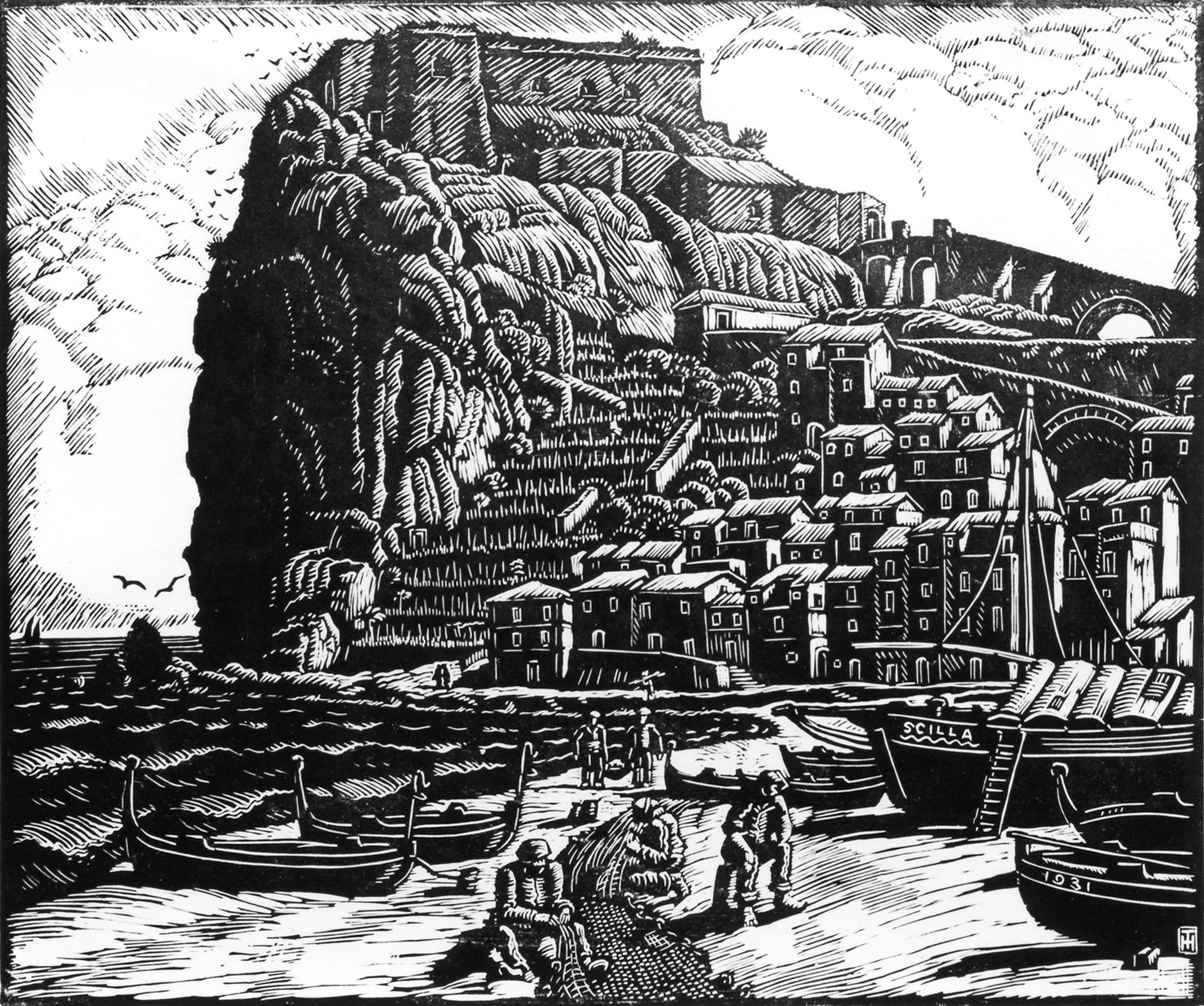
The reference to Scylla carries immense symbolic force because it unites myth with a real geographical place:
the treacherous rock at the entrance to the Strait of Messina, which deceives and destroys sailors.
Clytemnestra is thus assimilated to a hidden Scylla, “lurking” within the house just as Scylla lurks “among the
rocks,” an immobile predator who slaughters those who enter with confidence.
The royal palace thus becomes a deadly passage, and Agamemnon a ship doomed to destruction.
Giuseppe Ribuffo
