
Emily Lowe (Torquay – Torquay, 21 March 1882) was a British writer, a woman of strong and independent character, at
times daring, known for her travel accounts, including the journey she made through Sicily and Calabria in 1859.
The first woman in England to obtain a naval captain’s license and to cross the Mediterranean commanding a 350-ton
yacht, Emily Lowe broke the stereotypes of female travelers of her time: she was neither an intrepid spinster with a parasol,
nor a pilgrim in skirts, nor a picnic pioneer.
In 1859, in London, Emily Lowe anonymously published *Unprotected Females in Sicily, Calabria and on the Top of
Mount Aetna*, the account of a three-month journey through Calabria and Sicily undertaken with her mother, without
an escort and with light luggage, in order to avoid the presence of inconvenient gentlemen.
Fully aware of the uniqueness of her journey, the writer often suggests to the reader that she is a true traveller and not
merely a tourist and, as soon as she landed on the Calabrian shore, exclaimed: “Hurrah for Calabria! A land whose romantic
dangers protect it from the invasion of travellers.”
Although she sometimes fell into the traps of the stereotypes and prejudices that often characterize travel diaries, Emily
Lowe offers a delightful feminine portrait of the region and of the Calabrians of her time, while also highlighting the positive
traits of the society that hosted her.
Lowe arrived in Scilla by stagecoach (postal coach), which crossed Calabria from Reggio to Naples three times a week,
making the journey itself a key to understanding the territory.
Her encounter with a soldier, distinguished by courtesy and a sense of honor, helped dismantle the image of a land dominated
by danger, instead conveying the idea of a Calabria founded on dignity, respect, and hospitality.
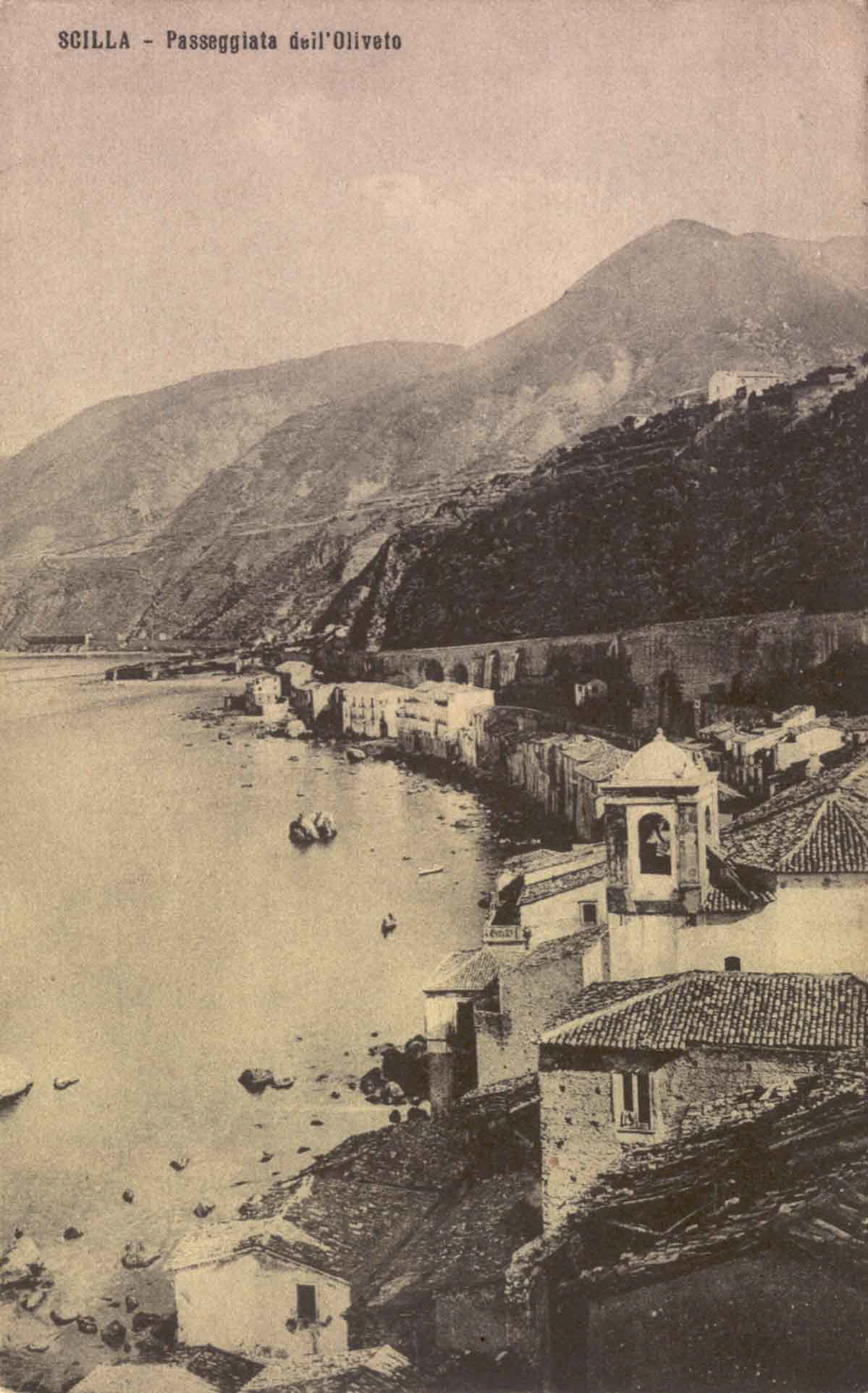
The description of Scilla then rises to a symbolic synthesis of nature and myth: the rock overlooking the Strait, evoked
through solemn imagery and Homeric references, loses its threatening character and emerges as a place of harmony,
beauty, and memory.
The gestures of hospitality and kindness shown by the people of Scilla become signs of a simple and gracious civilization,
reinforcing the idea of a land that remained genuine and unspoiled.
“A soldier carrying arms climbed into the coach, and before entering he carefully arranged his small sword so that it
lay between us, then followed it with his uniform and rank, and was welcomed as a gentleman; and as such he behaved
throughout the journey, making our wishes his law.
Instead of being constrained by the postal service, he placed the
coach, the horses, and the postilions at our disposal.
Thus he gave orders to stop at the most beautiful places so that we might sketch them.
First came Scilla, which looked like a ‘sea eagle,’ with its towering crest and its wings of fortified rock. Its ‘dogs,’ which
Homer said barked so fearfully, were only little rocks gently washed by the calm sea, cradling dolphins where once the
murderous Sirens sang.
While we were sketching, a gentleman came out of a garden to offer us a bouquet of roses, and with that small gesture
revealed a delightful fact: how rarely those places were visited by travellers, something confirmed by the absence of
beggars.
Stromboli rose like a pyramid with its summit cut off.
One after another, the Lipari Islands appeared on the horizon.
The Lighthouse of Messina, the tip of Sicily, with its two lakes, seemed to be striving to touch the coast beneath us, so
narrow was the Strait.
Stretches of mulberry trees, bearing white and black fruit, alternated along the road with vines trained upon tall stone
colonnades, laden with clusters so large that they had to be supported by baskets hanging beneath them, while other
bunches were drying to produce raisins.”
The author’s principal aim is to deconstruct conventional ideas regarding women’s ability to travel, presenting herself as an adventurous and courageous traveller while at the same time remaining romantic and sensitive. The arguments advanced by the author are intended to challenge stereotypes of vulnerability and domesticity associated with her sex and to emphasize female autonomy in the experience of travel.
Giuseppe Ribuffo
