
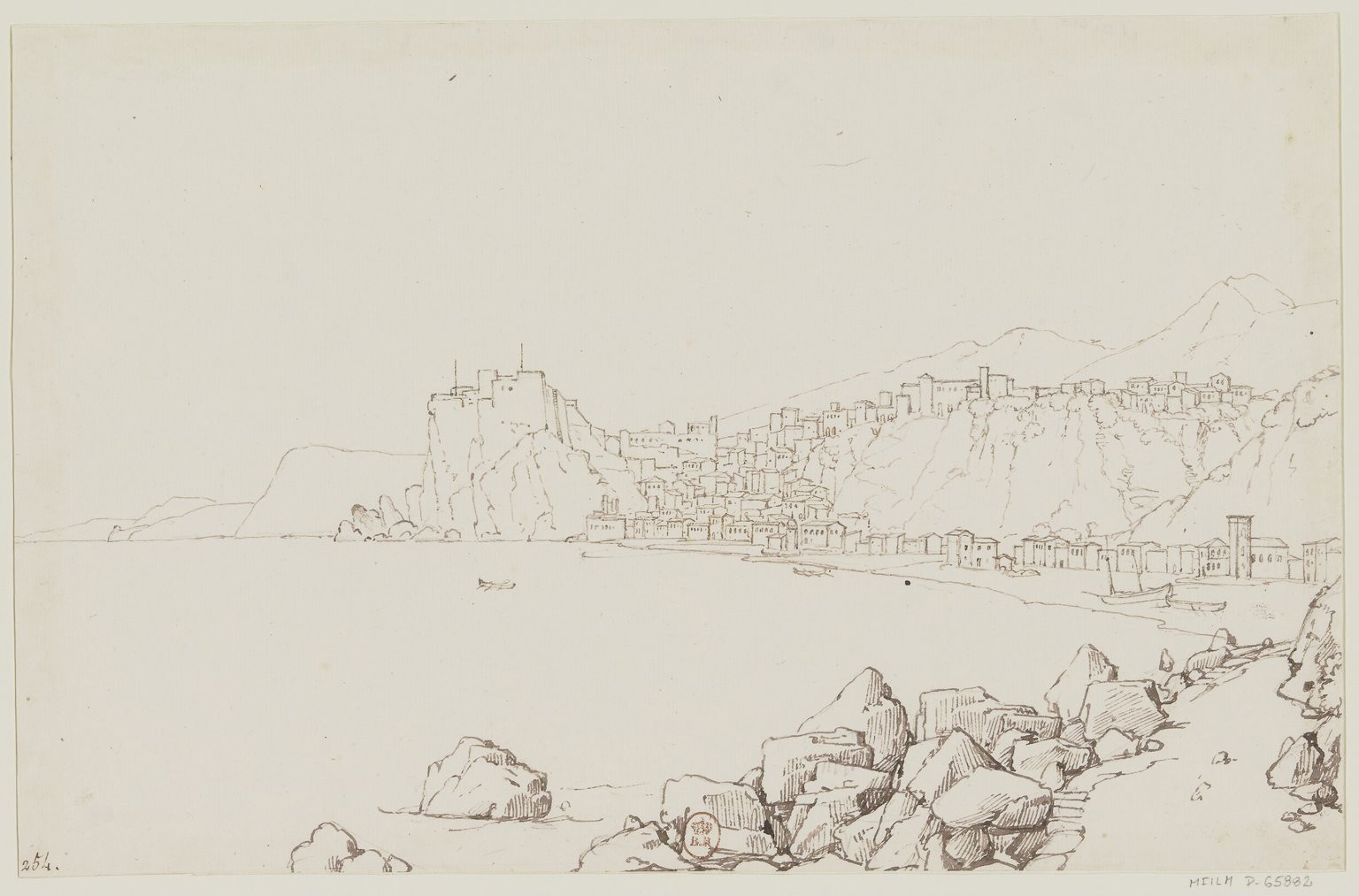
Edward Lear (Highgate, London, 1812 – Sanremo, 1888) was an English illustrator, artist, musician and writer, author of numerous travel diaries, remembered for his natural talent for drawing.
He worked for the Zoological Society and for the British Museum. His art was appreciated by the British royal family, to the extent that he became drawing master to Queen Victoria.
He travelled through regions then considered exotic, such as Greece, Albania, the Ionian Islands and Corsica, publishing diaries enriched with splendid illustrations.
Lear is also remembered for his vast production of limericks, that is, humorous “nonsense” verses, collected in the work A Book of Nonsense (1846), and for his botanical writings and “nonsense” alphabets, which in 1870 he gathered into the book Nonsense Songs, Stories, Botany and Alphabets.
As a naturalist painter, he published an illustrated zoological work dedicated to parrots: Illustrations of the Family of Psittacidae or Parrots.
Towards the end of the 1830s he moved to Rome, from where he began travelling throughout Italy.
In 1847, after visiting Sicily, Lear travelled by ship from Messina to Calabria, undertaking a journey through Calabria Ulteriore II (corresponding to today’s Province of Reggio Calabria).
The expedition, on foot, lasted from 25 July to 5 September and led him, together with his friend John Proby and under the local guidance of Ciccio and his donkey, from one coast to the other.
Travelling up the Ionian coast, Lear completed a circular route which, descending the Tyrrhenian coast along the coastal road in August 1847, brought him to Scilla, where he remained for two days.
His encounter with Scilla deeply impressed him: he was fascinated by the places rich in history and by the evocative landscapes, which occupied his pencil almost throughout his stay.
His memories were collected in Journals of a Landscape Painter in Southern Calabria (“Diary of a Walking Tour”), which represents one of the finest illustrated travel accounts ever produced. In his work, Lear portrays with effective realism landscapes of great beauty, depicted with a wealth of detail in engravings based on sketches or watercolours made during his stay in the town, and recounts scenes of life in a Scilla immersed in the historical context of the Risorgimento.
he uprisings that soon developed into the revolutionary movements affecting the Kingdom of Naples in 1847 forced Lear to interrupt his journey, preventing him from visiting the remaining Calabrian provinces.
27 August 1847
“There is a good road along the entire coast, which prompted us to send ‘Dighi-doghi-dà’ to Scilla and, as we proceeded, we occasionally stopped to make drawings, until we arrived in that town around noon and found a very clean inn on the seashore, right beside the most picturesque rock and castle.
Scilla is one of the most beautiful scenes on this coast, its white houses and the massive rock crowned by a castle standing out in noble relief against the dark blue of the sea waves; while the Lipari Islands and Stromboli, together with the Lighthouse of Messina, form a most beautiful background.
[…] Exploring and drawing Scilla occupied the whole day; but at its end, despite the favourable appearance of our inn, we could get nothing to eat except an old hen that could not be cut with knife and fork, and from this poor food and the compliments of the innkeeper we guessed that the bill would be proportionally high.”
28 August 1847
“A group of numerous onlookers surrounded us while we were drawing the castle this morning. ‘These,’ said an old man while we were very busy, ‘these are all people chosen by their government to gather information about our Kingdom’;
“A group of numerous onlookers surrounded us while we were drawing the castle this morning. ‘These,’ said an old man while we were very busy, ‘these are all people chosen by their government to gather information about our Kingdom’;
During the morning we took a boat to go to the rocks of Scilla, which appeared truly magnificent, rising above the boiling current of foaming dark blue water.
But the sea was too rough for a sailor as poor as I am to allow me to draw, so we returned to the inn, where, at the time of our departure before noon, there was a great dispute over the bill: we were asked for twelve ducats, which we gradually reduced to two before leaving Scilla.”
Giuseppe Ribuffo
