
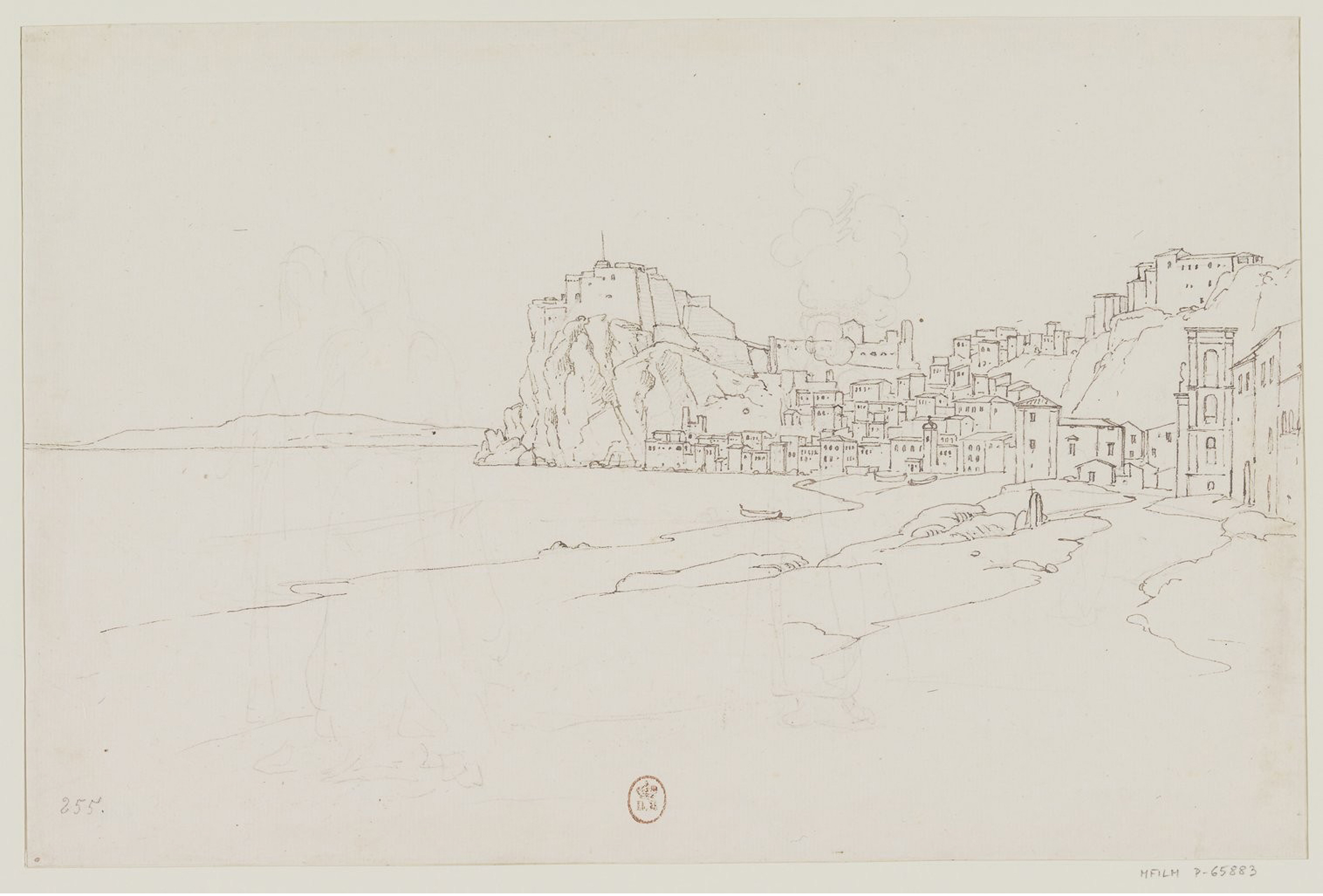
The Mother Church traces its historical origins back to the very dawn of Christianity itself. Scilla, in fact, immediately joined Reggio after the people of Reggio were converted to Christianity by Saint Paul through his preaching.
Tradition holds that the Apostle of the Gentiles landed in Reggio on 21 May of the year 61 AD, giving life to the first Christian community on Italian soil.
Born according to the Greek rite, it was originally dedicated to the Virgin Hodegetria, a title widely used during the Byzantine era and translatable as She Who Shows the Way.
However, already on 5 April 1595, the date marking the beginning of the first Pastoral Visit of the then Archbishop of Reggio, Monsignor Annibale D’Afflitto, the Mother Church appears dedicated to the Blessed Virgin of
the Conception, whose ancient gilded wooden icon stood upon the high altar. Following several earthquakes, particularly the devastating one of 1599, the structural stability of the building was irreparably compromised and a complete reconstruction became necessary.
Thus, also encouraged by Archbishop D’Afflitto, who desired that sacred buildings should reflect the Latin rite in their structural composition, work began on the construction of the new church.
Financed by Princess Giovanna Ruffo and by the University (Municipality) of Scilla, with the free collaboration of the people of Scilla in transporting the materials, by the middle of the 17th century the most beautiful church ever built in Calabria arose! This new sacred building, in the style of that century, was in the shape of a Latin cross and divided into three naves. The central nave was separated from the lateral ones by sixteen large columns of Carrara marble. The cornice above was also made of marble.
At the centre of the crossing rose a magnificent dome. In the two side aisles there were three altars on each side, and at the end of the central nave stood the majestic High Altar surmounted by a marble sculpture of the Virgin Mary, flanked on either side by marble angels kneeling in an attitude of veneration.
This building remained standing in all its splendour until 5 February 1783, the date of the terrible earthquake which caused, among other things, the collapse of the magnificent Temple.
Rebuilt, in 1813, during the French occupation, it was demolished by order of General Manhès. The site was used to place an artillery battery.
In 1816, with contributions from the faithful and the Municipality, a church entirely made of wood was built. Finally, in 1825 work began on the construction of the new building, which was inaugurated in 1868 and remained intact, in all its splendour, until the earthquake of 16 November 1894.
The tremors caused the collapse of the upper part of the two bell towers on the façade and the collapse of the four small domes that formed the roof of the building.
During the restoration works, the bell towers were lowered and the roof was rebuilt in wood.
At the beginning of the 20th century it was artistically painted and frescoed at the initiative of Canon Giovanni Minasi by the renowned Professor Capri of the Neapolitan school.
The disastrous dawn of 28 December 1908, however, marked the destruction of the church.
The tremors caused the collapse of the walls, the upper part of the façade and the bell towers. Only the presbytery remained standing. It was repaired with wooden wall structures and the roof was covered with sheet metal. By then deteriorated, it was decided to rebuild it at the will of the then Archpriest Santo Bergamo.
The Central Pontifical Commission for Sacred Art indicated, on 23 January 1948, the Roman architect Francesco Leone. The structure was completely demolished and, with it, the ancient crypt.
On 14 June 1958, during a solemn ceremony attended by the Archbishop, Monsignor Giovanni Ferro, and the principal civil and military authorities, the foundation stone was laid. Though not entirely completed, the church was reopened for worship on 8 December 1964 and consecrated by Monsignor Santo Bergamo on 1 February 1970.
The Eucharistic Altar was created using the frontal and side panels of what had been the high altar of the destroyed convent of the Observant Fathers. A true jewel of 17th-century marble inlay work. The church was completely bare, devoid of any artistic decoration.
In the mid-1980s a large mosaic depicting the Virgin Mary was installed to cover the wall of the presbytery, and in the mid-1990s work began on its artistic embellishment.
The archpriest of the time, Don Mimmo Marturano, taking advantage of the basilica layout of the building, opted for a style echoing Romanesque architecture. The church has three naves, with the central one separated from the side aisles by Romanesque columns featuring two pilasters at the front and back and two semi-columns at the sides.
The large openings of the matronea in the transept are closed by triple-light windows. The roof of the central nave is entirely clad in wood.
In the presbytery, the pillars are adorned with icons of the Saints venerated in Scilla and with symbolic ornaments.
The bases are covered with decorated marbles recalling the small columns of the altar, thus forming a sort of canopy above it.Within five triple-light windows set into the wall of the left nave are enclosed the fifteen Stations of the Cross.
The entrance is divided into three spaces by three arches and two areas recalling the triple-light windows of the transept.
n the left area is the Chapel of Penance, enriched by the ancient statues of Christ on the Cross, the Dead Christ and Our Lady of Sorrows, which are carried in procession on Good Friday.
In the central area are the two large shell-shaped marble holy water fonts that belonged to the ancient temple. In the right area stands the marble statue of the Immaculate Conception.
Originally placed on the high altar, this valuable work was commissioned by Princess Maria Ruffo from the Spanish artist resident in Naples, Giovan Battista Ortega, in 1608.
The statue rests upon the column that once formed the base of the ancient marble pulpit.
Beside it, resting on restored ancient marbles, stands one of the two ancient angels originally placed to the right and left of the Virgin Mary on the ancient high altar.
The Chapel of the Blessed Sacrament stylistically recalls the Byzantine crypt which, according to historical records, served as the first church of the community of Scilla.
Inside it is housed the Madonna della Porta (Virgin Hodegetria), which belonged to that building and dates back to the 15th century. The altar and the Tabernacle are composed of restored ancient marbles.
Dottor Rocco Panuccio
