
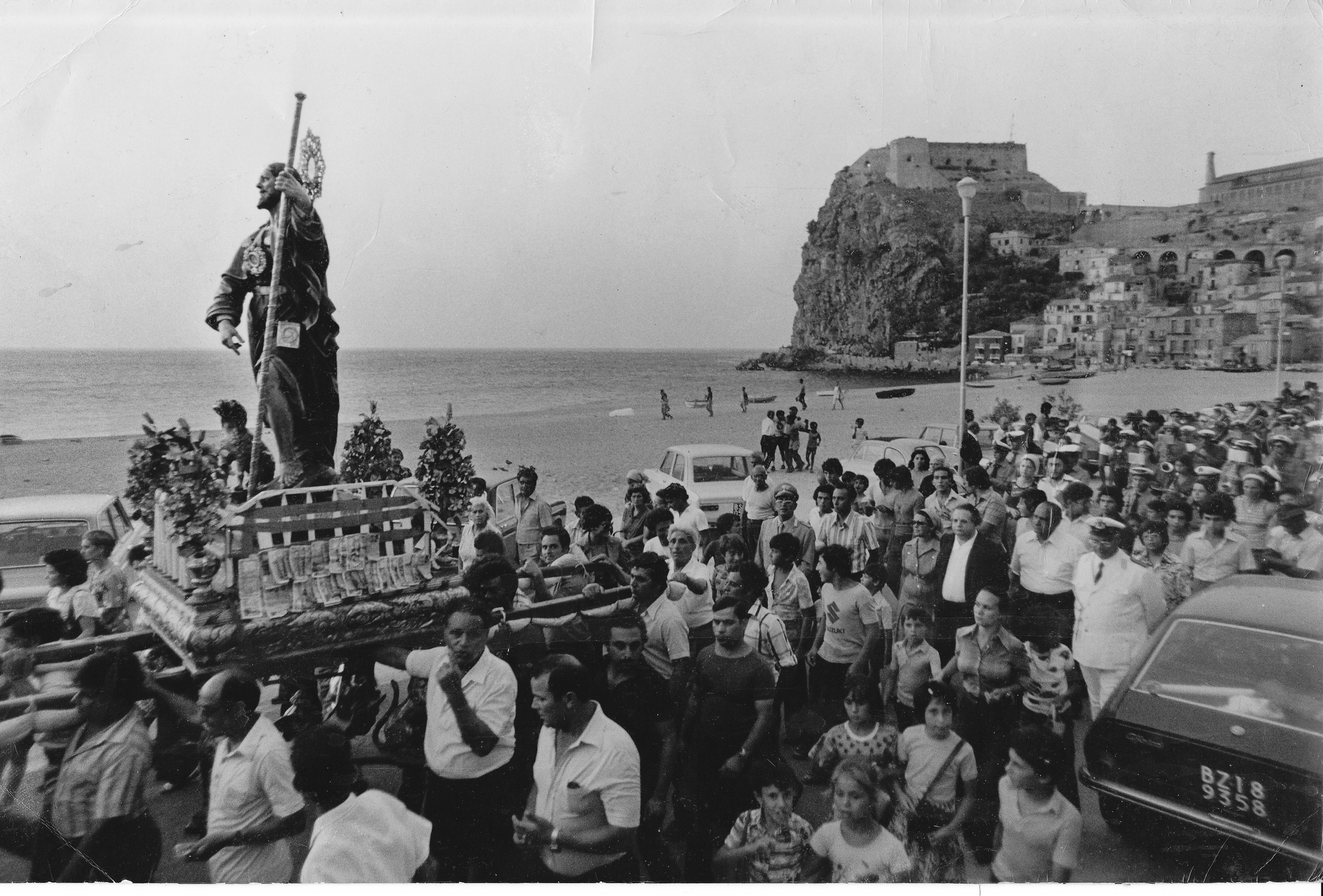
The origins of the Church of San Rocco coincide with the introduction of his cult in Scilla.
Between the end of the fifteenth century and the beginning of the sixteenth century, after surviving a terrible
plague epidemic, the people of Scilla, thanks to their commercial relations with Venice, became aware of the
presence in the Venetian city of the mortal remains of Saint Roch, the patron saint against the plague, identifying
him as the intercessor who had saved Scilla from the dreadful scourge.
It was precisely this conviction that led the people of Scilla to introduce the cult of the saint by building a church
in his honor on the site where the patronal church still stands today.
The oldest documents attesting to the existence of the Church of San Rocco in Scilla are the records written by
Monsignor Annibale D’Afflitto, Archbishop of Reggio, relating to his first pastoral visit to the diocese in 1594,
when, among other churches, he visited that of San Rocco.
A confraternity dedicated to the saint was also present there: “est Confraternitas sub vocabulo S. Rochi”.
The records contain no expressions such as nuper fundata or nuper erecta, which were used to indicate recently
built churches. Furthermore, thanks to these same records, we know that at the time the priest Antonio
Romano served as chaplain of both the church and the confraternity.
In 1738 work began on the construction of a new church, which was completed in 1751.
Devotion to the patron saint grew so greatly that, beginning in 1862, the people of Scilla decided to demolish
almost half of the old church, enlarging it and giving it more elegant architectural forms, decorating it with
stuccoes and marbles.
At dawn on 28 December 1908, a terrible earthquake struck, among other buildings, the beloved patronal church,
destroying its façade and roof.
The apse and perimeter walls remained standing, and the building was hastily restored by reconstructing the
roof entirely in wood and the façade, greatly lowered in height, in cement, lime, and wood, with two small bell
towers, one of which had a clock on the main façade.
By the mid-1970s, however, the structure was in poor condition, and it became clear that restoration and reconstruction
were necessary.
In 1973 a fundraising committee was established in Port Chester among the people of Scilla living there, and in
1974 another was created in Scilla itself. The archpriest at the time was Don Andrea Cassone, and the mayor
was Professor Giuseppe Vita.
A third committee was later formed in Toronto, Canada.
The committee’s task was to support and collaborate fully with the technical office of the Archdiocesan Curia,
while also applying political pressure to obtain funding and overcome bureaucratic difficulties with government
offices (Civil Engineering Department, Public Works Authority, and Ministry of Public Works). But let us take a
step back.
In 1953, the archpriest of the time, Santo Bergamo, submitted a claim for war damages through the Curia’s
technical office, supported by an assessment estimating the required amount at 10,000 lire.
Subsequently, this sum, deemed insufficient for the project, was increased in 1976 to 68 million lire by the Civil
Engineering Department following an inspection that revealed the worsening condition of the building over
time.
The following year (1977), Archbishop Monsignor Ferro proposed reallocating funds from other churches within
the diocese in the amount of 37 million lire, bringing the total available funds to 105 million.
The work was entrusted by the Archdiocesan Curia to the Pizzonia company, which began construction on 8
July 1980.
The turning point came with the appointment of Don Mimmo Marturano as Archpriest of Scilla in 1983.
After the Pizzonia company went bankrupt, the work was entrusted to the Scilla-based firm Socedil of Filippo
Martello. Thanks to a public fundraising campaign, renewed contacts with overseas committees and government
offices, constant dissemination of information through the parish bulletin, and the generosity of the people,
the work proceeded rapidly.
On 16 August 1990, in the presence of the principal civil and military authorities, His Excellency Monsignor
Aurelio Sorrentino consecrated the new Eucharistic Altar, and the Church of San Rocco was reopened for worship.
Today the church stands in all its splendor.
The magnificent wooden entrance door was created by the Focà brothers in 1885.
The structure, built in the Neoclassical style, consists of a single nave.
On either side of the entrance door are placed two of the four large paintings that once belonged to the Convent
of the Observant Fathers, destroyed in 1783.
The side walls are divided into eight large niches. Starting from the entrance, the first two contain the side
access doors; the four central niches house four side altars; and the last two contain the confessional on the
right and the organ on the left.
Mounted on the pilasters are the fourteen seventeenth-century Stations of the Cross paintings.
The nave ceiling, entirely rebuilt during the restoration works, is barrel-vaulted and decorated following the
style of the original presbytery ceiling.
It contains four painted roundels depicting the patron saints of churches that once stood in the area surrounding
the present patronal church: Saint George, Saint Sebastian, Saint Marcellinus, and Saint Aloysius Gonzaga.
One of the four side altars contains, within a stucco-decorated niche, a small wooden statue of the Immaculate
Virgin.
The statue can be attributed to the eighteenth-century Neapolitan artistic tradition and, adorned with a silver
crown and halo of stars, wears a wig made of real hair.
The floor, made of polychrome marble, is richly decorated with floral motifs interspersed with large rosettes.
The presbytery, raised two steps above the nave, contains on the left a marble ambo featuring finely decorated
balustrades on its two sides.
At the center stands the Eucharistic Altar, whose bronze frontal high-relief depicting the Last Supper was created
in 1990 by Carmelo Barbaro.
On either side of the presbytery are the other two large paintings that once belonged to the Convent of the
Observant Fathers.
In the background stands the majestic high altar (1872).
Entirely made of marble and in the Neoclassical style, it is surmounted by the niche housing the ancient marble
statue of Saint Roch, dating to the first half of the sixteenth century and attributed to the artist Giovan Battista
Mazzolo.
Dottor Rocco Panuccio
