
Alessandro Manzoni (Milan, 1785 – 1873), writer, poet and playwright among the greatest figures of Italian literature, is considered the father of the modern Italian language. His novel The Betrothed (1827), set in seventeenth-century Lombardy, is not only one of the masterpieces of Italian literature, but also the first great example of the modern Italian historical novel. Manzoni was one of the leading figures of Italian Romanticism and, through his works, helped shape the cultural and national identity of Italy. Among his most important historical works is the History of the Infamous Column (1840), dedicated to the events of the plague of Milan in 1630. Alongside his literary production, Manzoni also travelled extensively throughout Italy, where he drew inspiration from landscapes, monuments and historical places. Among his journeys, there is evidence of a trip to Calabria and Sicily. During this journey, the writer crossed the Strait of Messina and reached Scilla, where he devoted a passage to the observation of the place. Through a language rich in metaphor, historical references and personal reflections, he describes a territory suspended between myth and reality, but also a place characterised by strategic value, a dual dimension of sea and mountain.The sea, the imposing cliffs and the currents of the Strait become symbols of a landscape in which nature and history are deeply intertwined.The passages dedicated to Scilla are among the earliest modern literary testimonies to narrate the town through a direct and personal gaze, highlighting not only its environmental beauty but also its role in the imagination of the Mediterranean and in the cultural memory of Southern Italy. The reference to the mythological and geographical Scylla contributes, therefore, to reinforcing the identity and universal significance of this place. In Manzoni’s vision, the “myth” is transformed from a sea monster into a symbol of a city that has always known how to preserve its prestige in the imagination of the ancient world and of Mediterranean civilisation.
“From the Alps to the Pyramids,
from the Manzanares to the Rhine,
of that swift lightning
he followed the course from flash to flash;
it burst from Scylla to the Don,
from one sea to the other.
Was it true glory? To posterity
belongs the arduous judgment: we
bow our foreheads before the Supreme
Maker, who willed in him
to imprint a vaster trace
of His creative spirit.
The stormy and eager
joy of a grand design,
the longing of a heart that serves
restlessly, thinking of a kingdom;
and he attains it, and receives a reward
that it had been madness to hope for;
he experienced everything: the greater glory
after the peril,
flight and victory,
the throne and sorrowful exile;
twice in the dust,
twice upon the altar.”
From the Alps (campaign of Italy, 1796) to the Pyramids (campaign of Egypt, 1798), from the Manzanares (during the Spanish campaign of 1808) to the Rhine (during the German campaigns), the actions of Napoleon’s armies followed one another with astonishing speed. The poet traces an ideal route through the places made famous by the Emperor’s military exploits: the impetuous crossing of the Alps (where he reached Italy after defeating the Austrians), the victories in Egypt, the conquest of Madrid and the triumphs in Central Europe, all the way to the battles that marked the end of his future greatness. “It burst from Scylla to the Tanai (the Don River, in the campaigns of Russia in 1812), from one sea to the other” (The Betrothed): a sea or “Tanai” (Metaphor) and another sea (“Atlantic”).
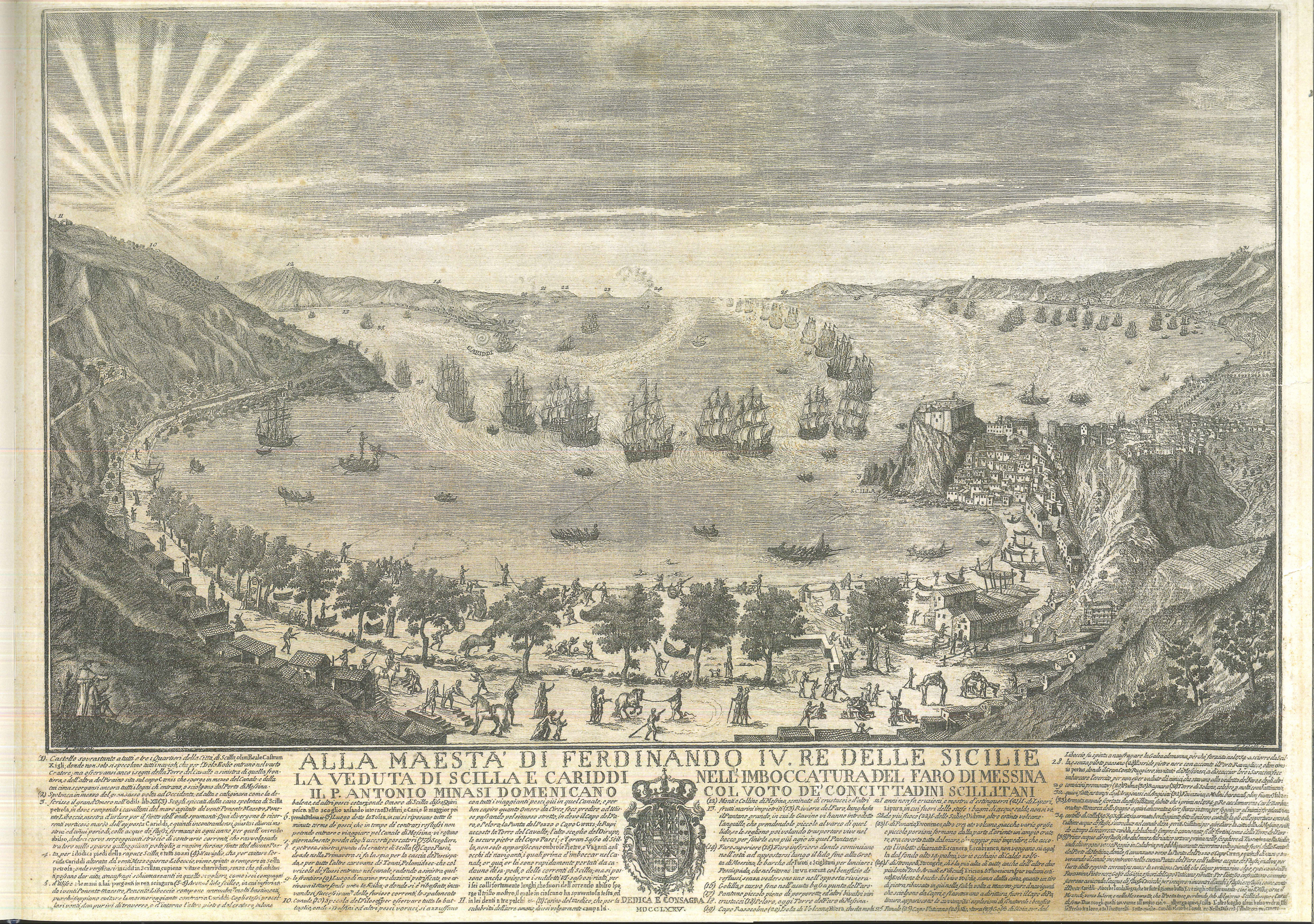
Scilla is highlighted by Manzoni in one of his most famous verses to emphasize the extension and scope of Napoleon’s military campaigns, connecting one extreme of Europe to the other.The expansion of the French army reached Scilla, establishing itself within its castle, where it encountered a natural and strategic barrier: the Strait. Despite repeated attempts by Napoleon, it marked the insurmountable limit of French expansion, preventing the passage toward the Faro, Messina and Sicily, which remained firmly under British control.
Giuseppe Ribuffo
