
Torquato Tasso (Sorrento, 11 March 1544 – Rome, 25 April 1595) was an Italian poet, writer and playwright,
recognized as one of the greatest authors of Italian literature; he worked at the Este court in Ferrara.
A tormented figure, he was a perfect representative of the complex period of the Catholic Counter-Reformation.
Emblematic of this controversial age is the genesis of his most important work, as well as one of the masterpieces
of Italian literature: Jerusalem Delivered (1581), an epic-heroic poem in ottava rima, dedicated to
the capture of Jerusalem by the Christians during the First Crusade (1096–1099).
The work contributed decisively to shaping the image of the First Crusade in the collective imagination. The
story recounts the final year of the Crusaders’ stay in the Holy Land and the final siege of the city of Jerusalem,
which ends with the conquest of the Holy Sepulchre by Godfrey of Bouillon, appointed commander of the
Christian forces.
The literary genre belongs to the tradition of the chivalric epic poem of the 15th and 16th centuries.
The work
circulated within the circles of the Este court in Ferrara before publication and enjoyed great success, but it
was also the subject of severe criticism for its innovative elements and for the space devoted to the romantic
idylls contained in the plot; these reactions, together with the cultural climate of the Counter-Reformation, led
the author to undertake a profound and troubled revision of the work.
Jerusalem Conquered, published in 1593, constitutes the final result of this revision. Driven by the desire to
bring the poem into conformity with the dictates and rigor of the Counter-Reformation, Tasso reworked the
poem, softening the love scenes and elevating the religious and epic tone of the narrative: in it, the passionate
elements are drastically reduced, raising the holy war to the dominant principle and inspiration of every event,
thus giving the work an eminently spiritual and moral character.
Within Jerusalem Delivered, Canto III plays a fundamental role in the epic construction: here Tasso shows the
Christian army gathering, organizing itself, and preparing for the great undertaking.It is the moment when the
multitude becomes a people, and the people become an instrument of Providence. It is within this context that
the passage concerning Scilla is framed:
“Golden helmets they bore, and golden mail,
and azure and white colours upon their arms.
Nor did those of Cefalù remain behind,
nor were those of Messina weary in war,
or those of Catania, where learning has its home,
or of Sperlinga, at last compassionate to the Franks,
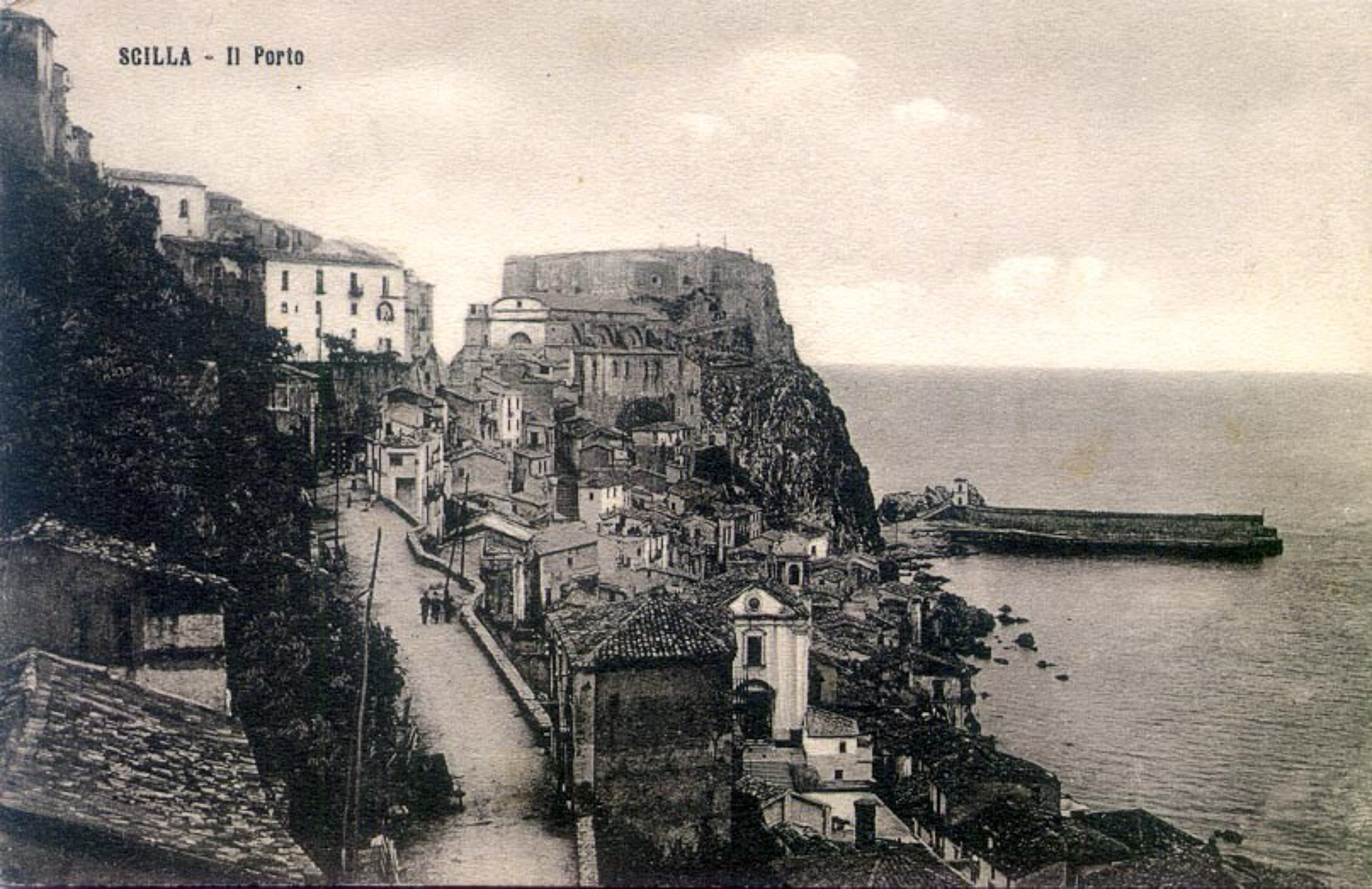
or those who dwelt near Charybdis and Scylla,
or Etna, which still burns and flashes.”
In this canto, the figure of Godfrey of Bouillon clearly emerges, embodying the model of the Christian leader:
not an impetuous hero, but a just and balanced commander, guided by faith and reason.
Around him is assembled a multitude of warriors from different regions of the Christian world, testifying to
how every land offers warriors shaped by its own history and nature, whom Tasso presents through a solemn
and extensive review typical of great epic poetry.
It is precisely in this review that the poet mentions Sicily and its men, emphasizing how all take part in the enterprise
without hesitation: from the men of Cefalù and Messina, strong and tireless, to those of Catania, city
of learning, and Sperlinga, remembered for its ancient compassion toward the Franks, while evoking powerful
images such as Mount Etna in flames and the strait dominated by the myths of Scylla and Charybdis.
The presence of Scilla assumes a profoundly symbolic value: it is not merely a geographical reference, but an
evocation of an ancient and dangerous world in which the sea represents instability, continual threat and the
ultimate trial.
The warriors who live “near Scylla” are men raised in contact with danger and with the untamed force of nature
and, for this very reason, they appear hardened, strong and capable of facing war with courage.
Through
Scilla, Tasso performs a poetic operation of great significance: he recovers the pagan myth and inserts it into
Christian epic, transforming it.
What in antiquity was a symbol of terror and destruction now becomes a disciplined force placed at the service
of a sacred cause.
The classical world is not erased, but absorbed and redirected, just as the different peoples of the army are ordered
under a single command and a single purpose.
Canto III, therefore, is not merely a descriptive moment, but an essential passage of the poem, for it shows the
birth of a collective harmony that precedes the battle.
Giuseppe Ribuffo
