
Richard Keppel Craven (Coombe Abbey, 1 June 1779 – Naples, 24 June 1851), son of the Baron of Craven and the daughter of the Earl of Berkeley, after his studies at Harrow School, moved with his mother to Naples in 1806, later settling near Salerno, where he purchased a convent that became a destination for English men of letters and travellers.
The young man devoted himself entirely to his passions: antiquities, history, drawing, and travel, interests that emerge in works such as Italian Scenes: Series of Interesting Delineations of Remarkable Views and of Celebrated Remains of Antiquity (1825) and Excursions in the Abruzzi and Northern Provinces of Naples (1838).
It is, however, with Travels through the Southern Provinces of the Kingdom of Naples (1821) that these inclinations find their fullest expression, certainly one of the richest and most important works of travel literature on Southern Italy.
The picture is made even more effective by Craven’s culture and remarkable powers of observation, and he also deserves credit for following itineraries often neglected, travelling through Campania, Basilicata, Apulia, and Calabria.
Between impressions inspired by the landscape and references to the mythical memory of the place, between thoughtful reflections on socio-economic conditions and lively observations on local customs, Craven’s book offers us a vivid portrait of life in Scilla during the early nineteenth century; showing how the town is not only the setting of those rugged natural beauties that over time generated the ancient legends which fixed it in the collective imagination, but also a hospitable, industrious community deeply connected to its own resources.
Fishing and the sea are at the heart of the local economy: the men are skilled sailors and fishermen, and swordfish is a precious resource that has supported the livelihood of the population since time immemorial.
At the same time, silk production involved the women, filling homes and gardens with an activity that was a source of income and pride, and a cornerstone of the maritime trade of Scilla’s seafaring community.
This connection between territory, economic activity, and daily life makes Scilla an example of balance between the natural environment and human activity: the community lives from the sea and the land, preserving ancient traditions that define its identity.
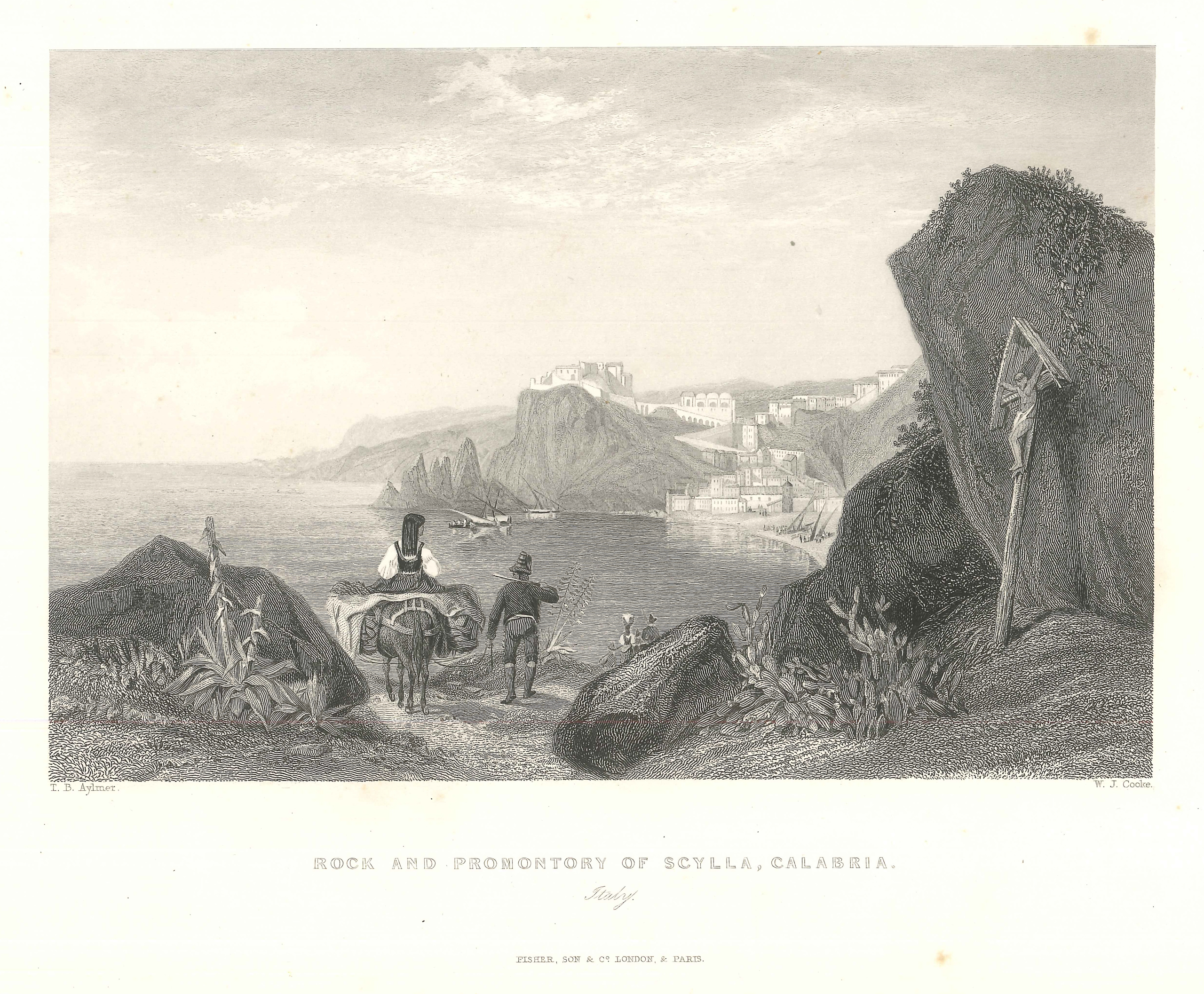
“From the north I followed the beach, […] as far as the village of Favazzina, […] where the road again climbs the mountainside to reach Scilla, which presents itself to view in the most picturesque manner.
It is built in terraces rising from the shore on either side of a promontory embellished and fortified by a castle standing upon its summit. This was once the residence of the Prince of Scilla.
It is now a modern fortress occupied by a small garrison.
Beneath this steep promontory, another lower rock stretches its fantastic masses towards the coast of Sicily and may, when lashed by foaming waves, present a threatening appearance to small vessels venturing too close.
But surrounded as it was by countless fishing boats, scarcely lifted by the gentle undulations of a perfectly transparent sea, it presented an imposing aspect amidst the general beauty of the scene. It would be useless to inquire into the causes that have stripped this celebrated rock of all its terrors.
Among these, the recurrent earthquakes alone would sufficiently explain the alterations in its form, which may have diminished the dangers it once posed to navigators.
If modern Scilla stands on the site of the ancient one, Charybdis must necessarily have changed its position, now lying just outside the harbour of Messina, about fourteen miles away.
I am more inclined to believe that Cape Pelorus, now Punta Faro, formerly lay farther to the north-east.
Therefore, with Scilla situated precisely at the entrance and narrowest part of the strait, the passage was extremely dangerous in bad weather.
During the summer, a strong breeze generally blows through the Strait and the sea is very rough.
These circumstances, together with the variations of the many currents near the cape, must have constituted the dangers for ships attempting to avoid the hazards of the Calabrian shores by steering too close to the opposite side.
The houses of Scilla are well built, but the ground is very slippery for horses and forced me to dismount while making my way through the winding streets leading to the upper part of the town, where I found the only stable.
Its five thousand inhabitants are remarkable for their good appearance, cleanliness, and industriousness.
The men are good sailors, devoted chiefly to fishing or silk production, and the various occupations in which the women are engaged regarding this product give a lively and picturesque appearance to all the dwellings along this coast, where silk is the principal source of income.
It is not uncommon to see boilers and winding frames beneath an arch of roses, and nearly every garden entrance is shaded by vines, while lively groups of beautiful girls fill the air with wild and harmonious songs, like all those of Southern Europe. Moreover, I have never seen any town so well supplied with fountains as Scilla, where there is one every few yards.
While my horses rested, I was kindly received in the house of the steward of the Prince of Scilla, whose wife, in less than ten minutes, set before me a meal made all the more appetising by fatigue and heat.
It consisted of eggs, macaroni, and swordfish, fresh almonds, watermelon, cherries, strawberries, and was accompanied by excellent wine cooled with snow from Aspromonte.
The swordfish, called xiphios by the Greeks, is caught in great quantities, as in the time of Strabo, who has left us a description of its capture that could correspond to the present method.
Its flesh resembles that of sturgeon, though drier; like tuna, its different parts vary in flavour and are therefore held in differing esteem.
Among the many dreadful effects produced by the earthquake of 1783, there is none so terrible and horrifying as that which caused the death of four thousand people who had gathered together with their prince in the hour of danger, as around a father and protector.
[…] The shock which on 5 February struck this entire stretch of the Calabrian coast was extremely tragic for the town of Scilla and levelled most of the houses situated in the upper part of the town.”
Giuseppe Ribuffo
