
Nonnus of Panopolis (Panopolis, Egypt ... – ...; fl. 5th century AD) was a Greek poet who probably lived during the first half of the fifth century and is universally recognized as the last representative of Hellenistic literature.
It is not known whether he was born a pagan and later converted to Christianity in adulthood, or whether, on the contrary, he was born Christian and chose to embrace paganism; the hypothesis of a conversion rests on no certain foundation, but derives from the fact that he wrote works of different inspiration: the Paraphrase of the Gospel of John, clearly Christian in character, and the Dionysiaca, his pagan masterpiece.
The Dionysiaca is a poem in 48 books composed in hexameter verse and represents one of the longest epic poems in world literature, with more than 20,000 lines.
The work recounts the victorious expedition of the god Dionysus to India against King Deriades.
In Book 42, placed in the final part of the work, the author temporarily interrupts the main narrative in order to create a digression centred on the amorous and mythological adventures of the god.
This section, traditionally known as the “epyllion of Beroe,” recounts the love between Dionysus and the nymph Beroe and is linked to the foundation myths of the city of Beirut (Lebanon), the poet’s homeland.
Within this digression, Nonnus of Panopolis also provides one of the many myths connected with the foundation of the city of Scilla and its rock, intertwining love, myth, and geography in a narrative rich in literary and symbolic suggestions.
“Taking up the very nets of your father Adonis,
I shall spread the bed of my sister Aphrodite.
What worthy gifts will Earthshaker bring you?
Will the salty water receive you as your wedding gift,
or will he spread for you, like Poseidon’s marine cloaks,
the skins of seals breathing the pungent odour of the sea?
Do not accept sealskins.
I shall offer Bacchants as handmaids
and Satyrs as attendants to your bridal chamber.
Accept also as my wedding gift the fruit of the vine,
and if, as the daughter of Adonis,
you desire a swift spear, you have the thyrsus which is my staff:
leave aside the point of the trident.
Flee, my dear, the crashing voice of the sea that resounds without ceasing,
Beside another Amymone the dark-haired god lay,
but after their union the woman became the spring that bears her name;
he slept with Scylla and made her a sea rock; he pursued Asteria,
and she became a deserted island;
he rooted the virgin Euboea in the sea.”
In this passage, Nonnus of Panopolis constructs a long persuasive speech in which Dionysus attempts to draw Beroe (Beirut), daughter of Aphrodite and Adonis, away from the love of Poseidon, who is presented not as a source of fruitful union but as a destructive force.
The tone is that of a mock nuptial praise that turns into a warning: the god of the sea does not bestow love, but drags women toward a destiny of transformation and annihilation.
To demonstrate this, Dionysus recalls a series of female figures who, after uniting with Poseidon, lost their human identity.
It is within this context that Scylla appears, evoked as an emblematic example of what happens to those who yield to the destructive eros of Poseidon.
Through the words of Dionysus, the author conveys one of the myths connected to the foundation of the city of Scilla, according to which it was born from the simultaneously loving and fatal union between Poseidon, god of the sea, and a young mortal maiden named Scylla.
Overwhelmed by an uncontrollable desire, the god united himself with her, forever shattering the maiden’s human existence.
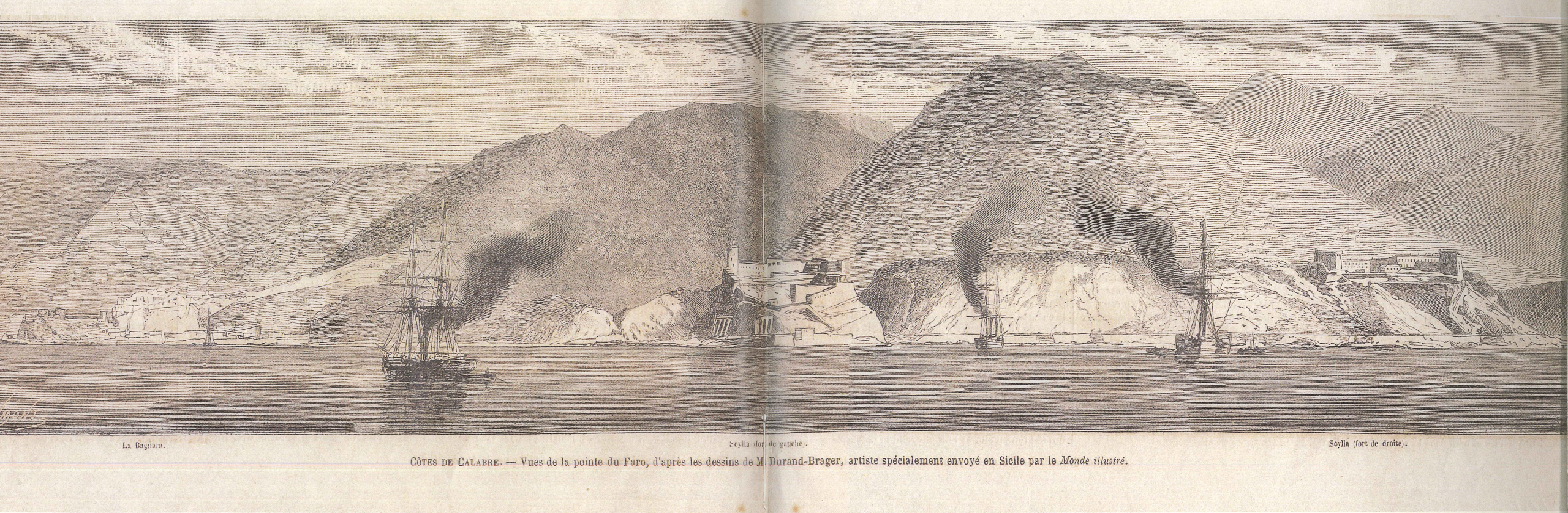
From that cruel encounter no offspring emerged, but rather a destiny-marked metamorphosis: the young woman was deprived of her human form and transformed into a lofty sea rock, the very one that still bears her name today, standing stern and upright at the entrance to the Strait of Messina.
After millennia, it silently preserves the memory of that tragic union, reflected in the harsh and solemn profile of its coast, condemned to remain motionless amid the waters that had betrayed her.
The myth transfigures the relationship between the force of the sea, represented by Poseidon, and the Rock of Scilla, against which it crashes without ceasing.
The violence of the god is symbolically reflected in the continual impact of the waves, which strike the rock with relentless force, renewing through time the original act.
In this dualism between the power of the sea and the immobility of the rock, the legend takes shape: Scylla becomes the point where the fury of Poseidon still manifests itself today, generating a powerful image that unites myth and reality and explains, in symbolic terms, the harshness and impetuosity of the waters surrounding it, which gave rise to the legends connected with the difficult crossing of the Strait of Messina.
Nonnus of Panopolis thus indissolubly links the destiny of the maiden to the place: the myth explains the shape of the world, and the world confirms the myth.
Scylla is not merely a poetic memory, but a concrete presence: a rock emerging from the sea to which the town is clinging, the eternal sign of a marine eros that does not embrace, but petrifies.
In this sense, the myth preserves a core of truth: because what Poseidon did to Scylla is still visible to the eyes of humankind.
Giuseppe Ribuffo
