
Napoleon Bonaparte (Ajaccio, 15 August 1769 – Saint Helena, 5 May 1821) was a French statesman and military
leader, founder of the First French Empire and the central figure of the first phase of modern European
history, known as the Napoleonic Age.
His figure inspired generations of artists, writers, musicians, politicians, and historians.
Born in Corsica to a family of minor Italian nobility, he studied in France, where he became an artillery officer
and later a general during the French Revolution.
Having gained prestige through his victories in the First Italian Campaign, he seized power in France following
the coup d’état of 1799. He served as First Consul from 1799 to 1804 and as Emperor of the French, under the
name Napoleon I, from 1804 to 1814 and again in 1815. He was also President of the Italian Republic from
1802 to 1805 and King of Italy from 1805 to 1814.
A great military commander and protagonist of more than twenty years of campaigns across Europe, Napoleon
is regarded as one of the greatest strategists in history. Through a system of alliances and brilliant victories
over the European powers, he conquered and ruled much of continental Europe, controlling numerous kingdoms
through loyal figures such as his brother Joseph Bonaparte and later Joachim Murat in the Kingdom of
Naples.
The disastrous Russian Campaign of 1812 marked the decline of his European domination. Defeated by the allied
powers at the Battle of Leipzig in 1813, he abdicated in 1814 and was exiled to the Island of Elba. In March
1815 he escaped, landed near Antibes, and returned to Paris, reclaiming power during the period known as the
Hundred Days, until his final defeat at the Battle of Waterloo in 1815. He spent his remaining years in exile on
the island of Saint Helena, under British supervision. Following his downfall, the Congress of Vienna restored
the pre-Napoleonic monarchies throughout Europe, ushering in the period known as the Restoration.
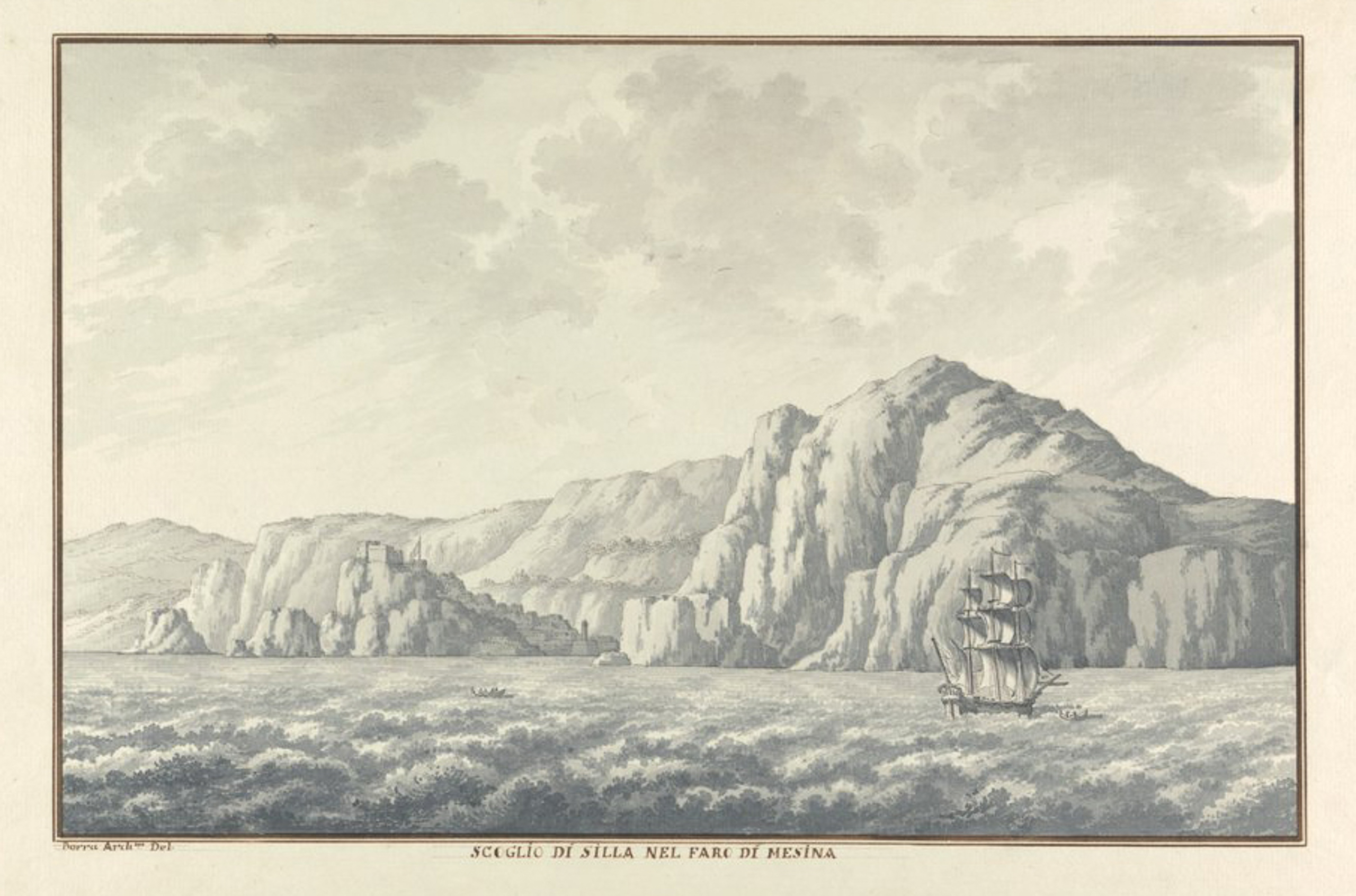
The French occupation of Scilla must be understood within the broader context of the French Decade (1806–
1815) in the Kingdom of Naples, during Napoleon’s military campaigns across Europe.
After the French invasion of the Kingdom of Naples in 1806, led by Marshal Masséna, the Bourbon monarchy
took refuge in Sicily under the protection of the British fleet. Scilla, with its castle strategically positioned on
the Strait of Messina, represented a key military stronghold.
Although the French occupied most of Calabria in 1806, the Castle of Scilla, defended by British forces and
Bourbon loyalists, remained unconquered for a considerable period. The first French capture of the fortress
dates back to the spring of 1806, when, after occupying Scilla, they established themselves within the stronghold,
which, together with Amantea and Crotone, represented a crucial point in the defensive network of the
region.
The French were subsequently attacked by overwhelming British forces and, after twenty-three days of fierce
resistance, were forced to abandon the fortress on 16 July.
The setback greatly angered Emperor Napoleon Bonaparte, who, in a letter dated 7 February 1808 addressed
to his brother Joseph, then King of Naples (1806–1808), described Scilla as:
“the most important point in the world,”recognizing both the town and its castle as assets of fundamental
strategic importance and urging his brother to act without delay to recapture them, since their continued loss
appeared to jeopardize every plan for the conquest of Sicily.
“Once Corfu has been secured, you will send a very discreet man to Admiral Ganteaume to inform him whether
you intend to have him appear off Reggio.
Tell him to present himself off Catania and Reggio in order to protect
the landing of seven or eight thousand men who would occupy the Faro, establish a battery there, and seize the
suburbs of Messina.
From that moment, the conquest of Sicily would be assured, as you could direct your forces
to Reggio and reinforce the expedition departing from there with up to fifteen thousand men.
This plan is based
upon the assumption that you control Scilla, the most important point in the world.
you do not control Scilla,
everything becomes impossible, and Sicily will be lost through your fault.”
A decisive role in the delicate phase of the French reconquest of the fortress was played by General Reynier,
who, after a difficult siege, succeeded in driving out the British on 17 February 1808. The British retreated by
sea to the Faro of Messina.
The recovery of the stronghold led De Rivarol to state that, together with Reggio, it ensured complete French
control over the region.
Not satisfied with their defeat, however, the British launched further operations during 1809. Three significant
naval engagements took place in the waters off Scilla between June and September, although British forces never
again managed to establish a foothold on the mainland.
The troops stationed within the castle remained on constant alert, rotating duties through a monotonous routine
interrupted only on 3 May 1810, when Joachim Murat, King of Naples (1808–1815), visited Scilla and its
castle in person to assess the military situation in preparation for a possible invasion of Sicily.
The king’s visit clearly demonstrates the importance attributed at the time to Scilla and its castle, both in comparison
with neighbouring settlements and because of the site’s strategic location.
Nevertheless, the expansion of the French army, which advanced as far as Scilla and established itself within
its castle, encountered a natural and strategic barrier: the Strait of Messina. Despite Napoleon’s ambitions
and repeated attempts, the Strait marked the insurmountable limit of French expansion, preventing passage
toward the Faro, Messina, and Sicily, all of which remained firmly under British control.
There are places that seem destined by history to stand as dividing lines between eras. Scilla is undoubtedly
one of them: a place that once again held in its hands the fate of one of the most significant military campaigns
in history.
Giuseppe Ribuffo
