
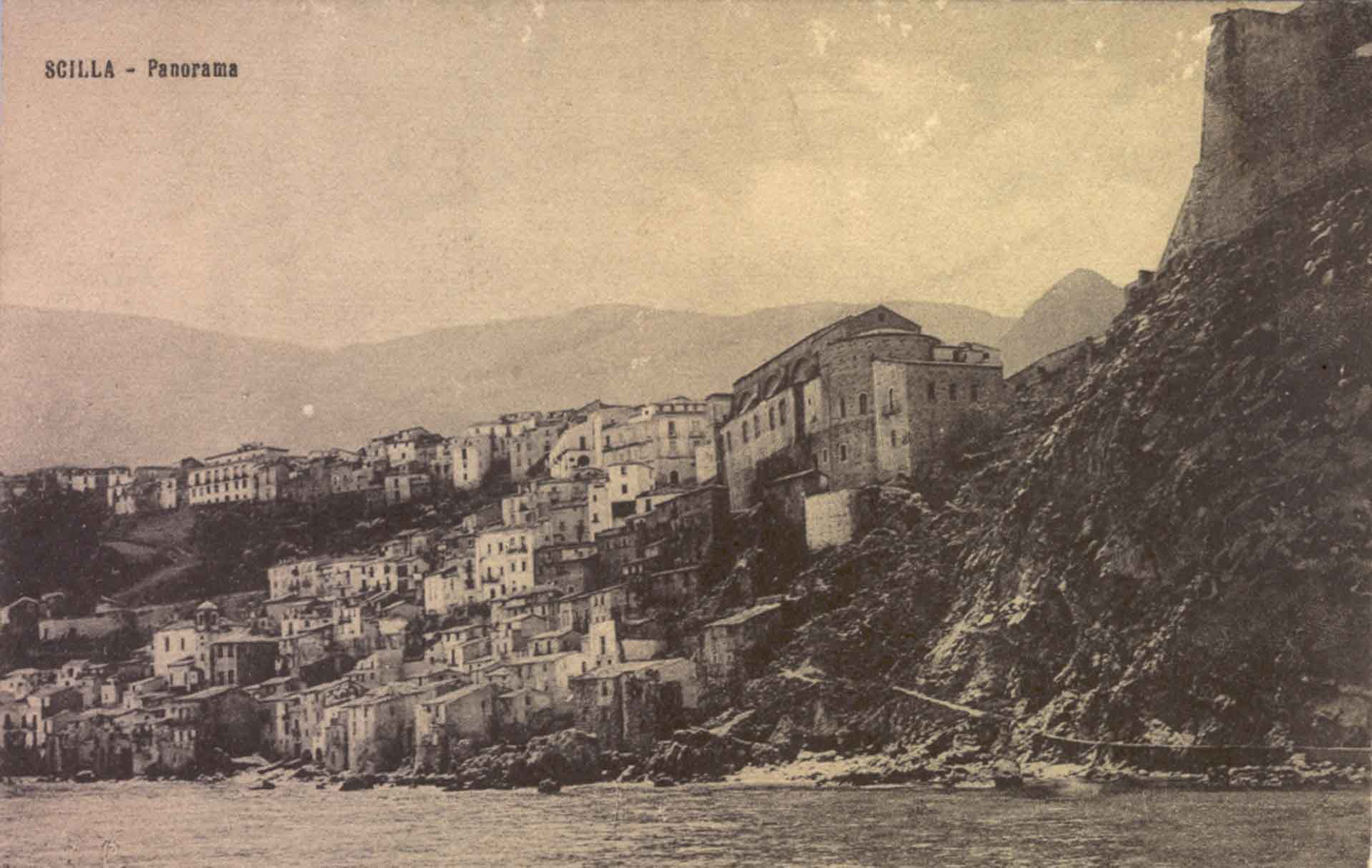
He was born in Scilla on 8 December 1757, to Francesco and Caterina Dieni, and grew up alongside his elder
brother Rocco, who had already embarked upon scientific studies.
From childhood he displayed a particular talent for drawing and a marked artistic ability.
He drew everywhere, especially in the countryside, where he felt free to carve onto stones or the ground the
animals he encountered, depicting them in their various postures.
As a result, his family became convinced that Mariano should pursue an artistic career and sent him to Naples,
to study under the painter De Dominicis and the sculptor Sammartino.
He made steady progress in the arts, but he also frequently amused himself by engraving figures and letters
onto copper with remarkable elegance.
This talent was noticed by his learned cousin, the Dominican friar Antonio Minasi, who decided to direct him
toward the study of engraving. At that time, the most renowned master in this field was the Florentine Bartolozzi.
In 1764 Bartolozzi had moved to England at the invitation of Dalton, librarian to George III, bringing with him
his already celebrated school, from which distinguished Italian pupils such as Minasi and Schiavonetti, as well
as foreign students such as Tom Kins, emerged.
It was not easy, however, for the young Mariano to be admitted to Bartolozzi’s school; therefore the influential
friar made use of his friendship with Madame Swinburne and Sir Hamilton, the British ambassador to the Court
of Naples, and thus achieved his objective.
The generosity of the Neapolitan Royal Court completed the effort, financing by governmental decree his journey,
his stay in London, and the expenses required to attend Bartolozzi’s school.
After three years of diligent work, Mariano acquired great renown and considerable fortune. Having become
highly esteemed within London society, he decided to capitalize on his engraving skills by becoming a print dealer.
For his work he employed drawings by Westall, Mayer, Du Creu, Lady Worsley, Lady Besborough, and William
Loch, as well as by Italian artists such as Pellegrini and Salvini.
He also drew inspiration from the great Italian masters of the past, including Raphael, Veronese, Correggio,
and Parmigianino.
His works were numerous and varied, dealing with mythology, allegory, history, and scenes from both natural
and social life. However, the field in which he excelled most was portraiture.
Particularly admired were his portraits of the Princess of Wales, the Queen of France, Louis XVI, and Henry
Swinburne.
The work that distinguished him above all others, because it was executed with the full measure of his commitment
and artistic genius inspired by profound gratitude, was the engraving depicting the Royal Family of
Naples, based on a drawing by the painter Angelica Kauffman.
The Bourbon monarchs had generously provided him with the opportunity to become the artist he ultimately
became. This work represents the highest expression of his art, both for the “truthfulness of the likenesses”
and for the tones, colors, and almost imperceptible shades that lend the composition an unsurpassed harmony
and serenity.
Bova sent twelve copies of this work to Naples, each furnished with gilded metal frames and glass coverings.
They were presented on his behalf by the British ambassador himself to the Neapolitan Court, where they were
greatly admired.
The excellent and mutually affectionate relationship with the Bourbon sovereigns was demonstrated again during
another painful episode in Bova’s life.
When he decided to return to Italy, taking advantage of the presence of his brother Rocco in London, who
could remain in charge of the print workshop and shop, he was owed a credit of twenty-two thousand pounds.
Upon arriving in Messina, he deemed it appropriate to ship a valuable cargo of artworks to London.
However, these were stolen in the waters off Sardinia.
His anguish was immense and plunged him into a deep melancholy from which he could not recover.
The benevolent and generous Neapolitan Court therefore granted the celebrated engraver a pension of three
hundred ducats to alleviate his distress; and when he decided to remain in Messina, it appointed him professor
of drawing at the Royal College there.
Among many other engravings, Bova produced those based on drawings made by Fortuyn for Father Antonio
Minasi; these illustrated various sites in Calabria, and especially in Scilla.
In Messina he continued to work; however, by then he lacked the enthusiasm and the driving force toward the
“beautiful” that true art requires, and consequently this final phase of his production was not the finest of his
career.
He lived for several more years in Messina and died on 9 April 1813.
His remains were buried in the Capuchin Church of Messina, while his portrait, painted by the artist Pellegrini,
is preserved in London by the Society of Engravers.
Giuseppe Ribuffo
