
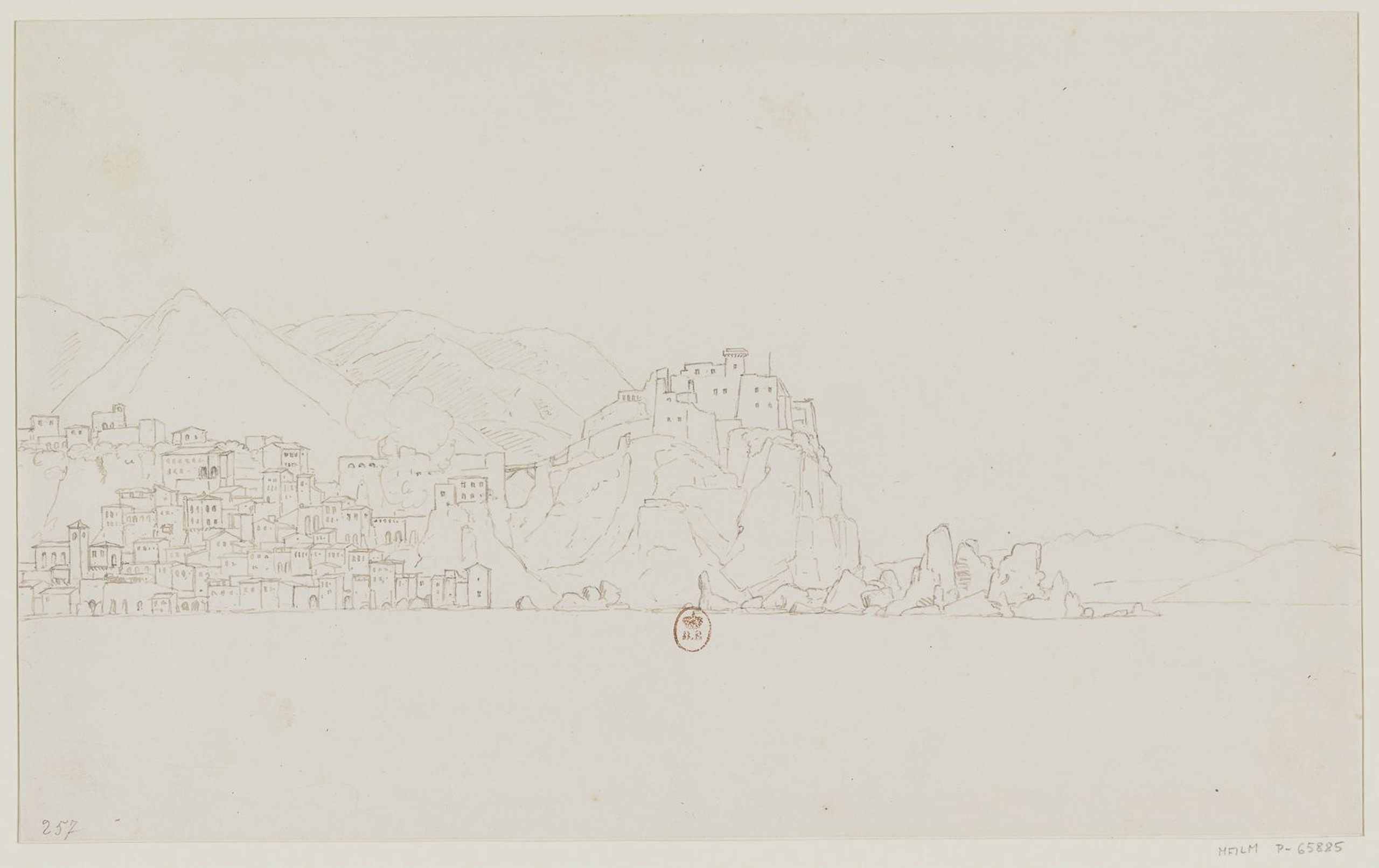
Lazzaro Spallanzani (Scandiano, 12 January 1729 – Pavia, 11 February 1799) was an Italian priest, scientist and biologist. He studied rhetoric and philosophy at the Jesuit College of Reggio Emilia and natural philosophy, mathematics, Greek and astronomy at the University of Bologna.
His academic career began in 1757 as professor of physics and mathematics at the University of Reggio Emilia; in 1762 he was ordained a priest and, from 1763, taught philosophy in Modena, where he gained a European reputation, progressively shifting his interests toward naturalistic subjects.
In 1769 he arrived in Pavia, where he devoted himself to teaching and to directing the Museum of Natural History.
His fame is linked to a series of researches and discoveries that revolutionized the life sciences, including the refutation of the old doctrine of spontaneous generation — according to which life arises spontaneously from inanimate matter —, the carrying out of the first artificial inseminations in amphibians, studies on animal regeneration, respiration and echolocation (the ability of bats to orient themselves in the dark by means of ultrasounds).
His fame is linked to a series of researches and discoveries that revolutionized the life sciences, including the refutation of the old doctrine of spontaneous generation — according to which life arises spontaneously from inanimate matter —, the carrying out of the first artificial inseminations in amphibians, studies on animal regeneration, respiration and echolocation (the ability of bats to orient themselves in the dark by means of ultrasounds).
He undertook numerous journeys; famous was the one to the Two Sicilies in 1788, recounted in the six-volume scientific and travel work Travels to the Two Sicilies and in Some Parts of the Apennines (1792). The account describes a long itinerary undertaken by the scholar in 1788 through Southern Italy, with the aim of studying volcanic phenomena, geology and marine fauna. Chapter XXVI is dedicated to his stay in the town of Scilla, and represents one of the emblematic pages of Spallanzani’s thought, since it places Scilla and its rock at the centre of an investigation that combines literature and science. For the author, Scilla is not merely a geographical point or a sailors’ legend, but becomes the symbol of natural truth that survives time and myth. The importance of this place lies in its ability to act as a bridge between the “exaggerated descriptions” of poets and the physical reality of facts. Spallanzani elevates Scilla to a fundamental object of study in order to demonstrate that nature, even when it appears terrifying, responds to precise laws.
By confronting this place “so well known,” the scholar does not wish to erase the beauty of the poetry of Homer and Virgil, but to ennoble it, finding in the real world the causes of the phenomena described. Scilla thus emerges as a universal key of interpretation: a natural monument unchanged for millennia, whose analysis allows superstitious fear to be transformed into rational and scientific knowledge, confirming the authority of direct observation over every ancient fantasy.
“Scylla and Charybdis, according to the tales of the poets, are two most voracious sea monsters that keep their dreadful mouths forever open, to swallow unfortunate sailors, one lying in wait at the right, the other at the left end of the Strait of Messina, where Italy and Sicily face one another. Virgil. Aeneid. Book III.
I have had no difficulty in making use of the verses of a poet in a book devoted to the search for truth,
nor shall I hesitate to produce now those of another poet; since among these exaggerated and fantastic descriptions of Scylla and Charybdis one may find some truth, and besides they provide material for interesting investigations.
I would have thought myself deserving of the greatest reproaches if, finding myself on the shores of the Strait of Messina, I had not sought to approach these two places, so well known and so celebrated for the very shipwrecks associated with them. I first set out in a small boat bound for Scilla.
This is a very high rock, 12 miles from Messina, which falls sheer upon the coast of Calabria, beyond which sits the small town that bears the same name.
Although there was almost no wind, yet two miles from the rock I began to hear a roaring, a thundering, and almost a confused barking of dogs; and having drawn nearer, I had little difficulty in discovering the true cause.
This rock opens in its lower part into several caves, one of which is extremely spacious, called Dragara by the people of Scilla. The waves therefore, agitated and entering them with force, breaking around them, pouring back, mingling together, and raising high sprays and foaming bubbles, create those multiple and varying noises.
I then realized how fittingly Homer, and after him Virgil, wishing to animate Scylla and portray her from nature, represented her lurking in the darkness of a vast cave; the former surrounding her flanks with furious barking mastiffs, the latter with wolves, to amplify the horror. Homer, Odyssey. Book XIII.
But the Greek poet, placing before our eyes the rock inhabited by Scylla, completes the picture better than the Latin,
But the Greek poet, placing before our eyes the rock inhabited by Scylla, completes the picture better than the Latin,
where he represents it as being of such height that its summit is always crowned with clouds; and so steep, so smooth,
Such, already three thousand years ago, or thereabouts, appeared the rock of Scilla, according to the observations of Homer,
and such today it appears, neither more nor less.
Such accuracy in this truly first Painter of ancient memories, noted by enlightened travellers in his other accounts, wonderfully proves that the surface of the sea waters was then at approximately the same height at which we see it at present; for if since then the sea had lowered by some fathoms, the foot of that rock, which according to my observations does not descend very deep, would have remained dry.
And this I consider one of the strongest arguments that the most notable lowerings of the sea are prior to that age. Such is the position and nature of Scilla. Let us now examine its dangers.
Although the tide throughout the extent of the Mediterranean is almost imperceptible, it is nevertheless very strong in the Strait of Messina, owing to its narrowness, and is regulated as elsewhere by the customary periodic rises and falls of the waters.
When the flood, or rather the current, is accompanied by a wind blowing in the same direction, vessels have nothing to fear, since either they do not enter the Strait if these two combined forces are contrary to them, and therefore cast anchor nearby; or if they are favourable, they enter under full sail, and run through it with such rapidity that it is like flying over the waters.”
Giuseppe Ribuffo
