
Gaston Charles Vuillier (Perpignan, 7 October 1845 – Gimel-les-Cascades, 2 February 1915) was a French illustrator, writer, ethnographer and traveller. A gifted draftsman, he illustrated several works of particular geographical significance published in France at the end of the nineteenth century. He worked for many of the leading periodicals of the time, such as *Le Tour du Monde* and *Le Monde Illustré*. Among the many journeys undertaken by the author, in 1888 he embarked on a Grand Tour of the Mediterranean that took him to Corsica, Sardinia and finally, in 1893, to Sicily, an experience he later recounted in his work *La Sicile, Impressions du présent et du passé* (1896). During his stay in Messina, the final stage of his Sicilian journey, Vuillier travelled as far as the Lighthouse of Messina (Capo Peloro), the island’s northernmost point. From this place, rich in history and suggestion, the author paused to observe the Strait, struck by the remarkable proximity of its two shores. It is from this privileged position that his description of Scilla begins, perceived as close and almost tangible, inspiring wonder and reflection, and where, as a spectator, he witnessed the ancient practice of swordfish hunting carried out by the inhabitants of Scilla and the Faro of Messina.
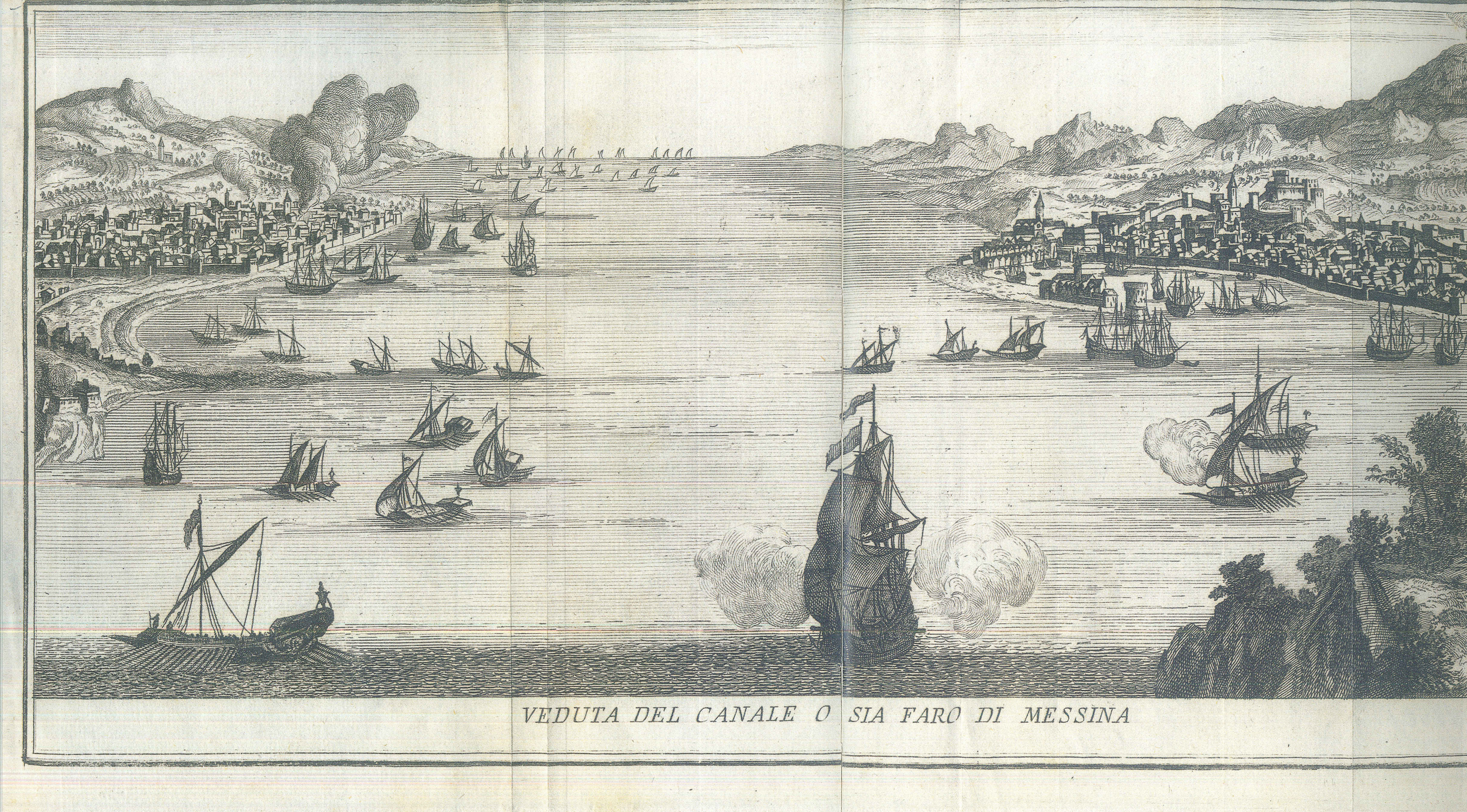
“Let us leave the boat, cross a fishermen’s village, and soon we arrive at Charybdis, the extreme point of Cape Peloro, one of the three promontories of Sicily, from which the ancients gave it the name Trinacria. Before us stood a lighthouse where once a temple to Neptune had been erected; facing us rose the Rock of Scylla, for we were at the narrowest point of the Strait separating Sicily from Calabria, which here does not exceed three kilometres. It is said that on calm nights, with an easterly wind, one can hear voices, the sound of bells, and the barking of dogs. At that moment we could clearly distinguish the houses of the village of Scilla, clinging to the famous rock. Aeschylus, Diodorus, Strabo and Pliny affirm that Calabria and Sicily were once joined; the very appearance of the landscape confirms this hypothesis, upon which so many scholars have expressed their opinions. It is highly probable that here, as at Calais and Dover, Gibraltar and Ceuta, some great convulsion separated the two lands. The Pelorian Mountains truly appear to be a continuation of the Apennines. […] These mountains are the only ones of primitive formation; their base is granitic. […] According to a legend, the name Peloro derives from Hannibal’s pilot, who was put to death for allowing the ship carrying him to be driven by the current toward the Rock of Scylla. […] Along these coasts, my courteous guide told me, many swordfish arrive every year; this fish owes its name to the formidable weapon with which it is equipped, for its upper jaw is shaped like a sword or blade, measuring a third of its body length. […] Every year, from the beginning of May until the end of June, they follow the coasts of Calabria, then cross the Strait and begin, from the northern side, their circuit around Sicily; only in autumn do they return toward the mainland. […] Strabo and Polybius wrote about swordfish fishing in these seas. I do not know how the ancients practised it; but today the fishermen place themselves in a long, flat boat specially built for this fishery, and catch them with a harpoon. When the fishing season opens, all the boats gather in the area where the fish are expected to pass, arranging themselves in a semicircle; one of them, the Ferriera, silently positions itself at the forefront, and a sailor climbing to the top of a mast four or five metres high, at the summit of which there is a platform, announces the arrival of the swordfish. Lookouts are stationed not only on the boats but also on the coastal rocks and even beneath the walls of the Castle of Scilla. When the movement of the waters or the sharp whistling sound emitted by the swordfish announces their passage, the boats move toward them and the harpooner aboard each boat launches his harpoon. […] This fishing is extremely interesting and attracts a large crowd to the shore. I witnessed it myself and can assure you that it is a scene full of animation.”
A few days later, Vuillier would sail from Messina aboard a vessel bound for Lipari, and there he recorded the final impressions of this journey, dedicating them to Scilla and the landscape of the northern entrance to the Strait of Messina:
“Towards one o’clock in the morning, while Messina slept, the steamer silently left the harbour, entered the Strait and soon passed beyond Cape Charybdis, that very cape where, not long before, I had gone in such pleasant and friendly company. The lighthouse of Scilla flickered upon the opposite shore and the lights of the town seemed to scatter like phosphorescent sparks upon the dark slope of the rock. After an hour of sailing on the calm sea, sudden jolts shook the vessel, which seemed almost to turn upon itself in a manner I had never before experienced in my sea voyages. The captain had taken the helm and was steering the ship himself. ‘We are in the middle of the Garofalo,’ he told me, ‘and the sea here is always rough.’ This Garofalo through which we were passing was the famous whirlpool of Charybdis; I leaned over the sea and saw around us the swirling and bubbling waves; the lighthouse of Scilla continued to flicker in the distance against the darkness of the shores. Then, spontaneously, a Latin verse returned to my mind::
*Incidis in Scyllam, cupiens vitare Charybdim.*
After Homer and Virgil, so much has been said about these two rocks!”
In this passage, Vuillier records his final impressions before leaving Sicily. The silent departure from Messina and the distant flickering of the lighthouse of Scilla mark a moment of separation, in which the landscape recedes but loses none of its intensity. The crossing of the whirlpool of Charybdis restores a tangible physical reality to the myth, as though the memory of the classical world were emerging precisely at the moment of farewell. Scilla, visible as a light upon the opposite shore, thus becomes the final Sicilian reference point of the journey: a fixed landmark that embodies geography, danger and myth all at once.
Giuseppe Ribuffo
