
Francesco Petrarca (Arezzo, July 20, 1304 – Arquà, July 19, 1374) was an Italian writer, poet, philosopher, and
philologist, considered the forerunner of Humanism for his rediscovery of the Latin classics and his search
for a complex inner consciousness that transcends the medieval vision. He is also one of the cornerstones of
Italian literature, especially thanks to his most famous work, the Canzoniere (1336), in which he celebrates his
love for Laura—perhaps Laura de Noves, wife of the aristocrat Hugh de Sade—a beloved and idealized woman,
a symbol of beauty and earthly desire, at the center of a tormented inner conflict. His work, in the vernacular
and Latin, profoundly influenced European literature, championed as a model of stylistic excellence by Pietro
Bembo in the early sixteenth century.
Another significant work of his is the Triumphs, an allegorical poem in
vernacular Italian, written in tercets, divided into twelve chapters grouped into six Triumphs, each dedicated
to a vision seen in a dream.
It features a succession of six triumphs, in which each allegory defeats the previous: in order, Love, Modesty,
Death, Fame, Time, and Eternity. The work analyzes man’s ideal journey from sin to redemption. At the same
time, the Triumphs fit coherently into Petrarch’s literary journey: it is precisely here that the poet develops
some key themes of the Canzoniere, such as the spiritualization of his love for Laura. In the Triumphus Cupidinis
(Triumph of Love), it is told how, one day, the poet falls asleep in Vaucluseand has a dream in which the
personification of Love passes by on a triumphal chariot, followed by a host of love’s vanquished.Having joined
the group, the poet recognizes numerous illustrious figures—literary, mythological, and biblical—as well as ancient
poets, and is finally led to Cyprus, the island where Venus was born.
Here, drawing on classical tradition,
he offers us a transposition of one of the legends connected to the founding myth of the city of Scylla, narrated
by Ovid in the Metamorphoses and linked to the unrequited love of Glaucus, therefore one of those vanquished
by love, for the nymph Scylla.
Rejected because of the appearance he assumed following the ingestion of a magical herb, which transformed
half of his body into a fish, Glaucus turns to the sorceress Circe to prepare a potion capable of changing the
nymph’s feelings.
But Circe, herself in love with Glaucus and hurt by his rejection, transforms the spell into revenge.
Blinded by jealousy, she causes Scylla’s tragic metamorphosis, transforming her into a monstrous form and
thus inscribing the myth into the symbolic origin of the place that takes her name.
“Among these fabulous and vain loves
I saw Acis and Galalea, who was in his lap
And Polyphemus making a great noise about it;
Glaucus swaying through that crowd,
Without her whom he seems to prize alone,
Naming another lover, bitter and wild:
Carmente and Picus, once one of our kings,
Now a lovely bird; and whoever moved him,
Let him have his name and his royal mantle and his insignia.
I saw Egeria weep; and instead of bones,
Scylla harden into rough and alpine stone,
Which would be the infamy of the Sicilian sea;”
Thus he describes Glaucus, who, “waving through that crowd,”wanders in the procession “without the one he
seems to prize alone,”that is, without the one he seems to esteem most of all, Scylla, while he calls for “another
lover”Circe,whom he describes as “bitter and wild”.Scylla appears immediately afterward and is the tragic result
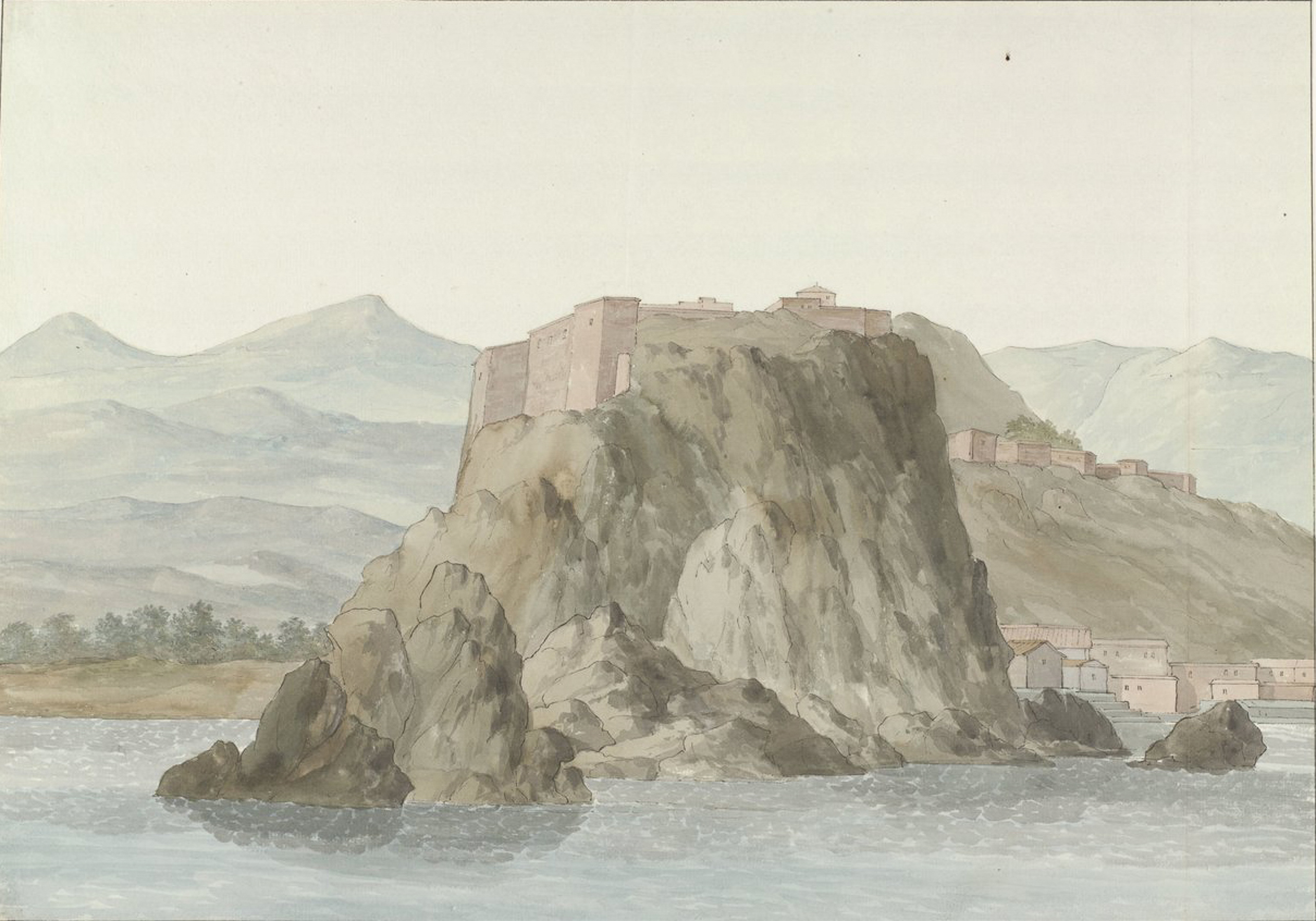
of that chain of passions: “and instead of bones / Scylla hardens into rough, alpine stone”;she is no longer
made of bones, she no longer has human features, but has assumed those of a rugged, high rock, “that was the
infamy of the Sicilian sea,”the same rock that still bears her name today.
of a rugged, high rock, “that was the
infamy of the Sicilian sea,” the same rock that still bears her name today. Thus Petrarch contrasts the restless
motion of Glaucus with the monstrous fixity of Scylla: a rock guarding the sea of the Strait of Messina, a visible
and permanent sign of the ruin wrought by vain loves, directly tying their amorous torment to the place where
they are located. Petrarch uses this story to show how love generates vain passions, envy, and painful transformations,
confirming that passionate love does not elevate, but overwhelms and destroys.
The second triumph
is the Triumphus Pudicitie (Triumph of Modesty): the protagonist is Laura, who, with the help of Modesty and
after a fierce battle, defeats Love and snatches many illustrious ancient and medieval women from his chariot.
This second procession ends in Rome, in the Temple of Patrician Modesty. In this passage, Petrarch, through
precise geographical references to the brutal forces of nature that act around the Strait of Messina, embodied
in ancient classical myths, gives us a sense of the intensity of the conflict that unfolds between Laura and Love.
“With no other noise of the chest are given
Two fierce lions, or two burning lightning bolts,
That make way for heaven and earth and sea,
For I saw Love with all his arguments
Move against her of whom I speak,
And she far swifter than flame or wind.
They do not make so great and so terrible a sound
Etna when most shaken by Enceladus,
Scylla and Charybdis when they are angry,
That on the first move there was no greater way
Of the doubtful and grave assault,
Which I do not believe I know nor can repeat.
Each one withdrew upward,
To see better; and the horror of the enterprise
had made their hearts and eyes enamel.”
Not even Mount Etna, when shaken by the giant Enceladus, or the roar of “Scylla and Charybdis when they are angry,”that is, at the height of the turbulence of the sea currents they generate in the Strait of Messina—beyond the symbolic value of mythological figures, synonymous with brutal force—produce a sound as terrifying as the “dubious and grave assault” (the harsh combat) brought by Laura on Cupid, which he witnesses. In short, the passage allegorically represents the victory of Laura’s virtue over the temptations of passionatelove, described in an epic language that underscores the grandeur of the event.
Giuseppe Ribuffo
