
Albert Jouvin de Rochefort (c. 1640 – c. 1710) was a French traveller and cartographer and, for a period, Treasurer of France in Limoges from 1675 to 1702. Little information is available about his life.
He is the author of a travel diary, Le voyageur d’Europe, où sont les voyages de France, d’Italie et de Malthe, d’Espagne et de Portugal, des Pays-Bas, d’Allemagne et de Pologne, d’Angleterre, de Danemark et de Suède, in which he describes his journeys through Europe and the Middle East, also including Egypt and the Holy Land.
These volumes are accompanied by maps illustrating the routes undertaken, engraved by François Lépine, known as La Pointe, who specialized in the production of maps and geographical charts.
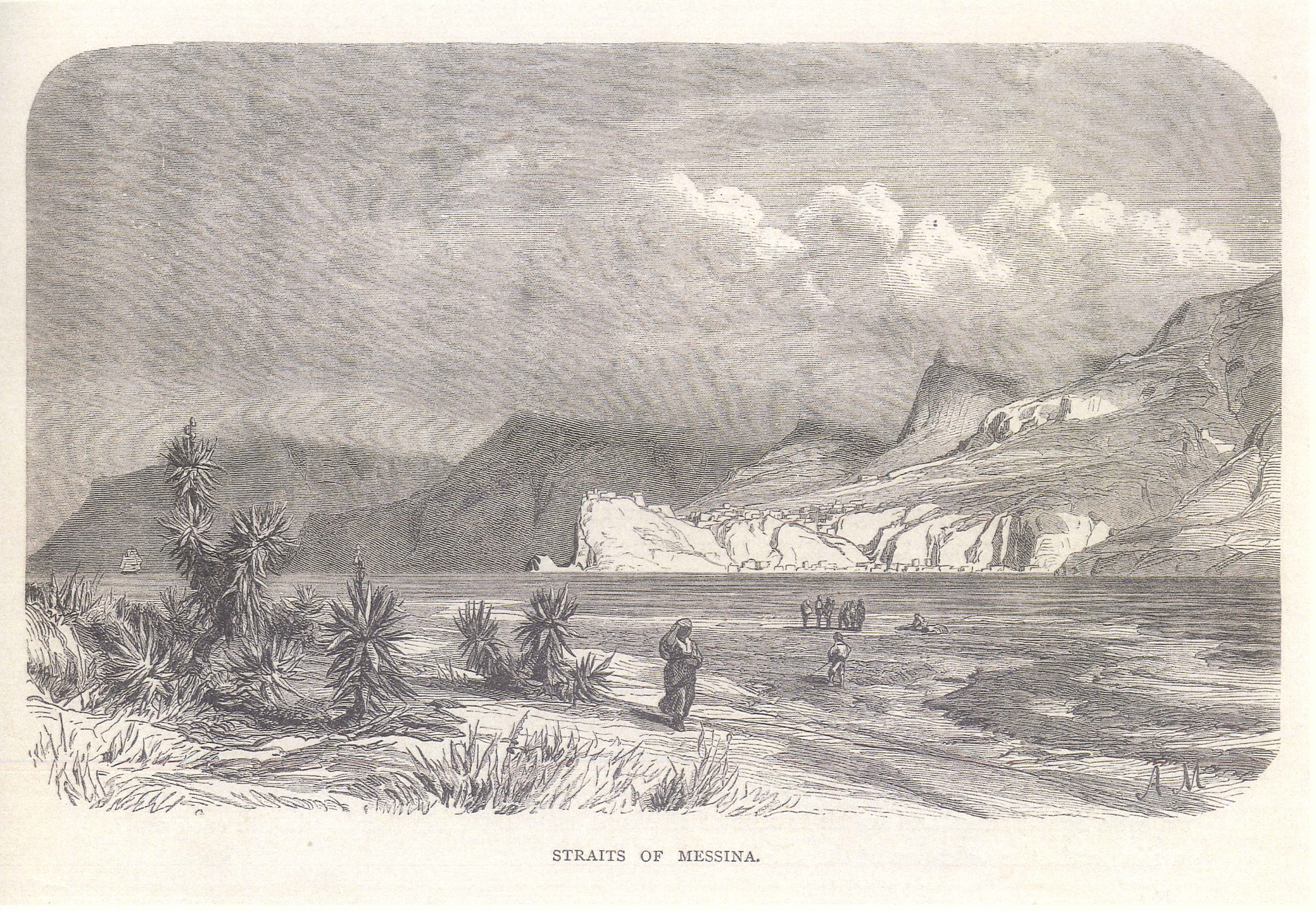
Rochefort approached Southern Italy by sea, circumnavigating Sicily and reaching the Strait of Messina from Palermo.
During his stay in Messina, Rochefort travelled as far as the Lighthouse of Messina (Cape Peloro), the extreme point of the island. From this place, rich in history and suggestion, the author paused to observe the Strait, struck by the close proximity of the two shores. In this passage, Rochefort builds a bridge between the direct observation of nature and ancient mythological tradition, showing how myth arises from the direct experience of the sea.
The description of the isthmus and, in particular, of the violent movements of the waters in the Strait of Messina is based on personal experience: the author observes the whirlpools, boards a boat, and experiences first-hand the force of the currents that drag and spin vessels.
It is precisely this physical reality, unstable and dangerous, that gives substance to the figures of Scylla and Charybdis, which do not appear as simple poetic inventions but as symbols of real dangers to navigation.
To avoid the whirlpool of Charybdis means exposing oneself to the rock of Scylla, in a precarious balance that Rochefort attributes to the natural conditions of the channel, dominated by powerful and ever-changing currents.
Such circumstances force passing ships to rely on the assistance of local pilots to cross it: experienced sailors of the area who know the currents, whirlpools, and most dangerous points of the channel, and who guide vessels safely, avoiding the most treacherous stretches, such as the depths of Charybdis and the rock of Scylla.
In particular, Scilla is identified by Rochefort with the term Sciglio (in the local dialect U’ Scigghju), which, far from being a simple lexical variant, represents the traditional name by which, since antiquity and still today, the inhabitants of Scilla and of the Strait of Messina — particularly those of the city of Messina and its villages — refer to the Rock of Scilla.
From this toponym, deeply rooted in linguistic usage and collective memory, derives the dialectal term Scigghjitani, still used today to designate the inhabitants of Scilla, that is, the inhabitants of the Sciglio (U’ Scigghju), the inhabitants of the Rock.
“This isthmus lies only about two fathoms above sea level, its lands are sandy and in some places suitable for the cultivation of vegetables, but the lowest point is used for salt pans,
[…] from the end of this isthmus one can see the abyss of Charybdis, so famous among the Latin poets, and especially in Ovid, who speaks of it as the most dangerous place in the whole sea.
It is not far from this peninsula, only a few steps away, where we saw the water turning in the shape of a basin thirty paces wide,
[…] This aroused our curiosity, so we took a boat to have a closer look after seeing some fishermen whose boats were spinning because of the force of the waters carrying them along, as though they were descending into the middle of this turning motion without, however, sinking them, and indeed creating difficulties for them in getting out; because they
assured us that they had never seen anything there, nor had they ever experienced difficulty in getting out with a few strokes of the oar. We advanced with our boat over this abyss, which immediately took it under its control, making it perform several large turns before reaching the centre, […] because it kept turning and turning, as though plunging into a great hole which many told us had once been very dangerous, especially when the sea is rough: something quite common at this Lighthouse of Messina, where the winds reign so furiously that ships arriving from foreign countries cannot approach Messina without danger unless they make use of pilots who are natives of the place, waiting for them at the entrance to this lighthouse in order to guide them into the harbour; This inspired Ovid to write the verse:
Incidit in Scyllam cupiens vitare Charybdim
Because anyone coming from the East, while trying to avoid the abyss of Charybdis, would have struck the rock of Sciglio, which can be seen at the entrance of this channel, near the Castle of Sciglio, projecting into the sea opposite the Lighthouse Tower, where this channel is at its narrowest, being only seven miles wide.
But what is most remarkable about this channel is a strong ebb and flow, which causes it to run every few hours, from east to west and from west to east, with such speed that, if opposed by contrary winds, any ship wishing to enter it would run an almost unavoidable risk of perishing, being scarcely able to withstand such force.”
Ma ciò che è più sorprendente di questo canale è un forte flusso e riflusso, che lo fa scorrere ogni poche ore, da est a ovest e da ovest a est, con tale rapidità che, se colpita da venti contrari, qualsiasi nave che volesse entrarvi correrebbe un rischio quasi inevitabile di perire, essendo a malapena in grado di resistere a tale forza.”
A few months later, during the return journey from Malta, Rochefort again stopped at the port of Messina, where, having found a vessel bound for Naples, he boarded it and, taking advantage of favourable weather and sea conditions, managed to land at Scilla.
Here he visited the castle, built upon the rock of the same name, the source of the ancient myth of Scylla, recalling in an erudite manner the stories of the classical tradition associated with the place, with particular reference to Ovid’s Metamorphoses, which he had already mentioned during his first passage through this stretch of sea.
“Messina at first sight appeared to us as beautiful as it had before we went to Malta: we stopped there only to choose a means of passage, which we found in two ways: one was a Flemish ship bound for Naples; and the other was to take an express felucca as soon as we reached the quay of Messina, with the same intention of travelling to Rome and crossing Calabria in order to see this great part of the Kingdom of Naples: he added that by this means we were free to remain, proceed, or linger along the road and in the cities wherever we considered it appropriate, according to the agreement we had made with the master of the felucca, very skilled in his profession; for this reason we embarked one morning, in order to escape the current of the Strait of Messina, assisted by a light wind which gave us the opportunity to visit the Castle of Sciglio, from which projects the famous Rock of Scylla, which Ovid describes as having once been so formidable to ships passing through the Strait of Messina.
It stands at the entrance of this strait, opposite the Lighthouse Tower, from where we set sail for Calabria.”
Giuseppe Ribuffo
